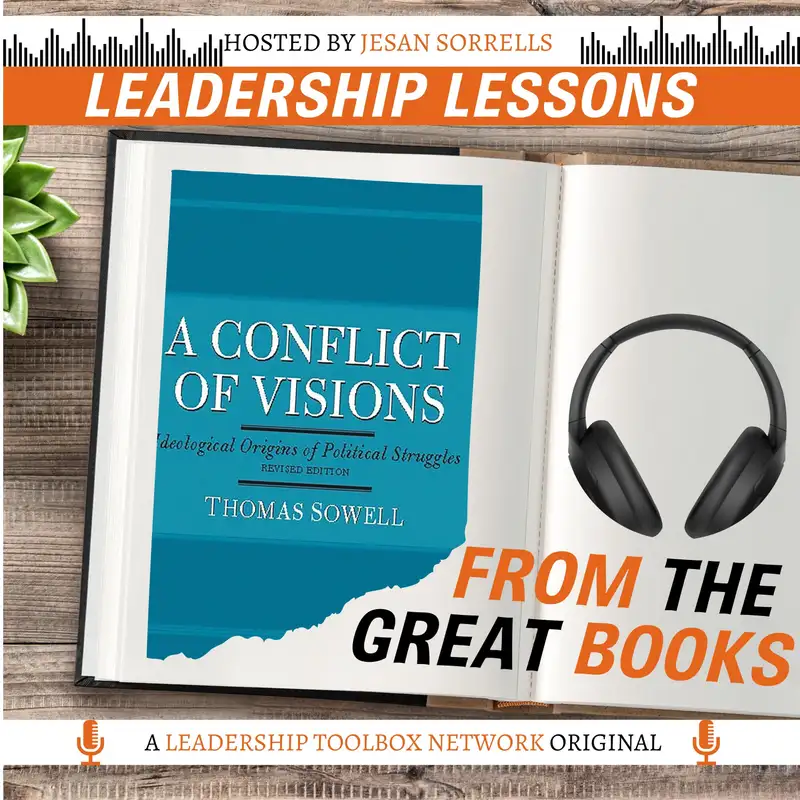
A Conflict of Visions: The Hidden Origins of Ideological Conflict by Thomas Sowell w/Jesan Sorrells & Ryan J. Stout
Hello, uh, my name is Jesan Sorrells, and this
is the Leadership Lessons, uh, from the Great Books podcast,
episode number 180.
That's right, we're only 20 episodes away from our big
200th episode. Uh, you're going to want to pay
attention, uh, to that. And so from our
book today, we are going to start as we have been Um,
every single episode starting this season,
um, rather than starting with a long soliloquy, soliloquy, we're going to start
off with— we're going to start off with a basic
introduction, right, to the content. Now, um, the
book that we are going to be talking about today with our guest, um, in
the very first chapter addresses, uh,
the, the, the, the root causes, the seed
of many of the problems that we see today in our
societies and in our cultures, not just in America,
but everywhere else where you might be happening to be listening
to the sound of my voice. This seed
is binary at its root, and it
is— once you see it, and my guests and I are going to
talk about this today— once you see this seed and you see its fruit,
you will never— you'll never again mistake the fruit for the actual seed.
You will be able to go to the root causes. And that was part of
the point of the author that we are talking about today writing this
book. So as a matter of fact, we open up with
this line from the very first chapter entitled The Role
of Visions. And I quote, one of the
curious things about political opinions is how often the same people line
up on opposite sides of different issues. The issues
themselves may have no intrinsic connection with each other. They may range
from military spending to drug laws to monetary policy or education.
Yet the same familiar faces can be found glaring at each other from opposite sides
of the political fence again and again. It happens too
often to be a coincidence, and it's too uncontrolled to be a plot.
Or as I would say, just to pause a second, a conspiracy.
A closer look— back to the book— a closer look at the arguments on both
sides often shows that they are reasoning from
fundamentally different premises. These different
premises, often implicit, are what provides the
consistency behind the repeated opposition of individuals and groups on
numerous unrelated issues. They have different
visions of how the world
works, and we're going to talk about
those visions today as we explore,
well, the visions, uh, and the conflict
that exists between those two visions in our book, A
Conflict of Visions: Ideological Origins of Political
Struggle by the great Thomas
Sowell. Now, in
thinking about this book, I want you to take a couple of things into consideration
before I introduce my guests. Just some things to whet your whistle, some
ideas that I've got here. The fact is that
we, meaning you and me and every other human being, you know,
we don't all share the same worldview. Now, we know this
when we're lined up, as Sowell wrote, on
opposite sides of—, um, political issue
or a cultural issue or a social issue or a monetary
issue. And due to the vagaries of genetics, environment, choices, and even
the kinds of messages we take in and reject, our worldviews are shaped
in fundamentally different ways. This molding, of course, leads to
different outcomes for different peoples. Some outcomes are
great. Some outcomes are poor, as I was talking about with my guest before we
hit the record button today. And some
outcomes are shockingly average.
Sure, marketers, propagandists, politicians, and others seek to
manipulate worldviews and their inputs to accomplish the goals that
they seek to achieve. But even they don't realize that even they
have worldviews that leak out of the bucket of their mouths and
reveal their own motives and desires. They're
not fooling anyone. And actually, my guest today would
really appreciate this. In reality, no one is
fooling anyone. Some people have just decided to go
along, uh, for the ride. At the bottom— and
we're going to talk about all this today— when we strip away all the fluff
and the nonsense, the reality is that, as Sowell
has mentioned in his book in Chapter 1, there are
two competing visions of human nature. These two visions
are incompatible with each other and are fundamentally
irreconcilable. They are both zero-sum. And to make matters even
worse, or even more complicated, most people can't even
recognize, identify, and critically examine either of the two visions
that undergird their own individualized and previously
held worldviews. And I would assert, preciously held
worldviews. These two visions locked in negotiation, which sometimes
escalates into open conflict, uh, are fun— the fundamental reasons
we don't perceive the world in the same
way. Leaders, we don't enjoy acknowledging
in our leadership, but two visions are locked in a zero-sum
battle, not only within individuals, but within organizations and
even cultures. And I don't think we're going to come to
a solution to this today
because as a partisan for one vision over another. I do not
think there is a
solution, but I'm open to being convinced otherwise. And thus I want to
bring in my, my guests today. So back for
this episode is a person who I didn't have on
my bingo card for this year to select for this book to talk
about. The most unlikely person I would've ever thought would've come onto this show
to talk about this book, but he has his own reasons. And we're gonna
explore what all those were. Our good friend
and, uh, raconteur, as I always say in Man About
Town, Ryan J. Stout. How you
doing, Ryan? Could not be better, my friend. Thank you kindly.
Always a joy and, uh, honor to be back and, uh,
having these conversations, keeping me engaged
in, uh, literature and,
um, and, and leadership and conflict resolution,
as, uh, said prior to the show, as, as, as
a ballast,
personal, personal sort of like ethos, or working towards
that. The other day, I, um,
you know, I have a history, as I'm sure some
and— we're all due of, uh, kind of being
reactionary. But, uh, and as we mentioned previously, the kind of like the
COVID years, um, that kind of brought the maybe worst out of me.
And, and, uh, I had a— when I started reading this book and I was
thinking about you, and I— and what popped into my
head was, why would I
not seek conflict resolution in
all interactions. Why would— why would I not try
to resolve whatever is in front of me? And, um,
it's been— it's been something that's, uh, been part of like the morning meditation for
the last few weeks. So, so in addition to all the
aforementioned, you know, uh, much appreciated. I'm glad to talk about
it today. Awesome. Awesome. Yeah. And as a person who
sort of is not, you know, is not afraid of conflict or
doesn't avoid conflict, I don't seek it out, but I'm not afraid of it
when it shows up as, as many people are in
our era. Um, you're right. It's one thing to
sort of navigate conflict effectively. It's quite another to know
what the underpinnings are of conflict. Um,
and to engage with them, engage with those underpinnings. Like, one of the things I
always tell folks that when I work with them in organizations is,
uh, leaders, teams, all of that, it's actually one of the big tips for today.
You have to know subtext in order to effectively negotiate
over context. And the deepest subtext that you can ever know, you can
ever critically examine, is the visions that
are undergirding people's actions, right? Right. Um, and we confuse
a vision for a worldview. We'll talk about that today, but
visions inform worldviews. So what we see informs what
we— what we actually believe. And then what we believe influences
how we vote, how we eat, um, even how we walk
down the street, the social media platforms we go to or don't
go to, even the kinds of people we choose to hang out with and have
conversations with, and the kinds of people that we choose to yell at online and
call you know, all kinds of dirty names to. All of this is
influenced by our vision, right? Our grand vision of the world. And, and
most visions unfortunately are
unexamined. And Sowell talks about all of this in his
great book. Speaking of Sowell, let's, let's jump into
that. So, um, Thomas Sowell, let's talk about him.
Thomas Sowell, um, was— well, not was, is— he's,
he's still alive. Um, he has
written over— oh gosh, well, over 60, I think it's approaching
60 books now, um, on economics and social theory as
well as cultural theory and philosophy. Um, and he has served as a
fellow at the Hoover Institute at Stanford University for many,
many years. Um, in commenting on many issues of the day,
he stands alongside Shelby Steele, Armstrong Williams,
and other quite frankly, because we're doing this in February, Black conservatives
who spring directly— whose, whose ideas spring directly from
the influence of Booker T. Washington. And I've talked about this on the
show before, and Ryan may not know this, but I've talked about this on the
show before. There are two strains of thought inside of Black culture,
two, two rails, such as it were, two, two visions, honestly, huh,
in Black American culture. Um, one rail is defined by
Booker T. Washington. And if you follow that rail down
the road, you wind up like— you wind up at the feet of writers like,
um, like, well, like Thomas Sowell, um, but also Albert Murray,
um, who probably would identify himself more as a centrist. Um, but then
Shelby Steele, Armstrong Williams, and ultimately I think, uh, the
young guy who we, who we already covered, um, last episode,
um, in, um, Arguments for a Colorblind America.
Um, Coleman Hughes. Yes. So we, we talked about his book, uh, Coleman Hughes.
You could trace a direct line from Booker T. Washington to Coleman Hughes, but you
can also— there's another rail, um, in,
in, in African American thought and culture where the
root of it, or the, the beginning of that rail starts in the theories
and the thinking of W.E.B. Du Bois. Um, you know, The
Souls of Black Folk. From W.E.B. Du Bois, you can get
to Marcus Garvey. Um, you get directly to Marcus Garvey,
you get to, um, uh, Malcolm X, you get
to Eldridge Cleaver, um, and finally you wash up on the shores
of Ta-Nehisi Coates and Ibrāhīm
X. Kendi. And those are the two rails that African
Americans in America have been riding on for the last, I
would say, 150
years intellectually. Culturally, and even ultimately politically. By the way, the day
that we're recording this, uh, Jesse Jackson, uh, passed away
at the age of 84 years old.
And while politically and based on his premise
and his worldview, I disagreed with Jesse
Jackson, we cannot disagree with the impact that
he had. Without Jesse Jackson, you don't get Barack Obama and
even Thomas Sowell. Would
say that. Um, Sowell's ideas— now this is where I want to switch to— Sowell's
ideas are so succinct and sharp that their provenance cannot
be argued against, just discussed, even by those
who vehemently disagree. So Sowell has the
unique sort of, um, the unique
sort of, uh, notoriety
where You know, that opposite line, that W.E.B. Du Bois to
Ibram X. Kendi line. They know who he is,
but he was born in 1930, right? Um, he, he
came of age before the civil rights movement. He thought the folks in the civil
rights movement were knuckleheads, and he was already writing, writing and arguing in the
public as a public intellectual, public African American intellectual, prominently
before those guys even came to prominence. And so they
can't. They can't say that, well, he didn't do the thing or he
didn't understand the pain. And he grew up in the— he was a
high school dropout, grew up in the segregated South, all of the things, right? He
checks, he checks all the boxes, and yet he came to radically different
conclusions than all of them did. And so his arguments
are argued against, but never the place where he
came from. And his arguments are so watertight that even his enemies
have to admit that they are worth
arguing against. This book that we're going to cover today, A Conflict of Visions,
represents, along with The Vision of the Anointed, which we haven't read on the show,
and A Kliquest for Cosmic Justice, which I read, gosh,
probably 15 years ago, and that book blew me away.
Um, they are an informal trilogy of works designed to
examine and clarify the two competing visions in the world that influence
everything from economics to race relations.
This book specifically lays out the implications of both
visions and examines the logic behind each vision to
fully understand and to fully logic out—
while giving credit where credit is due— what people mean when they say
the words justice, equality, or even power,
all of which have become buzzwords in
our current American
cultural moment. By the way, we're gonna reference George Orwell in the English language here
a little bit later on. But Saul is a person
who is so disciplined with his language and so disciplined
with his ideas, uh, that you could tell he is not a
lazy thinker by any stretch of the imagination
and very powerful. So as I said, I hadn't
necessarily thought that Ryan was gonna be the person to pick up this book and
say, hey, I wanna do this one. Um, I thought maybe Tom Libby might
want to, might want to pick that up, or, or maybe Libby Unger, or
maybe David Baumrucker, or maybe another guest who had been on our show. Um, because
Ryan and I tend to talk about Jack Kerouac, right? We tend to
talk about, uh, Charles Bukowski. Eventually we're going to hit on Bukowski in here, and
we're gonna— I'm gonna— he's gonna be the first person that I tap on the
shoulder for that. Or myself and Brian Bagley, we talk about
theology books, right? Anything by Doug Wilson or
Thomas Aquinas or, uh, Richard,
um, Richard, uh, or, uh, uh, Ronald, um,
Niebuhr, Ronald, Ronald Niebuhr. Like we're, we'll talk about theology books, right? In
theology context. Or if I'm gonna talk with Dave, I'm gonna talk with
him about Dostoyevsky or, or
Nietzsche, right? We're gonna talk about those kinds of areas. And so each one of
my guests is not necessarily pigeonholed, but they do have books they
like. And I give them plenty of space to pick the books they like. I
had not anticipated Ryan picking this book, and so I want to talk with him
a little bit about that today. And so this is my question for him to
start off: what do you know about Sowell? I sort of laid out some things
that are publicly available about him, but what do you know about Sowell? And had
you ever read any of his work or his writing before this? And sort of
why did you figure this was the book that you were going to— you're going
to sort of cut your eye teeth on? Today. So
thank you so much for the introduction, appreciate it
as always. The first time— very much so,
in preparation for this, outside of reading
the book, um, watched several interviews
Thomas Sowell, uh, also other people talking about
Thomas Sowell. And you mentioned Coleman Hughes earlier, and
I watched a, and, and Coleman Hughes said
that this was a transformational book for him as well,
to see things, uh,
in a deeper— uh, to get to the kind of the root cause or the
bottom of things. And so he said he, he kept hearing
this guy Thomas Sowell. You hear this guy's name again over
and over, and he's like, all right, let me see how crazy this guy is,
or something along those lines. And then he read had read this book, and it
was like, oh, it was kind of like one of those aha moments. But prior
to that, it's like, how have I, uh, heard of Thomas? Really,
the first time I, I knew the name, I knew
he was, uh, important in a
lot of socioeconomic areas and theory and that sort of thing, but I really had
no idea like who he was or why. You know, you just kind of hear
people's names and, you know, that's persons of importance, but I really don't know much
about them. So that is
what motivated to um, to, to take the opportunity to, to
read this book. What really, um,
kind of the diving board into learning about
Thomas Sowell was the George Floyd
era, because during that time, I mean, I remember, I remember speaking
with you like the week it happened. I was in
Asheville, North Carolina, and, um, something you
said. There was something that my— so it was interesting.
So my cousin David, who's a 60-year-old white dude
who's been working, uh, for Chrysler for the last 40 years— he started when he
was 20 years old, okay? He recently
retired. But, uh, he said something almost identical in
a text message to me as what you said to me over
the phone. And I was like, all right, so let me— what am I not
seeing here? Because this very much so almost outlines the constraint versus the
constrained, the vision versus like the preconceived notions of, well, I wouldn't think that
these two people have a very similar response
to, to this event. And so that
really launched into, um, Coleman Hughes, and I, I came
across Glenn Lowry and John McWhorter, and their
And I kind of got hooked on them for probably 6
months. Yeah. And started to see
in a much sort of deeper— and in,
in the way, as you said, uh, Soul
chooses his words wisely, you know,
these are gentlemen here. I think that— I think the title of one of the
podcasts or the YouTube channels, it was like the, the something, the Black
intelligentsia. And it was by Lowry and John McWhorter. And you
got it. And who— and John McWhorter
is someone who willfully admits that he used
the benefit of what was called— what it was, it's, it's now DEI,
but what was the old affirmative action, affirmative action?
He said, yeah, I wouldn't have, you know, probably gone to the education— I wouldn't
have had the job opportunities. He's like, I'm grateful. And and
he admittedly so is like it, but he doesn't necessarily agree with it. So then
we see also see the constrained versus the
unconstrained vision within his perception of his own life and how it benefited him
even though he does not agree with it. And also
coming across these cases, like these court cases where say it's, uh, Clarence
Thomas or another judge where they say, I
agree with the argument, but that But I'm
not here to agree or disagree with an
argument. I'm here for the law, for the law. Yeah. And
to stick true to the law. And
so that is just some of like the
unraveling of how complicated, complex a lot
of these situations
can be. And interestingly enough,
I think a lot of people, if they were
to read this, would, you know, it
kind of reveals, you know, on some level, a lot of us are not who
we think we are.
Mm-hmm. And so reading about kind of like the constrained versus
unconstrained, and we were just talking about, you know, if you're not a Democrat when
you're younger, and then a Republican when you're older, and that sort of thing.
And it's like, A lot of these
things can be masked as one another. Mm-hmm.
Well, what's interesting is, just to play off
of that, so Ryan knows me fairly well, folks. I
think other than, other than a couple of other people, and Derulo Nixon, who comes
on the show all the time,
he knows me probably best out of all, all the, all the guests. Ryan's
known me for Gosh, what is it, like 20 years now? Something like that. It's
been a minute. It's been a minute. Let's just say it's been a minute. 25
years. It's 25 years. Okay. I wasn't gonna put the 5 in there. Why do
you gotta do that to me? Why you gotta, why you gotta curse at
me like that? Um, but I
am the most unlikely person
to go to a school
for art. I'm the, I'm the most unlikely person to do that. And yet I
did. I went to— I, I pursued my undergraduate degree in art, got my
undergraduate degree in art, um, looked at beautiful
paintings, attempted to draw beautiful things, attempted to create beauty, attempted
to inject something beautiful into the world, got an artistic
and an aesthetic sense and understanding that has,
uh, stood me well, um, during the course of, uh, during the
course of my career and has helped me quite
frankly in business., and in other places where you wouldn't think
an artistic sensibility would matter,
right? But that is an example of
what Ryan's talking about, looking at someone, assuming they have
one vision, and then it sort of squirts out in
another direction, right? And this is where I think the brilliance of
Soul's book really lies, is that the, the dividing line between
the two visions, the, the irreconcilable dividing line
between the two visions lies not in our institutions, um,
or even in our culture, but I think it lies
in our— in ourselves, right? So the ways in which Ryan has lived
his life— I mean, Ryan has lived, in comparison to myself, a fairly— and we
don't need to go into all your history— but a fairly unconstrained life up to
probably about 10 minutes ago. No, no, up
to about 15 years ago. Yeah, yeah, yeah. And even then, even then, Even then,
but yes, please continue. Yeah. Yeah. Um, but even then, to your
point, even then there were places and you and I have talked
about this privately and in other conversations, there
were places where the constraints showed up where you went, ah, that's
the line, but no further. Right. And you see this, by the way, in people,
I'm going to use a public example. You see this in people
who, who lived a life of an unconstrained vision, like a
Bill Maher. Who are now sort
of going, oh wait, oh wait,
my vision's changed. And the ironic thing
is when a— not ironic, but the interesting thing is when a
person's vision changes, we say their mind changed and, or, or, or we, we
want to toss them out of the quote unquote tribe, whatever tribe we happen to
be in, whether that's the constrained tribe or the unconstrained tribe. And don't worry, we'll
talk about these diff— these distinctions in just a, a moment
here. We tend to wanna throw them out of the tribe.
But the reality is that on a
case-by-case basis, we are all doing this. We're all making these
kinds of decisions, even when I'll make it very small.
When I discipline my kids, I, I'm not always disciplining my
kids from a constrained vision. I have to balance that. It
can't all be constrained, 'cause otherwise I'm gonna give 'em a complex. You
know, but it also can't be all unconstrained. Otherwise, I'm a
gentle parent and they don't learn anything. And then, and then eventually, eventually they're
going to have to go to timeout for adults,
which is called jail. And so we don't need more of that. We actually
need less of that. Right.
So I think people, what, what Sol has hit on and what
Hugh's picked up on is this line that runs
through the human heart and he put it to words. He, he gave it, he
gave it, he gave it language, right? And
not, not religious language, not mythical language. He
gave it hard, practical, solid, and even to your point on the critique of the
book, and I'd like you to talk a little bit about what you thought of
the book here, but repetitious language, right? I mean, he, you
mentioned it yourself, so go ahead. Yeah. Talk a little
bit about that. Yeah. Getting to breaking
down things such as— the
first— okay,
articulated versus systemic rationality. Mm-hmm.
And one of the videos I was watching earlier
was talking about language. And so
when, when, when the unconstrained vision
uses the word equity for equality, it's
more reference to the equality of outcome, right? And
so in the constrained vision, it's the
equality of process, right? And so just make sure that we're following
the same laws, and it's up to the individual who
is flawed and not perfectible, to carry it out to the
best of their ability. And whatever the outcome is, is
the outcome that they essentially
have, uh, earned. Whereas, uh, the unconstrained vision and the
equality of outcome is, let's make sure that everyone, you
know, has a trophy. And
much like
the disciplining of, of 'Asan's
children.' Uh, there's, there's a time and a place for it. And
I think what gets
confusing is where one philosophy or one idea or
one vision starts
to overtake the other, depending on
who is administering the consequence, so to speak. So for instance, yes,
so if you're the constrained— so the constraint, you're— do
you want to make your child
a better, more successful human being, uh,
provide lessons for them and have
them understand the consequences so they
can feel better later? You may not feel great about it because you're seeing,
you know, uh, your child and loved one suffer for a little period of
time, but you understand through your own experience, which
is much different than the articulated words, with your own experience,
that it will be long-term beneficial.
And the unconstrained, where it's like, okay, well, I
want to feel good right now,
essentially, and I don't want to punish my child. I don't want to see them
in pain, and that makes me feel good.
So there is this, uh, in— to borrow the constrained vision—
there's the trade-off. That's right. Do I want to feel good now, or do I
want to feel good later? And, and, and yeah, and how do you want to,
you know, how do you want
to accept responsibility in, um, in the outcome of, of, of the person that you're
responsible for his life? Mm-hmm. Um, yeah, that was just— yeah, go ahead. Well, no,
well, it's interesting that you brought
up consequences, right? So, um, I was raised and
I've, I've, I've, I've integrated into my worldview, kind of
like Jung integrating the shadow, right? I've
integrated into my worldview the idea of consequences, right? And
I'm trying to get that across to to, to
my kids now, right? Um, one of the most outrageously revolutionary
things that the most constrained woman I've ever met in my life, my
mother, said to me— who, by the way, started off unconstrained and then gradually became
more constrained as she got older, which was
interesting. Um, but, but, um, by the time I met her, she was like halfway
through that journey towards becoming— towards, towards an object more
of a constrained vision. Um, but, um, One of the most consequential things she said
to me at 9 years old was, hey
son, you can do whatever it is
you want. Now here comes the, here comes the
comma or the semicolon, but, which normally
negates anything you said before, right? But you
have to accept the
consequences of your decision. And for 9-year-old Hasan, that was like fireworks
going off in my brain. My neural— my neurology, I— and this
is why it, it stuck with me for so long. My, my, my,
my neurons started sparking off, right?
Because rather than hearing the, the but on that end first, right? Or what came
on the other side of the but, I heard you could
do whatever you want. And then after
my neurons calmed down, the consequences for the actions part really started to like,
really started to like kick in. Like there will, if I decide, I've told
this story to my kids, if I decide I'm going to climb the ladder,
which my father has left by the side of the
house, God bless him. Um, God rest his soul and God bless him.
If I decide to climb that, that ladder
and decide recklessly to jump from the roof of my house to the roof of
my dog house. Which looked like an easy jump. I mean, it did. It was
only like, looked like it was only 12 feet. It was probably more like 50,
but like, I'm gonna make this jump, right? If I decide
to engage in reckless behavior, there is a consequence behind that. So I
can climb the ladder. Here's the consequence. I'm gonna be at the
top of the roof. I can even back up and start and, and think about
starting to run, but there's gonna be a consequence. I might slip on the gravel.
It was, it was a roof. In New Mexico, there's gravel on the roof. They
didn't put tar on it till much later, whatever. It was a whole thing. I
might slip on the gravel, go through the roof, but there's
all kinds of consequences that are going to happen. And as long as I'm
willing to checkmark the box on each one of those consequences, I can
do whatever I want. That idea, the
power of that idea, which is based in the transition of going
from a constrained vision or from an unconstrained vision to a constrained vision.
And giving that idea to a
child, particularly this child, probably led to more—
it led to shenanigans, but it also led to, um,
it also led to fewer— also led to fewer problems
over the course of, over the course of many, many years. And this is what
I think we have to give to our children. We have
to give them both visions, but we have
to present them in equal fashion, right? We have to present
them as either process, right, to your point, um,
or outcomes and say, you know, which one, which one do you want? And at
a certain point, of course, we also have to say, no, you know what, just
based off of life experience, I just know more because
there's just things you have, you just, you just don't know.
You just don't know. Like, that's just the way it goes. One
of the interviews, uh, Thomas Sowell is, is asked a question,
and the interviewer says, uh, well,
don't you think, um, the
university system, educational system, uh, would be able to suss out—
and he was talking about, uh, just the general population,
American population— suss out that nonsense? And he said, yes,
it very much did so, until nonsense
became a large part
of
the
curriculum. And so when it— I look at, I mean,
how is it not understood at this point of really
all you need on some levels, like money and
power, to kind of navigate and, and not get in trouble for anything? Do
we not have enough evidence that that there's— I
mean, the 2008 financial crisis, how many people went to—
one guy. Oh, one guy, maybe, or something. Yeah, yeah, yeah, yeah.
Everybody else got bailed out. Yeah. And so,
I mean, it's when, when the body
that is supposed to, uh, govern, or the body
that does govern, cannot adhere or follow
their own laws and the individuals
they're elected to represent
are, uh, the fated— of this sort of
unintentional consequence lays on the individuals who, who
are doing the electing, then
that, that's the— that's, uh, I said before, I know there's a diagram, it's
somewhere between like an ouroboros and a Venn diagram, kind of like
mixed And I know, uh, Eric Weinstein has— there's
this, uh, like the infinite energy diagram thing, and it's, it's kind of— oh
yeah, it's like a Möbius strip inside of a thing. But that's what it
kind of— it's, it's— and how these things are on a continuum,
and it's not just necessarily like—
what this also showed was, was there's not necessarily
a good and bad. So there's— it's It's more like
kind of on this continuous spectrum, more of like, you know, you
would see, um, kind of like, uh, the political— the political
outlines or the political diagrams, uh, going too far one way
or too far the other way. Too far the other way. And some—
and like you said, with the raising of your children, and, uh, just talking to
a friend of mine the other day who was a lieutenant in
the police in Edison, and, uh, you know, he said, uh, And he
said, you know, he said, I stopped on,
uh, so much weed letting people off, you know. He's
like, because I understand. He's like, I read the situation. And so this is, this
is— you think police officer trained, blah blah blah. He said, but
I understand that, you know, I could— I read the situation and
I read the person and I understand
that like I could, I could have such a negative influence on how
the rest of this person's life turns out
through this one action. And he had to use sort of
like better judgment or, um, something in the sense that, that,
that he could live with. And so,
yeah, I— yeah, it
just, it, um, it, it just kind of made me rethink and think
about a lot of, um, We're going to get to the question, but a
lot of what influenced decisions in the past as
well. And, and whereas necessarily, like you say, you know, you see
a police officer, he's, you know, he's iron to the knives, he has
a hat, this and that, and that's who he was. And to, to, to, to
someone getting pulled over by that, you think the
absolute worst possible outcome. Yeah. So those things aren't necessarily, but what he
said was you, you absolutely need
both sides because without, you know, you, you
raise, you know, the one or the other. One or the other. Yeah. Yeah.
You raise the very, you raise the very tiger that's going to turn on you
and eat you, you know? Um, so you could either raise
a tamed tiger that will, that you can, that you can ride, right?
And that you can guide and that eventually you can release out and it'll go
do the tiger things that it's supposed to go do. Or you'll raise a tiger
that'll turn on you and eat you. Um, and it always—
the tiger always turns on the
tamer who raised it. Um, and then he jumps into some ideas that
I think we, we don't actually look at the bottoms
of. He starts with, um, uh, a guy named— who I never heard of before
I read this book, and I had to go look him up. Um, a
gentleman named William Godwin., who wrote a book
in 1793 called, um,
Inquiry Concerning Political Justice. And
this individual, Godwin, proposed basically what is an unconstrained
vision of human nature in opposition to many
of the writers of the Federalist
Papers. Um, and, you know, there were a lot of
folks in the late 18th century and early 19th
century who were trying to suss out what these two visions
of human nature could be in a political
context, right? So he traces in this chapter
both of those visions and he, he names, of course, the proponent, the,
the, the grandfather, the great-grandfather of the proponent
of the unconstrained vision, Jean-Jacques Rousseau, right? Um, and
the Rousseauian vision that eventually would lead into a Marxian vision which
would eventually lead into a Stalinist vision, which would
eventually lead into the current vision of human flourishing that we have
in the great nation state of
China. On the other side, he proposes that we have more
of the representatives, or that there are the representatives of a constrained
vision, uh, folks that started with Hobbes and Locke and
then eventually wound up through the Founding Fathers and
came down to, to today. In what we see not in necessarily
the dregs of 20th century progressivism, but more in
the dregs of 20th century conservatism.
Um, Ronald Reagan, or even, dare
I say, George W. Bush. Now, we put
political figures to these visions, and we do so because
many of us, to, to Ryan's point, aren't exactly— particularly in
the last 80 years in our country— aren't exactly educated.
In how politics is a lagging indicator of where,
where a society is going culturally and philosophically. Or as I often
point out to my children and to anybody else who'll listen to
me, um, the politicians and the government— you could frame it all in that kind
of way if you want— they're always the last drunk person
coming to the party at 4:30 AM, and everybody else has
already moved down the street. We're already on something else, and they show up
last and they want to create all
of the legislation. These two visions, as Sowell points
out, really are surrounded by and really are consumed with
the basic conceptions, as he says in his very first line in
Chapter 2, um, their basic conceptions of the nature
of man. So in a constrained vision, the moral
limitations— I'm going to quote directly from this— in a constrained vision, the moral
limitations of man in general and his egocentricity
in particular were neither lamented by Adam Smith, who he quotes, uh, right at
the beginning of, of that piece of the chapter, nor regarded
as things to be changed. They were treated as inherent facts
of life, the basic constraint in his
vision. The fundamental moral and social challenge was to make the best of
the possibilities which existed within that constraint rather
than dissipate energies in an attempt to change human nature.
An attempt that Smith treated
as both vain and pointless. Folks with a constrained vision tend to believe that the
constraints that we have on ourselves at an individual level, that scaled
up to a societal and cultural level, are tragedies of
human nature that can only be
ameliorated or negotiated through what sometimes seem
as though are brutal trade-offs. On the other side, the other rail, you have the
unconstrained vision, and this is where he brings up
William Godwin's work, Inquiry Concerning, uh, Political
Justice. It was an immediate success upon its publication in
England in 1793, and of course it was later on popularly
associated with the French Revolution. And when Britain saw what was happening with
France, where heads were rolling literally everywhere, Godwin
was immediately shuddered to the
back. Pache rose, Rosa Parks immediately shuddered to the
back of the bus. However, Godwin lays out the
unconstrained vision of human nature in this way, and
I quote directly from Sowell: Wherein Adam Smith's
moral and socially beneficial behavior could be evoked from
man only by incentives, in William Godwin's man's under—
in William Godwin, man's understanding and disposition were
capable of intentionally creating social
benefits. Godwin regarded the intention to benefit others as
being, quote unquote, of the ess— essence of
virtue, and virtue in turn as being
the road to human happiness. Unintentional social benefits were
treated by Godwin as scarcely worthy of notice. His
was the unconstrained vision of human nature in which man
was capable of directly feeling other people's needs as more important than
his own, and therefore of consistently acting impartially even when
his own interests or those of his family were
involved. This was not meant as an empirical generalization about the way most
people currently behaved. It was meant as a statement of the
underlying nature of
human potential. Now, that idea has echoed down
to our time through every révolutionnaire that's
ever walked the planet since the French Revolution. All
the way down to, well, all the way down to Mr.
Momdami in New York City, or, or even down to the
local level in your own town of a person
who has a vision that is unconstrained for maybe, I don't know,
putting in something as banal and uninteresting as a wastewater
treatment plant versus people who would rather not have that thing in their
backyard and have a more constrained vision
of where that should go. When we think about these
visions, visions seed worldviews, and worldviews grow like trees, and
they produce the fruit of identities. I would assert that in our
era, we actually have it backward. We think that identity comes first
and then worldview comes second. Actually, no, I think we have it
deeply backward. Vision comes first, worldview comes second, and then we
decide what our identity is. Identities then produce passions,
fuel interests, and encourage or discourage
the growth of skills. Visions also provide groups— and this is where it's important for
leaders to understand the difference between a constrained and an
unconstrained vision— vision provide groups with goals to accomplish
and benchmarks to attain. Visions are hard to articulate because they
rely on leaders understanding themselves as
well as understanding their followers. Now, once a vision is
articulated, it is almost impossible to destroy it. This
is why Rousseau and also the founding fathers continue to be the
people whose visions we argue over even now, and in
disparate places that have nothing to do
with either America or France. But
this is also why marketers, propagandists, and
quote unquote influencers really like manipulation,
deceit, and tricks of language to hide
what their visions really are. So this leads to my
next question for Ryan, next formalized question, and we're gonna kind of
kick off a conversation here. Um, Ryan, where have you experienced the outcomes? Because we
can actually see this in practical ways. You and I were talking about this before
we even got started. Where can you see the practical ways that a,
an unconstrained or a constrained vision has shown
up in your own life? So, uh, before
we get there, just seemingly, uh, the elected official or the savior
sort of from the unconstrained, it, it, it
has tapped into like the emotion
of, of, of individuals and tapping into
that emotion. Utilizing sort of charisma and language and
all the information, uh, to get—
to, to somehow like commodify natural
rights. Yes. And think that you're being done a
favor. And it's this big— it's— there's a, there's a, you
know, there's a line from, uh, my big
factory planning The mother is, is kind of like trying to train the—
or at least school the, the wife-to-be for the
husband-to-be. And it was like how she deals with her husband, the, the patriarch,
the old patriarch of the family. She said, well, I
just manipulate him in a way to— so he
thinks that it's his idea, and then he's
all proud, and then they end up doing
whatever she wants. And so it's interesting to see, like,
there's, there's so much like, you know, sort of dichotomous discourse in
how these things kind of pop in
and get applied into our contemporary times. So how it's for me, so
as you know, a few
years ago, I, I started it, I applied to
be a substitute teacher in a in Ohio, living in Cincinnati,
in the Mariemont School District,
hired me. And, um, I said, I like the school so much, if you have
a full-time position as a sub, I would love it. And they said, well,
we think you're pretty great too. So I, I
reported there every single day for that
entire school year. And they, uh, they liked and appreciated so
much of what I did that, uh, the
principal met with the school board and, uh, of the town,
of the council, however they, you know, whatever bureaucracy determines this
within. And at that point they said, uh, we think
you're so great that we, we created a position
that did not exist before for you to work
with this population, which was,
um, special needs, uh, And, um, and I was like, wow, that's incredible, that's
wonderful. I felt very honored. And when it came— then when it came
to kind of like a
salary, it ended up being pretty like, I don't know, about $100, $150
less a week than if when I was
a substitute teacher. And so when I brought to their attention— and
so this is a lot, it's As I was teasing
through this the last, like, 24
hours, it is, uh, in, in, uh, in bipolar is something called a mixed episode.
And so that's like mania and depression,
you know, butting heads. That's a, that's a gross simplification.
However, for this conversation, I think it'll work.
So between these two things, and this is— I'm quoting the principle
in, in when I say this,
Mr. Stout, there is no doubt—
I believe there's no doubt that— I, I think there's no doubt
that you can teach any class
in this building. And I was like, oh wow, that sounds
like I'm gonna have some sort of value that's, that's gonna be
commensurate with pay, or vice versa. And it, and it,
and it wasn't. And then when
I presented, kind of like just restated his words back
to him, it was just like a, well, this is just
the way it is. And so it
was a lot of mixed
messaging, um, whereas I think
there was a lot of, uh, I think there was a lot of,
uh, constrained vision and unconstrained vision in,
in that entire process, which seemed to drag out for probably about
a 2-week period, and
which ultimately, uh, resulted in me, uh,
not accepting the position because I would have had to get a
full-time job to keep
that job. So that's insane. So it's saying I couldn't I couldn't wrap
my head around that reality,
right? And so it— that was also contributed to, you know, me moving back
to New Jersey and being like, I don't even
understand anything anymore, right? Nothing, nothing really
makes sense anymore. Um, and I mean, I even
had like some educational components, uh, and it's like— and this is,
this is where, you know, so So I
was hired largely due to experience and
having working with those populations. Uh, but I didn't have a piece of paper
saying that I did so. And there was lots of— there was several people there
who did have the, the piece of paper saying they did so, but were
not good at their job because they had no experience
with working with that population. And I was, generally
speaking, a few years older Uh, and I think that has in
some cases some inherent value. And so we're bouncing back between the
constrained and the unconstrained vision here. And it got, you
know, I, I think it— regardless of
how much you articulate, the
system can get mucked up. In
those two sort of
like, uh, irreconcilable— I think— please go. Yeah, yeah, no, I think as I was,
I was making a note while you were talking. So one of the things I
would note from that story, and that's great, um, I,
I would think
that experience is the, um— and I, and I think Saul would agree with this—
is Experience is the field of— that's
the field of the constrained vision, right?
Because by experience, you understand what the trade-offs are in
a way that's not theoretical. You understand
them in terms of brutal truth, right? In terms of the,
the brute force of reality. Uh, at the close of the show today, I'm gonna
talk a little bit about ceilings. Right? Because our, our, our skills
hit a ceiling, right? Our passions hit a ceiling. Our
interests hit a ceiling, right? Um, in my own life, I've
started projects, I've ended projects. Um, I've, I've gained money and I've lost money and
I've done all these kinds of things, right? Those all go
into the bucket of experience, but there's no way
to measure that other than to look at it in terms of
trade-offs and dealing with the world as
it is.
That's experience. But credentialing— credentialing uncoupled from experience— let me be
very clear about this— credentialing uncoupled
from experience is the provenance, or is the province,
such as it were, of the unconstrained vision. And even
Sowell brings this up in his chapter when he talks
about social processes, right? So social
processes exist to create outcomes. Well, who better to lead on those outcomes
than people with a theoretical vision of, of man's nature? And
where do we go for a theoretical vision of man's nature?
Where do we go to really reinforce our
shoulds rather than what actually is? Well, we
go to credentialing. We go
to licensing. We go to— academic
education. We don't go to the plumber on the street who's
actually plumbed for 30 years and say, hey, you know how
to plumb for 30 years, come over here. No, no, no,
no, no. Instead, we go get the
person who has come to plumbing with
all this theory, and we say, come over here and plumb for us.
And then he costs 4 times as much as the person who's plumbing— never picked
up a wrench in his life, right? And no understands the
theory of plumbing, but not exactly the practice. One of the great, one of the
great, one of the great movies in the last couple years that I actually bothered
to go to the theater about and go to the bath— go, or go to
the theater to see was, um, Oppenheimer, right? Directed by Christopher
Nolan. And there's a great line that Robert
Oppenheimer, played by Cillian Murphy, Um, has in that, um, in that, uh,
in that movie, um, he says to one of his fellow physicists, I believe it
was in when, when they finally got to New Mexico, um, in like the middle
of the second act or something, he says, at a certain point you have
to move from theory to
practice. At a certain point you have to move
from the credentialed unconstrained vision to the experience
and the constraints that experience will put upon you. Because of the ceilings
of reality. And this is exactly what I think you're talking
about. Yeah, it was
really brutal. Like, I never— it's—
there's, there's nothing, um, more
sobering than thinking you'd had, uh, you know, in some sense
kind of arrived at
a greater purpose contributing to, society in a
very immediate, well, way with, with working with children. And they love
me, I love them. It was a, it was a, it
was a very
symbiotic relationship in that regard. Symbiotically
mutual. And only to be told by someone who
was initially— this was, this was through other
teachers telling me Yeah, that guy was a teacher, but he sucked as a teacher,
so they moved him to here, and he sucked at that position, and then they
moved to— so this one guy was in the school district, this was his fourth
job, and they had to like create a job just to keep—
because he had all these credentials, he had all these degrees saying that he
was X, Y, and Z, but he couldn't perform any of
those jobs to the level of
decent. And so not being a serviceable person, they'd rather
hang on to the credentials than— and, you know, um, in addition to
that, one of my favorite lines— my favorite
line in The King's Speech, when the
wife of, uh, um, the wife says, I thought you were
a doctor, I thought you were a language specialist, you know, he goes, no, I
never said I was any of those things. Well, she was like, well,
if you're not a doctor, then you
can't possibly help him. And so,
yeah, well, and, well, and, and, and tipping my hand here a little bit, I
think one of the, one of the, one of
the challenges— so Ryan asked me, um, before we, we hit record, I want to
sort of answer this question now sort of a little bit more publicly, but he
asked me, um, you know, do I
think the pendulum is swinging back from the
excesses of the 2010s, huh, and the first part of the
2020s politically in this country and culturally in America right
now and in the West overall.
And, and, um, the way that I would like to answer
this question is this: the pendulum always
swings away from an unconstrained vision when the unconstrained
vision and the proponents of— the proponents of that
vision hit upon the ceiling of reality,
and, and, and reality is undefeated. It just is. So to
your point about the gentleman who's moved through 4 different roles
and has been terrible and suboptimal and— and,
you know, and incompetent at all of them—
he may survive the pendulum swing. In his role,
for sure, he might survive the pendulum swing. And, and, and he's rolling the dice,
right? He's rolling the dice that he'll be able to survive the pendulum swing, batten
down the hatches. And this is
what bureaucracy does. Individuals in bureaucracies, um, batten down the hatches and then they, they
try to ride out the storm, right? Um, it's this idea that,
uh, you know, pendulum swings are temporary, but
I'm permanent. Okay. Except the problem is, or the,
or the, the challenge there is if the pendulum swings
back too far, not too far, but swings back
further than what, you know, initially maybe a credentialed vision
that comes from an uncon— or credentialed outcome that comes
from an unconstrained vision, um, would appreciate. Eventually what
winds up happening is house is cleaned
and, and, and doge is the Elon Musk's doge is the, is the example to
which I will point as the lived example, um, that
may be coming to a bureaucrat near
you, right? And when we see these things happening
at the local level, not at merely the national level where they can be kind
of ignored because it's over there, right? At the local level, then
we can say with some certainty that
yeah, the pendulum is indeed moving Towards a more constrained
vision. Now, the question we can argue, and folks with an unconstrained vision are going
to argue about this with me, I can already hear them, and they're going
to say, well, is this a good— well, we have to
define what we mean by good. And
so in a, in a constrained vision, good is
just which trade-offs are better or worse, right? Which are going to
come, come to a better or worse outcome, or Or in the case of not
better or not worse, optimal or suboptimal. Let's just frame it
that way, right? Whereas in an
unconstrained vision, good means literally a moral cosmic good.
And the problem is we can't get to a moral cosmic good on this
side of heaven. That is unattainable. Even through revolution, that
is unattainable because what all the revolutionaries eventually find
out is that the people who are selling you an
unconstrained vision eventually
wind up constraining you, usually
physically. There's no lack of evidence. Yeah, but, but, okay, but, but Soul, Soul
brings up— Soul brings up an excellent point when he talks
about visions of, um, I think it's in the next chapter, visions of social processes,
or it might be in— hold on a second, let me pull it here. Um,
because he talks about— obviously he talks about the social
processes, time, freedom of justice, right? And you have the same— I think you have
the same edition that I do. So he talks about it here. I mean, we've
already mentioned this before. It's on
page 63, Youth and Age, right? So with experience
and articulated— just to quote from Sowell, right? With
experience and articulated rationality having such vast differing weights in the
two visions, it is virtually inevitable that the young and the old
should be seen in correspondingly different terms. In the
constrained vision, which depends upon, quote, the least fallible guide of
human experience, close quote. The young cannot be compared to the old in a
word we throw around a
lot on this show— wisdom. Adam Smith considered it unbecoming for the
young to have the same confidence as the old.
Wow. Can we bring that back? Ha ha ha. The wisest and the
most experienced are generally the least credulous, he
said., and this depended crucially on time.
Quote, it is acquired wisdom and experience only that
teach incredulity, and they
very seldom teach it enough. Close quote. By contrast,
when knowledge and reason are
conceived as articulated rationality— that's credentialism, folks— as in
the unconstrained vision,
the young have considerable advantages. Uh, Condorcet, uh,
French theoretician, wrote in the 18th century, quote, a
young man now leaving school possesses more real knowledge
than the greatest geniuses, not of antiquity, but even of
the 17th century, could have acquired
after long study, close quote. Now
we laugh, but we're not any better. Back to soul in an unconstrained vision where
much of the malaise of the world is due
to existing institutions and existing beliefs. Those least
habituated to those institutions and beliefs are readily seen
as especially valuable for making needed social
changes. According to William Godwin from
his 1793 book, quote, the next generation will not have so
many prejudices to subdue. Suppose a despotic nation —by
some revolution in its affairs—possessed of freedom. Um, the children of the present race will
be bred in more firm and independent habits of thinking.
The suppleness, the timidity, and the vicious dexterity of their
fathers will give place to an
erect mien and
a clear and decisive judgment. Close quote. Every
swing towards an unconstrained vision relies on the children and the youth to lead it.
And this is what we are seeing in our culture right now. I just saw
a video the other day of high school
students fighting ICE folks and their
local, like, cops, right, to, like, stop ICE from going
into schools and taking
out illegal immigrant kids. And
I'm like, who— why are we using
children as shock troops to
fight adult battles in America in 2026. Why are we doing that? But that's
the ultimate expression of an unconstrained pigeon. And I would venture
to say, it's
part of my French, uh, if I didn't have a brother,
my brother didn't have me, and this was— we were
living in— if we didn't kick the absolute shit out of
each each other on a daily basis. We may have
been fighting those people too, but you understand and learn
something as a child. This is what animals— this is what puppies learn.
This is what animals in the wild learn when siblings— when
bear cubs fight, when little bears fight, when
you fight, you rough and tumble with, uh, what could be your
sort of equal. And you understand that, uh, you
start to understand what the limitations are, that it's probably not going to work out
for you if you walk up to somebody and pull their gun
out of the holster and then you get smacked upside the head.
Oh, and you're going to say that you were violated somehow.
And listen, take all the political— take all of
that out of it. Just in an
incident, just in an
isolated incident of someone doing that
behavior. You're not the victim if
you're provoking the man with the
gun. I have not commented on the death of
the two individuals who were protesting ICE activities
in Minneapolis, Minnesota on this show because that's very much current events. And I
have— where this is not a show about current events, this is a show about
necessarily being timeless, such as it were, right?
Because our human problems are indeed timeless. With that
being said, let me comment very briefly. If
you're a grown adult, man or woman, and
you do not have an understanding, to Ryan's point,
that another grown adult with a gun and
a badge who has been granted
power by the state— if you don't understand that,
that individual, if you muck with
them, the rules of engagement suddenly shift. Then if you're just mucking
with someone who doesn't have a badge and doesn't have a gun
And has it been imbued by the power of the state?
And again, to Ryan's point, take out all of the political implications
out of it, take out all
the sociocultural whatever out of it. If you don't understand the
fundamental difference between interacting with, with those
people in two different manners,
then you are behaving quite frankly, not any better.
Than the children that
are in those videos fighting ICE agents. You're behaving no better
than a 14-year-old or a 12-year-old or a 13-year-old or a
15-year-old. And you need to go back because
what has happened is you have been
infantilized at a certain point in your
mindset. And this is what Godwin was seeking to— Or this
is what the, the, the purveyors of an unconstrained vision believe, or this is—
these are the people who the purveyors of an unconstrained
vision believe will be the shock troops towards
a glorious, socially changed,
dare I say, even utopian future. And these are the people that a person with
an unconstrained vision looks at and says, they
don't have wisdom. What are we doing? I'll bring up, I'll bring up
a personal example that takes badges and all that out of the
situation. I'm living— sure, it is 1999. I
have a friend who is 6'4", 240 pounds. I played
baseball with him, big dude, carry himself, hold himself. We're walking down the
street in New Brunswick, New Jersey,
and there is, uh, a couple guys, uh, standing
on the corner —on George Street. And one of the guys,
he's like doing karate to no one. He like is fighting the air,
you know, and he's a big dude himself. And he stands, and out of nowhere,
we could see from about a half a block away, and this dude just
jumps up and does a spin kick, right? And Ben, who's
this large person who can handle himself, uh, he crosses the street, and I, I
as we're crossing the street together. I was like, you scared of that guy? He
goes, I'm not scared of anything
on land. However, if I can avoid that by simply crossing
the street, then I'm going to cross the street to avoid it.
There's no need for me to do that. And so to take politics
and take badges and all that shit out of the situation,
it's, it's more of, uh, you know, what are
you willing to risk, right? And understand exactly,
you can do whatever you want Mom, thank you. You can
do whatever you want, hey son, but you're gonna pay for it. You're
gonna pay for it. Well, and the thing, one of the things
that gets you really, really,
if you're unconstrained or if you're constrained in your vision of the
world and in your worldviews and your politics, I would recommend,
this is just sort of a brief recommendation before
we, we switch to another topic
about social processes. I would recommend
taking a good, a good self-defense class. Just take a good self-defense
class, not martial arts. I'm not recommending that. I always talk about jiu-jitsu at least
once on this show. This is gonna be the moment I talk about it. Yes,
I'm in jiu-jitsu. There's nothing that makes you— there's nothing that moves
you from being unconstrained to being constrained like being in a, like being
in a jiu-jitsu engagement with somebody who's like 113 pounds and you think you can
take them and then they just hold you for
5 minutes. And you can't do nothing. There's nothing more— there's nothing
that will move you from an unconstrained vision to an understanding of where
the ceiling is on your skills and interests
and abilities. Even if you are, to
Ryan's point, you know, 6'4" and 240. Okay, cool.
You're 6'4" and 240. Let's grapple. Go ahead and grab me. If I know a
little bit of something and I'm in jiu-jitsu, and I don't even have to know
even that much, like if I'm 2 or 3 years in, I'm still a
white belt. I'm still the beginner, right? Trust me. Go ahead, grab me.
Let's, let's just see how this goes. But there's that
kinds of— those kinds
of experiences, grappling, boxing, combatives, self-defense. Um, I would assert team sports don't do it
as well because most things to your point about crossing the
street are 1v1 and then other people usually, usually come in. We can see
this on videos. You know, of how like things work
in the world and most people have a vision of
themselves. And this is why I like your friend's perspective, cuz I actually have that
perspective as well. They have a vision of themselves
as, uh, I'm going to do this unconstrained thing inside of this fight
and it's just gonna magically work. Right. And I don't have a problem with you
having an unconstrained vision about your physical prowess. Um,
I do have a problem, however, when your unconstrained vision doesn't
work out in the constraints of reality. In comparison to somebody else who,
who may have also had an unconstrained vision, but has earned the right to
have that because they put in the time and they put in
the constraints. So my pro tip is go do, go do some kind of self-defense
something. Go put yourself under some kind of physical pressure. Go
do that. And your
vision will very quickly change
for sure. Yeah, there's nothing like—— to steal a
word from Robert Highland, there's nothing
like grokking powerlessness to understand that you are not the
end-all be-all. There you go. That's right. Well, and, and, and you have to
get that. You have to get that message. As I have
gone on my jiu-jitsu journey, that message continually gets updated. The
OS continues to get updated as you go higher and higher because
you actually— what you realize is how little you actually know
about whatever it is you're actually doing and
where your ceilings actually are. Okay, back to the book, back to
A Conflict of Visions: The Ideological Origins
of Political Struggle. So both, um, by Thomas
Sowell. Both, um, Ryan
and I have the 2007 Basic Books edition, um, and it is a revised edition.
Um, if you could find the original of it, I recommend going and There you
go. I'd recommend going out and getting it. It has this great blue cover. I
love it. It looks— and when you put it on your shelf, you'll look smarter.
So just go out and get it to put it on your shelf. You'll
just look smarter from it. Uh, chapter 4, I'd like to talk a little bit
about this because this is actually very important. So
chapter 4 is about visions of social processes,
right? And we are trapped in the social processes of our time. And
this is why this chapter is very, very
interesting to me. So He covers several different areas. First,
he talks about order and design. He talks about process costs because
he's an economist and he believes in those. Then he talks about
freedom and justice. And finally, he wraps
up the chapter with implications, right, around freedom and
justice and order and, um, and order and design
for both the constrained and the unconstrained vision. He opens his chapter— he
opens up Chapter 4 with this idea. He
says, differences in the visions of human nature are reflected
in differences in the vision of social processes. It is not merely the
social processes are seen as mitigating the shortcomings of human nature in
one vision and as aggravating them in
another. The very ways that social processes function and
malfunction are seen differently by the two different visions, which
differ not only in their view of morality, but also in their
view of— and this
gets back to consequence— causation. Social processes cover an enormous
range from language to warfare, from love to economic systems. Each
of these in turn comes in a great variety of forms. But there
are also some things in common among social processes in
general. Whether viewed within the framework of a constrained
or an unconstrained vision, social processes have
certain characteristics and order, whether or
not intentionally designed. Social processes also, and this is hugely important
to remember, take time and have costs. Each of these
and other aspects of social processes is seen
differently in the constrained and the unconstrained vision.
This is— hugely important for us to understand,
particularly when we look at
on page 91, visions of freedom and justice. So I'm going to make a point
here and then I'm going to go into a little bit of my analysis and
I'm going to ask, I'm going to ask, uh, going to ask Ryan
a question here. The two visions judge social processes by
fundamentally different criteria. This is under freedom and justice.
In the unconstrained vision, where individual intentions and individual
justice are central, it is enormously
important whether individual rewards are
merited or merely reflect privilege and luck. Both individual leaders and social policies ought
to be chosen with a view to their dedication to the goal
of ending privilege and promoting either equality or merit.
Where have we heard this today? But in the constrained vision,
Social processes are to be judged by their ability—
this is important— to extract the most social
benefit from man's limited
potentialities at the lowest cost. This means rewarding scarce and valuable
abilities, which include abilities which may be mere windfall gains to the
individual possessing them, being in many cases either natural
endowments or skills cultivated at prosperous parents'
expense, but too costly for most people's means. Sometimes the scarce and valuable traits
to be rewarded may include skills and orientations
picked up almost by osmosis
from being raised in families where they exist. This is
the core— close quote— this is the core of
all of our arguments today around
social justice. When we think about —how this comes about. There is an idea in
the field of psychology called locus of control. Now, locus of control
is a very old idea. It's
from at least the 1950s. And, um, it basically states that some people believe
that they are in control of their own lives. And
people who have a high locus of control, um, don't really care too much about
the input of others from the outside world.
They're not driven by external factors.
They're not driven by social constraints. Okay. Other people who have
a different locus of control, they have a more of a, more
of an external locus of control, engage in constant reaction and response to
the vagaries of inputs on them from the outside world. I
have people in my family who are like
this. Locus of control, of course, at a psychological
level, represents the individual application of the larger societal
ideas that Soul is addressing. People with an unconstrained
vision have a high external locus of
control. They are very much consumed by how
external processes are impacting their ability to engage in the world.
Whereas people with a high in— with a constrained
vision have a high internal locus of control. They are very
much consumed with what are the skills, abilities, talents, and
passions and of course interests, and what
is the personal ceiling that they can
reach before they, well, get to their goal. The challenge of our time is
that in our public lives— and this is the core idea
here, folks— in our public lives, politicians,
celebrities, marketers, and leaders sell people on an unconstrained vision
for their lives. They sell audiences on that. But when people look around
at how they actually live
with each other, constraints,
ceilings on their activities bind them brutally everywhere. Ryan, I think
one of the things we're missing in our time— this is a, this is an
idea that I'd like to explore with you. I think one of the
things we're missing in our time
is an arising among elite leaders. So elite leaders sell an unconstrained vision, but if
you look at their private lives, they live
very constrained lives, but they don't sell that. You see
this in marriage rates, right? So among upper income people, people making what
we consider to be upper income, which in this society
now is considered to be $250,000 and or more.
That's considered to be upper income.
Among those people, the rates
of divorce are single digits. They're very low. Whereas the ranks—
the rates of consistent marriage— now, whether those
marriages are happy, sad, whether there's cheating, adultery, shenanigans, who knows, right? We're
not talking about any of that. Just the two
people stayed married, it didn't divorce. The rates of staying married are incredibly high in
the double digits. I think it's like 60, 80%,
90%. It's up there. But when you
look at how those people, those celebrities
particularly, but politicians as well, sell the
vision of unconstrained
good, human good, the people below that, uh,
class rank or class distinction
or wealth distinction. Their divorce rates are 50%, huh, or more
in some cases, depending upon which racial, ethnic, socioeconomic group
you look at that's below the $250,000 a year
rate. And their marriage rates are roughly the staying
marriage rates are roughly the same, roughly
the same level. So there is a disconnect between
what the elites and the politicians and
the marketers sell and how they actually live. And I think the challenge of our
time and the challenge going forward to the future is
going to be how do we get more serious elites to actually
sell the vision of
the life they live in a serious way so that people
will switch their behavior over. Because no one's list— I will say no one, very
few people are listening to you and I. I mean, people
are listening, but very few, let's be honest.
And if Taylor Swift and Travis
Kelce get married, they're probably gonna stay married. And all
of Taylor Swift and Travis Kelce's fans though, are probably going to
buy into the unconstrained vision of their lives and get
divorced chasing and looking for— right. Looking for their own Taylor Swift or their own
Travis Kelce. How do we fix this disconnect? Because this is, this is the challenge
of our time on freedom, justice, equality. If we want to fix any of the
social— like, if we want to fix child poverty, the easiest
fix for child poverty— Sol has even written on this— the easiest fix for child
poverty is for two parents to stay married regardless of circumstance.
That's the easiest fix for child poverty. That's how you break this poverty— the
child
poverty cycle. That's how you do it. Thoughts? How do we get people to start
selling more of a constraint? That's the question. But, um, it's funny,
the, the question that Sol has asked at the beginning, and I either
referenced it or said it, uh,
when we started or before the
podcast, education usually sorted out this nonsense,
right? But, you know, as he said, uh,
nonsense became part of the curriculum. So, right, uh,
and then, so there's always a quote, John Adams
quote, that I, I like to reference, uh, when because there's
no panacea,
there's no overnight, there's no quick fix, um,
and both with the constrained and unconstrained mentioned
the process in the last segment. And John Adams: I
must study politics and war that my sons
may have liberty to study mathematics and philosophy.
My sons ought to
study mathematics and philosophy,
geography natural history, naval architecture, navigation, commerce, and agriculture, in
order to give their children
a right to study painting, poetry,
music, architecture, stat— statutory
tapestry and porcelain. Yeah, so, and also what
we talked about prior to the podcast was the foundation. I
think it's solid. And, and this is often, you know, I
would venture to say that
people who have, uh, a daily or
regular regimented, uh, spiritual practice on some level have
a less, uh, of a divorce
rate than, than, than otherwise. Uh,
I know finances contribute to that
as well, but it has to— I mean, but I know,
I know poor people who— I know poor people who stayed married, to your point.
I know poor people who stayed married who had a
strong— who have, not
had— who have a strong religious foundation, right? Um, And
it can be asserted, I think, that among— I, I picked on celebrities and elite
and elites. I use them all in the same sort of
bailiwick. I don't, I don't
separate them out, but I would
assert that they are probably going to sell more of a constrained
vision if they have religion
and a spiritual practice versus if they don't. And
I think we see this in the, the
revelations to the normal public— not us who have been involved in
conspiracy theories since the mid-1990s,
but to the regular news-watching public— of
the shenanigans— and I'm not using that
term, uh, lightly— going on with Jeffrey Epstein. On his island, and we don't
need to go into the specifics of that. I
don't know how we get— I don't know if this is a case of the
elites doing what elites always do, which is, I got mine and I'm going to
pull up the ladder. But it's a, it's a, it's
a psychological pulling up or a, or a, or a
spiritual pulling up or a social pulling up. As
much as it is a material pulling up. Saul, even in one
of the interviews, he's talking about how
this exact thing on
how, uh, Obama, who, uh, very successful financially, uh, and on the
left— and it's the left versus the right and, and what their capacities
to sort of like, or what the, the
data tells
us of who contributes or donates more to, uh, uh, um, charity. Charity, yeah. And
so, and he said the greatest example is Obama, who's doing very well
for himself, has a brother in Africa
who's living in complete destitution, right? And so
if you— so it's back to, are you going to practice what you preach?
Like, and so, and well, so, so here's I think this is something that kind
of coincides with the constraint versus the unconstrained is, you
know, the answer is we're talking about
the, uh, internal versus external locus. Okay. Uh, internal locus is probably a great place
to start because the change has to come from within. If you don't want to
change, then it's not going to— you need to start yourself. You're not going to
change— you're going to change yourself before you're
going to change anybody else. And so where the, uh, I think the,
the hiccup and some of the confusion can come because I
mean media and what our elites and are
selling is this one particular thing and it works
very much so on the
superficial level of looks and aesthetics. And now
what they're selling is a lot of times is,
is like you, you, you, you, you, you, you, you, you— like, it's a
lot of me, love, self, self, self. And we're— and it's
interesting because the answer is yes, to look
inward. It's not to look— and so it's— there's a— is
a confusing message there. It's like, no, bring all the
attention to your— to yourself. And like, readings
like, uh, you know, the epidemic of narcissism
or whatever you want to throw in the
Uh, uh, but that's— don't stop it— the hat you're wearing
or the, or the clothes that are on your back or the
name brag— name brand that's on the tag. You know, there has to be
something like deeper, and that's where the absence of spirituality and the spiritual
bankruptcy, you know, America and much of the world
as well, kind of get, uh, confused and diverted from the things that are, I
think, healthier is for us to create and contribute
that solid foundation. And technology has created such, uh,
demand for immediacy, whether good, bad, or indifferent, that, uh, much
like I was talking before the show, you know, can
get pretty confusing out there. And if you don't have
some of those, uh, foundations or those, those, uh, um, yeah, those foundations
in place, then when things get really,
really rough, you know, you may be drawn towards something that looks
good on the outside and is shiny. However, you
know, it just decamps your inside. Yeah, yeah. And, and so, yeah,
so that's, you know, I—
yeah, taking a look inwards, um,
and the best way that I have found personally for
those things. There is an educational component. There's like, what you're— what you, you know,
what am I feeding my body? What am I feeding my brain? What am
I feeding my soul? X, Y, and Z. Uh, but I think
the closest and
the most direct and quickest way to regain, uh, um,
some sort of license over the internal locus of control is,
is helping being of service in the community.
And so it does a couple things. You're not thinking
about yourself, and yet you're providing something that otherwise individuals would not be able to
do for themselves, or you contribute to the
betterment of others. And by virtue— and not just— not virtue
in the sense of the unconstrained solving problems, virtue
in the sense of, uh, let's call it, uh, self-esteem
almost, or, or some sort of, uh, like higher
calling or some sort of, um, reflection of what you would like to see in
the world. And you're contributing in that way
instead of being some sort of
like vacuous individual who is aspiring to claw their way to the top
of the mountain because, you know, their favorite, uh, reality TV show is sitting on
the top of the mountain and that's where they need to
be as well. When we think about the solutions to problems, I talked
about the, the swing of the pendulum, right? I
have more and more become convinced that, and this is, you know, not
been recently, but I've
more and more become convinced that our— the solution to all of our
problems at a leadership level is all local. It's all
localized solutions to, to the, to these problems., right? So
to your point about serving
in your local community, right? If I want to— if I want to have
an unconstrained vision, or if I'm the owner or the purveyor
of an unconstrained vision, the best place
to work that unconstrained vision out is not at the— to your point, the top
of the mountain where the reality TV star show lives. That's not the best place
to work it out. The best place
to work out that unconstrained vision is— I'm gonna pull a Jordan Peterson here, but
inside of my own family, making
my own bed. And
that'll give me— trying to fix my uncle of
his systemic racism is going to give me all the challenges I could
ever possibly need for the rest of
my life. That's as hyperlocal as it can get. Yeah. And, and, and that's for
the, that's for the unconstrained vision. For the constrained
vision, the challenge is on the opposite end
where if I am only constrained to
the local, I limit my ability to see that while I fixed my
neighborhood and picked up the trash in my neighborhood. Those neighbors over there
on the other street are also my neighbors in the,
in the sort of biblical, who is my neighbor sense,
right? The New Testament biblical sense. And I probably
need to take a group of neighbors from my street
who have cleaned up my street, go one street over. I don't have to clean
up the whole town, go one street over, introduce myself to those neighbors and
go, hey,
you want to pick up— now the constrained vision. And then I have to,
um, and then I have to, and then I have to figure out after
I convince my neighbors to go one neighborhood over Then I have to convince
those neighbors one neighborhood over that it's worthwhile to pick up their own trash and
that we're going to help them and to convince them that we're not going
to fool them. All of the, all of the challenges that
I'm looking to scale up in an unconstrained
vision or in a constrained vision
are present in my local circumstances. And this gets to locus
of control too, in my mind, where I think So one of the things we
don't talk about a lot on the show is self-awareness,
which we probably should talk about it more, but
self-awareness is not self-esteem, nor is it navel gazing.
Self-awareness is the ability to look
at what you've done or not done and say, whether it's
in a spiritual practice, a meditative practice, whether it's driving home in your
car after work without the radio on, without a distraction.
With turning off the white noise in your head, looking at what you've done,
looking at what you've accomplished and saying, is this absolutely the
best way for me to have been oriented today? And if the little voice inside
of you says, no, you could have been oriented differently. And then you
start talking to that little voice and you start saying,
hey, how
could I been oriented differently? Now we're
not coming. Pache
Christianity, we're not coming from a space of, uh, conviction— or no, I'm sorry, not,
not conviction. We're not coming from a space of condemnation. We are
instead coming from a space of conviction. And I think that voice
changes from conviction to condemnation because the
conviction is positive, condemnation is negative. We switch from that, or
that voice switches internally when we know we haven't gotten there. And I've seen this
even in my own life, when we know we haven't gotten there And
we think that the thing is all on us without bringing other people in
because we were meant to be in relationship. And to
your point, education, I would put relationships in there. All of it goes
in and it makes it a very complicated soup. And at the end of the
day, you wanna keep that complication as local as possible. So again, if you wanna,
if you wanna fight systemic racism, start in
your own family. Seriously. Don't start with
like Shopify or Spotify or like the United Way or your, even your
local government. Don't start there. Start with your racist Uncle Dan
or your racist Aunt Bertha. Start
there. Like, go bother them. Try to change them. This self-awareness piece
is, you know, we talked about, uh, you know, um, uh, how do you,
you know, how do you, how do you influence someone to move
from a
closed mindset to a growth mindset, right? And, and, um, and, and something I
brought up in the beginning of the, of the,
uh, the show, um, and this was really throughout the— I think it's close to
26 or 27 years we've
known each other, but whatever, um,
is, is the idea or in the
practice of you know, leadership and conflict resolution. So probably
for the
longest time, I viewed those things as something out— like, unattainable. And it's not
something to attain. It's more
of a— I would think of practice. And, and you're talking about like,
how do you switch that mindset? And it's, it's You know,
what I've really been acutely aware of the last
6 months is, wow, what, what can
I contribute to this conflict or
this, this interaction that
is, uh, based more on a
conflict resolution, uh, uh, and, um, community-oriented than self-serving? And as we
know very much so in the familial context, like if you were
taking care of your family, you're also being taken care of. And so
it's just that it's the, the, it's the process is not
immediate. And so it's not, you know, it's not
something that's easily gravitated towards because, you know, as I
mentioned a few minutes ago, um,
wanting to see results immediately. Well, and
I also think, I think we're the generation The tail end of Gen X,
man. Like, I'm going back to this— this is one of the themes we're exploring
on this show this year is restoration, right? And who's going to
be the leaders on restoration? And if
we want to make it about generations, quite frankly, I think that those of us
who are on the, the younger end of Gen X, so those
of us who are in that, that, that 46 to
52-year-old age bracket, those of us who are floating in there Those
of us who are young enough to have
some common cause with older millennials, but are also, um, old enough to look
at Gen Zers who are in their 20s and 30s
and kind of go, what are you doing exactly? Those of us who
are able to sort of walk that tightrope generationally in
our families first are going to
be the vanguards of leadership. Um, around this space. And by the
way, the reason we're going to
be the vanguards, partially it's practical. The boomers, for all
of the knocks against them and all of the, all
of the, all of the vitriol spewed against them, are passing into
history whether we like it or not. They just are. This
is what's happening. And over the next 10 to 15 years. It will
happen at a quickening pace that will be so shocking to
us younger Gen Xers. It will take us by surprise if we're not prepared. So
that's number one. So I want, I want us to all get prepared. This is
me talking to me as well as me talking to Ryan as me talking to
all of you. We need to get prepared. We need to get
our crap together. It's time, right? Because
one day we will be looked to by the Gen Zers and
by the younger millennials and even by the older millennials, and
we will be taken to task for what we didn't do
as far as leadership in our own families, the opportunities we missed
inside of our own families, regardless of whether or not where our visions are, we
are going to be taken to task. And I don't think we're ready for— we
ain't, we ain't ready for that reckoning. That's— we're not wired for it. So that's
going to be interesting, but I want us to avoid that. We're really good at
avoiding the reckoning. So Gen Xers, I'm talking to you because you know what I'm
talking about. We're really good at avoiding the reckoning and this is how we
do it. Okay. This is, this is the key, uh, that you hang around your
neck in case you're gonna be latchkey. Okay. So I'm giving it
to you right now. Okay. Um, the, the second
thing is, the second thought that I
have is as we turn the corner on the, the, the, the chaos of the
country that's we've been through in the last 25 years,
I think the thing that we have
to set down Uh, and I said this, this before, a couple of
episodes ago, we were talking about The Great Instauration and a couple of other things,
a couple of other books that we've talked about earlier this year, earlier
this season. But I think we have to set down irony and
cynical detachment in order to make this work. And we
have to be sincere. And that, again, I'm speaking to
my Gen X folks out here, young and old. I
understand how hard this is going
to be. Trust me, I know, but we have to start
putting it down. And the easiest and safest place
for us to put down our, our ironic
detachment and put down our cynicism
and pick up sincerity and actually lead with sincerity is going to be in our
families. So that's my good word. And we have to do it sincerely.
We cannot do it from another place. Can we joke and be funny and all
that other kind of stuff on the, on the— absolutely, that's
okay. But when we're leading in our
families on these things, whether it's anti-racism or anti-taxism or whatever you
want to lead on, even just like
dealing with undealt with trauma, right? And saying, I forgive you and
I love you and everything will be fine.
Giving that forgiveness and taking in that forgiveness. We have to do it with sincerity,
and that's going to be really hard for us
as a generational cohort. But just
like most things, I think we can manage it. I don't think we have
a choice, and I think we
could manage it. And that's
so much— I mean, trade-off. Absolutely. Manageability, manageability is
not a solution. There's no— there's no— because it's—
so looking at these two, the, the outlines of the, the
constrained versus the non-constrained and sort of
like the breakdowns of each one, uh, it just— if you,
if you look at— go back to antiquity,
it just, it just seems that we're talking about, uh, man's
nature is flawed, selfish, and and, and
thick. I mean, we've been essentially,
as a species, we're dealing
with the exact same problems with different outfits. Yes.
For the last 100,000 years. Yes. If not longer, who knows? We don't
even get into the hollow
moon. We've got so much to talk about. No, huh? What Martians— but anyway,
um, Yeah, I mean, it's, it's, it's the human
condition. And so the human condition
hasn't really changed. No. And so— no, and we use technology to
gild the lily. And we think that because we've, we've— I've said this before
on the show, right? We think that
because we've, we've achieved a certain
level of technological expertise, that somehow we've, we've chipped a great,
a great piece off of the rock of reality. And, and we haven't,
but that's a, but that's an unconstrained, that's a constrained vision, right? So I have
a constraint. I do. I will admit I have a constraint. If you haven't, if
you haven't already guessed it, I have a constrained vision. I
mean, that's the point of this podcast is that, you know, and
I do frame it and we're, we're coming up towards the end of our last,
last sort of segment here where we talk about solutions
to problems. I do frame solutions to problems as solutions because That's what
people like to hear. They like to hear that, hey, I'm gonna solve
this and then, you know, it's gonna be done. And there were— leaders love to
hear that. I'm gonna solve this problem. It's gonna be done. Use some of the
things Hasan and his guests talked about
and then we're gonna move on,
right? Except the reality is, to, to Ryan's point, we can either be ground
down by the idea that we're always gonna be facing this again and again and
again. And so we can fall into cynicism
and nihilism. That's
very easy. I mean, that's what Camus and Sartre,
and before him, before those, those boys, Nietzsche and Dostoyevsky, that's what all those
guys would say, right? Fall into nihilism, fall into existential
dread. Well, I'm gonna stick up for Camus because
he was an absurdist above all,
and his philosophy was if you, uh, essentially
He's like, if, uh, you're not— it's not, you know, he still talks
about in, uh, Mythos Sisyphus, you know, the really— suicide or
not, blah blah blah, right? Yeah, he, he said,
uh, well, first we must not despair. Number
two, number two, he said, if
you're having such difficulties with life and it is,
uh, you're combative with the idea of
having to live. He said, so, so the absurdist, he
said, you're not combating life. He said,
you are resisting death. And so if you are stuck in that
place of you don't want to live and be here because
X, Y, and Z challenges, and, and, and, and so
don't look at it as an obligation to live life.
It is, it is, it is a resistance, you're, you're
denying death. You're not letting death have the satisfaction
of taking you down. Okay, Kevin, I'll grant
you Camus might have the minority report on this. I'll give you that. I'll give
you that he might have the minority report on this. And by the way, I
do agree with half of that. Eh, maybe an eighth of that. Um,
yes, to despair is a sin, by the way. That's, that's even in
Christian circles. To despair is a sin. It's
sinful. Like, because our hope lies not in despair, right?
It doesn't lie in, um, looking into the abyss, to
paraphrase from, from Nietzsche, and seeing the abyss, you
know, uh, stare back through,
uh, back through you. And because we
are human,
we tend to fall into that abyss very often. However, I don't think
that that's the, that's the way we, we,
we do the trade-offs, right? And so solutions are sexy, right? Except of
course, when we're just arguing about the problem, which is what we've been pretty much
doing for the last 25 years, right? Argue about the problem, argue about the problem,
argue about the problem. And I get so sick of arguing about the problem. Done
arguing about the problem. We know what the problem is. Great. We got the problem.
And, and actually with this book, what we've done is we further refined what
the problem is. So now we can actually
have a conversation about What are the potential trade-offs and what
are the results? What are the outcomes of those trade-offs?
What is the causality? Another area we don't understand that leads to
these kinds of trade-offs. And then what are the consequences, right?
We can sort of have that discussion rather than burying our heads in the sand
and just kicking the can down the road, which we've been doing for
the last 25 years in a chaotic culture. You brought up the
2008, you know,, you know, economic crisis, right? Or I
bring up to revisit again our current, our
current contratrompe around illegal immigration. There are simple but not
easy solutions. And maybe I shouldn't say solutions. There are
simple but not easy trade-offs
for these two kinds of problems. And the issue is the people
who would have to execute those trade-offs or
the people whose ox would be gored. Buy those trade-offs, don't
want their ox gourd. And if they would just say that, like if the banker
would just say, I don't want to go to jail. I did
what the federal government told me to do.
Go yell at that guy. The banker
would save his, his, his head from the noose. Instead, he doesn't say that.
He just sort of hides and weasels around and goes and talks to the federal
government people. And by the way, just as a side note, I think this is
why people like, for better or worse,
they like Donald Trump because as Dave Chappelle pointed out years ago, he
was the first guy who stood
on a stage in between Barack Obama and Hillary Clinton. And
when they both accused him of using the system, he turned around and
said to them, it was a system that you built. I use
the system you built. And I know you build it
because your friends come to my place to ask me for more money so you
can build it more. And all of a sudden Barack Obama
and Hillary Clinton had nothing to say. And Chappelle goes, and this is the great
line. He goes, uh, he goes, it's like a man sitting
outside a burning building with the people standing there, right? With a can full of
gas and a handful of matches and going, yeah, the building's on fire and
it's your fault. He's like, I've I've never heard— to Chappelle's point— I've never
heard a white man say that ever in my life. And that's why
Donald Trump got elected, if you want to really know,
because that's what we want. We want people that actually— now, what they do about
it afterward, that's a different thing altogether, but they
actually say out loud what the trade-off is. And
that's where we're going in this session, or this
next, this
final area of our time together, because Ryan has greatly
glorified us with his presence today and his— from this book. And,
um, and so we got to go on a restoration project. And I think, I
think the big project— I've been leading up to this— I think the big part
of our project is not that we don't perceive the world the same way. I
don't think that that's, that's really a thing, because to Ryan's point
human beings are always going to not see the world the same way. Heck, you're
going to have two people born in the same family who are going to— one,
one's going to have a constrained vision, one's going to have an unconstrained vision, even
if they're raised by two parents with an unconstrained vision or two
parents with constrained vision or two parents were kind
of opposites. This is how it's going to happen, right? Um, because the
mix of experience and genetics and all of this is
just too— it's just too much. Right? Nature versus nurture. I think instead
what we should probably be
pursuing is the creation of trade-offs by serious
leaders. And American culture has allowed, for
better or worse, since at least
the 1970s, unserious and unconstrained manipulators to sell their ideas.
And that began the unraveling of our society, um, in the decade in which
both myself and Ryan were born and has just continued. At
a pace until, you know, right now. And the
chaotic aftermath of that
unraveling is also what we've experienced because, again, ideas and actions
have consequences. It's not just things that occur
in a vacuum. Now on this show, we've read Orwell. We read, um, episode
number 85, Orwell and the English Language. That's a great essay. I would go back
and read that and listen to that episode. Um, and Orwell was consumed with
the deterioration of our language as far back as the
1940s. Uh, we read B.H. Liddell Hart on
failing to learn from history in episode number 167. And when we
have slovenly language and we fail to learn from history, we
are constantly surprised whether constrained or unconstrained our visions are.
We are constantly surprised by the— well,
to paraphrase from Thomas Sowell, the people lining up consistently time after
time on the exact same sides of a particular issue. We gotta get ahold of
our language. We've gotta get ahold of our history. We have to learn.
And even in spite of all that, I still hold that the United States
is the country best positioned with the people best
positioned to lead, inspire, and practically tackle the
restoration project ahead of us in the next 25 years. We can only
get to this project, however, if we have serious leaders, serious about
history, serious about language, and most importantly, serious about their
visions, serious about the tragic nature of reality, serious about the
honest and hard and brutal trade-offs required to make
a vision become a reality. Only children, like the ones we
talked about in a previous segment, and adults with
childish temperaments believe that adulthood can
be the realm of unconstrained limits. By the way, some of those
childish people who are adults and who are behaving in
a childlike fashion
also run some of our biggest
corporations— Google, Amazon, OpenAI— and they're playing with dangerous
fuel with an unconstrained vision. By the way, I
read an article the other day in one of these, uh, newsletters that I follow
from— because I, I pay attention to the tech bros
very closely, and somebody stood up— I won't tell you the name—
but somebody stood up at MIT
sometime late last year and claimed that death was immoral and that they were
going to spend a lot of money
to defeat death. Is it— oh, okay, the initials PT.
Do they run
a— do they run a, uh, surveillance— giant surveillance, uh, business?
I'm not going to give you the name. I just said I saw the quote.
I went and looked at the article, and it
was indeed in
MIT Technology Review, and I thought, wow, to collapse. Okay, did
this person also just do
a 4-part seminar on the Antichrist? It is
the ultimate unconstrained vision. We are going— death is immoral. Transhumanism. Think about
where you start with that. Death is immoral. Think about where
that come— what vision that comes out of. That,
that statement is downstream from a whole series of
assumptions that start
from an unconstrained vision of human potential. Unbelievable.
Anyway. But also lacking seriousness, I would assert, which is even more
problematic, to borrow a modern word that
I don't like, but more problematic than, than,
than just talking about the immorality of death. We are drowning in
a need for serious leadership, not
leadership that takes itself seriously, but leadership that is
soberly, practically, and without hype. Laying out what is actually capable
of being achieved by people with the talent, skills, and passions, the people that we
are leading, and quite frankly, the people that we are responsible for,
and at a furthest level, the people that
we have empathy for really need— whether those people are in
our family, in our local neighborhood, or even in the organizations that we
work in. We need serious leaders, and this is
what we're crying out for. Now, I do believe we have serious leaders. I
do believe we have leaders who are mugged by reality. And I do believe that
these things take a long time. The pendulum takes a long time to swing back.
And I think we are in the process of beginning that, but it's going
to be a long, slow upward slog to paraphrase from Milton or
Marilyn Manson. It's going to be a long,
hard road out of hell and up into
the light. Ryan, final thoughts on all of this. What do
you think? Can we— how do we use Thomas Sowell's
writing? Why should leaders read this? What can they take from this? Like,
how will this help them? How will this help the person who,
like yourself, may not necessarily be in a big
leadership position with a big title, but is leading
people nonetheless? How is this
book going to help them? So I think
first and foremost, there is no— there's
no jargon here. These really,
like you said, he's
succinct, he's direct,
and outlines and provides citations
to other individuals who were serious and direct And carrying— number one,
I think just by reading the book, uh, and to, uh, I
think the word osmosis was used earlier, just
by on some level through osmosis of
reading the book, something is going to infiltrate. Um,
and I think just in that regard,
by proxy, it's going to, uh,
hopefully add something to the— at least the
awareness of an individual's capacity
to be a leader. And,
um, this is digestible. It is of— in the, uh,
in the concepts that one sort of relates to and can— because you can— it's,
it's— I'd say it's pretty easy to go through here and
go, oh yeah, that's me. 'Oh, that's not me.' So, um, you can be
made aware of what your deficiencies are and what also
you excel at, and, and, uh, in a, in a pretty
easy term because the language is so clear and
direct. Um, I think— I mean, I don't think you're— you know,
my mother who reads every night, but she doesn't
read this sort of material, it wouldn't you
know, even, even through, even through her lens,
it would, I believe, have
some effect. And so it's accessible. Um, I
think if you're serious about being an active participant
in your own life, which is probably first and foremost, um, uh, something
that, that, uh, and even if you're not there, this I mean, this, you
know, one of the things that is, is
pretty common after, uh, being a guest on this
podcast with you, Hasan, is I, I often have the thought— or every time I
have the thought— well, I've got a
lot of work
to do. And if anything, a reminder that, uh, I mean,
in every episode that I've done, it's clear It
doesn't matter if there's one person watching or 10,000 people
watching, listening, you're still touching someone. Like, someone— it's hitting
someone's ears. And, and, and very much like AA, you know,
in that regard, it's like, I am responsible. And
so, and it doesn't make leadership a
completely, uh, out of the realm, uh, just concept or idea. You don't have to
be a president, you know, like you said,
you don't have to be you know, the CEO or some sort of Fortune 500
company or something like that. It's, it's, it can be in your own family,
it could be at the workplace,
and it can be as, as simple as, as,
um, as simple as redirecting a conversation, uh,
in regards or, or towards more of a conflict resolution. And,
and, and through, uh, you know, at
least the
attempt of, uh, resolving even the most minor conflicts, it's, it's, it's through
that process you're assuming some sort of like leadership
skill. And I think, you know, just
like anything else, like putting yourself in situations
to express those things
as well. And I think through
practice, um,— and repetition, uh, things become easier. And whereas it
may have been difficult to have that hard conversation with a family member, but if
you— and if you, like you said, if you start with
a family member and you have that hard conversation, and then the next person is
going to be a little easier, and then a little easier.
And then, and then what I've experienced is like, wow,
the conversation's actually not hard. There is, there is,
there is, there is a perhaps a level
of fear that is, is, uh, like the subtext of
why, you know, I didn't want to, uh,
be a leader or, or,
uh, contribute to resolving a conflict or contribute to, uh, something
that's going to have a more
lasting effect and not produce like, uh, some sort of, uh,
immediate solution. Like, oh wow, I don't have to be, you know, the—
like, I can— what if I can be the stepping stool?
Like, you know, we all don't have to be, you know, uh, and
I think probably like Mother Teresa
is, is, is, is someone in, in contemporary times that is, is, uh, kind of,
um, kind of jives in that sense. And I just— I mean, from what
I understand, she, she basically had an
argument with God whole life. Yeah. And,
you know, she was sainted and, and
for her work. And— but that's not why she
was doing it. So, yeah,
I mean, really, really impressed by the book. Impressed by how it— you
see something like this, and it can be a little
daunting. Because it's a lot of it you know, the ideological origins
of political struggles. Not, not a lot of people
lining up around the block for that sexy talk. And,
and, and, uh, when broken down, I mean, you know, often I have to read
with the dictionary and thesaurus and that sort
of thing. I mean, this is outlined pretty crystal clear. And,
um, yeah, I mean, a worthy read for anyone. And
even if you just type in, uh, in a Google search, title
this book in Thomas Sowell's
name, and just read an article, read something
that references this book. I think it will have some relevance, at least on
the very least changing your mind on what these terms mean and
how they can be applicable
in, in a, in a semi-regular or
practiced, you know, way. Awesome. Awesome. Cool. Well, thank you very much, Ryan, for coming
on our show today. Thank you very much for your time and for taking on
and tackling this book with us and
going on the journey. And well, with that, we're out.
Creators and Guests