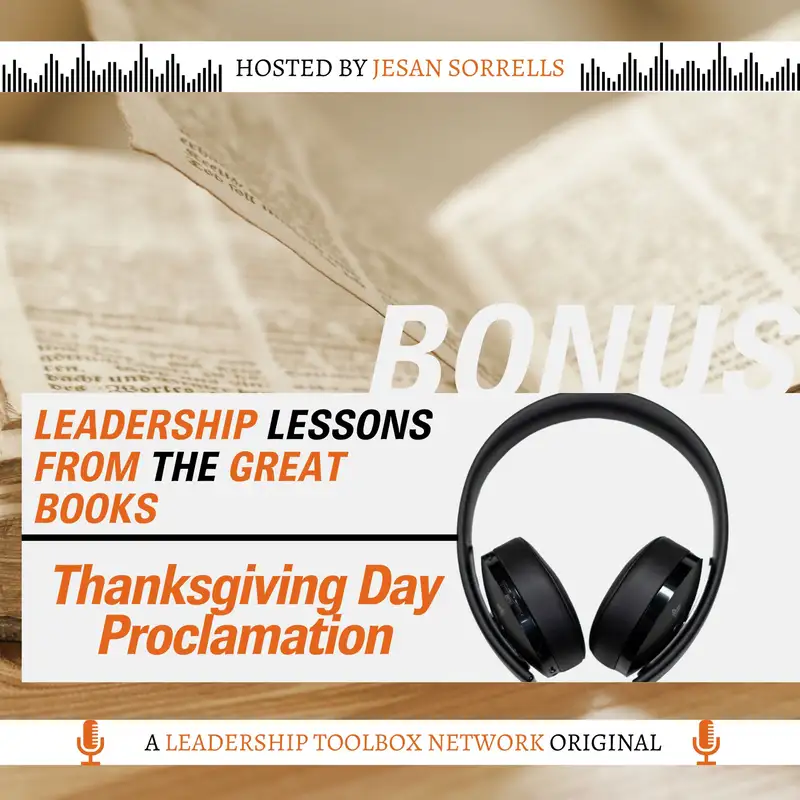
BONUS - The 1789 Thanksgiving Day Proclamation by President George Washington
Because understanding great literature is better than trying to read and understand
yet another business book on the Leadership Lessons from the Great Books
Podcast, we commit to reading, dissecting, and analyzing the great
books of the Western canon. You know, those
books from Jane Austen to Shakespeare and everything else in
between that you might have fallen asleep trying to read in high
school. We do this for our listeners, the owner, the
entrepreneur, the manager, or the civic leader who doesn't have the time
to read, dissect, analyze, and leverage insights from
literature to execute leadership best practices in the
confusing and chaotic postmodern world we all now
inhabit. Welcome to the rescuing of Western
Civilization at the intersection of literature
and leadership. Welcome to the Leadership Lessons from
the Great Books Podcast from the Fred W.
Smith National Library for the Study of George
Washington and Mount Vernon Thanksgiving
by T.K. Byron, Ph.D., Assistant
Professor of History, Dalton. State College
Quote since the settlement of. The colonies, Americans were
familiar with setting. Aside days of thanksgiving, prayer, and
fasting. In response to significant events.
In 1789, President George Washington issued a
proclamation designating November 26th of that year as a national
day of Thanksgiving to recognize the role of Providence in creating
the new United States and the new federal Constitution.
Later, President Abraham Lincoln took steps towards designating it a
permanent federal holiday. Americans
traditionally recognize the first Thanksgiving as having taken place at
Plymouth Colony in the autumn of 1621.
The separatist Puritan settlers of Plymouth, known as Pilgrims,
held a feast after their first harvest as a way of thanking God for their
blessings. Invited to their observance were members of the neighboring
Wampanoag tribe, among whom such a harvest celebration was also
neither unfamiliar nor uncommon.
The 1621 Thanksgiving celebration, however, did not become an annual event.
Rather, residents of Plymouth and the other colonies held days
of thanksgiving and fasting over the years at different times of the year
and for a variety of reasons.
During the American Revolution, the practice continued. Colonial
legislatures set aside days of prayer to recognize military victories against
the British Army. After British General John Burgoyne
surrendered to the Americans at Saratoga, New York, in
October 1777, the Continental Congress suggested that a national
day be set aside to recognize the victory. Commander
of the Continental Army, General George Washington agreed, proclaiming
December 18, 1777, as the first national
Thanksgiving Day. The Continental Congress supported similar
Thanksgiving proclamations through 1784.
In 1789, Representative Elias
Boudinot from New Jersey presented a resolution requesting that
Congress persuade the now President of Washington to
declare Thanksgiving observance in honor of the creation of the new United States
Constitution. Congress agreed and passed the
resolution creating a joint committee to make their request to the
President, Washington issued a proclamation on October
3, 1789, designating Thursday, November 26,
as a national day of thanks. In
his proclamation, Washington declared that the necessity for such a day
sprung from the Almighty's care of Americans prior to the Revolution,
assistance to them in achieving independence, and help in
establishing the constitutional government. Not ignoring the
authority of state governments, Washington distributed his proclamation to the
governors, requesting that they announce and observe the day within
their states. Newspapers throughout the country
subsequently published the proclamation, and public celebrations
were held. Washington himself marked the day by attending
services at St. Paul's Chapel in New York City and by donating
beer and food to imprisoned debtors in the city.
The 1789 Thanksgiving proclamation, however, did not
establish a permanent federal holiday. Washington
issued another proclamation in February 1795 to recognize the
defeat of a taxation rebellion in Pennsylvania. Later
presidents, including John Adams and James Madison,
declared days of thanksgiving, but it. Was not until the Civil war
of. The 1860s that President Lincoln
initiated a regular observance of thanksgiving in the
United states. From the Mount
Vernon Educational Resources
Thanksgiving Proclamation of 1789
by the President of the United States of America. A. Proclamation
Whereas it is the duty of all nations to acknowledge the providence of
Almighty God, to obey his will, to be grateful for
his benefits, and humbly to implore his protection and faith
favor and whereas both houses of Congress have by their joint committee
requested me to recommend to the people of the United States
a day of public thanksgiving and prayer, to be observed by acknowledging with
grateful hearts the many signal favors of Almighty God,
especially by affording them an opportunity peaceably to establish a
form of government for their safety and happiness. Now
therefore do I recommend and Assign Thursday, the
26th day of November next, to be devoted by the people of
these States to the service of that great and glorious Being who is the
beneficent author of all the good that was, that
is, or that will be, that we may then all unite in.
Rendering unto him our sincere and humble. Thanks for his kind care and
protection of the people of this country previous to their becoming a nation for
the signal and manifold mercies, and the favorable interpositions
of His Providence which we experienced in the course and conclusion of the late
war, for the great degree of tranquility, union, and plenty
which we have since enjoyed for the peaceable and rational manner in
which we have been enabled to establish constitutions of government for our
safety and happiness, and particularly the national one now
lately instituted, for the civil and religious liberty with
which we are blessed, and the means we have of acquiring
and diffusing useful knowledge, and in. General
for all the great and various. Favors which he hath been pleased to confer
upon us and also that we may then
unite in most humbly offering our prayers and supplications to
the great Lord and Ruler of nations, and beseech him to pardon
our national and other transgressions to enable us all,
whether in public or private stations, to perform our several and relative
duties properly and punctually to render our national
government a blessing to all the people, by constantly being
a government of wise, just, and constitutional laws,
discreetly and faithfully executed and obeyed to protect and guide all
sovereigns and nations, especially such as have shown
kindness unto us, and to bless them with good government,
peace and concord, to promote the knowledge and practice of
true religion and virtue, and the increase of science
among them and us and generally to grant unto all
mankind such a degree of temporal prosperity as he
alone knows to be best
given under my hand at the City of New York, the third day of
October in the year of our Lord
1789.
President George Washington
thank you for listening. And subscribing to the Leadership Lessons from the Great Books
Podcast. If you're listening to this on any of the major podcast
players like itunes, Google podcasts, or Spotify,
please go ahead and leave us a five star review and
write a little bit in there. A couple of sentences is good enough
that actually helps us game those algorithms that I was
just maybe addressing. And of course it
helps us grow the show. Tell all your family, tell all
your friends, and tell the leaders in your life that you know
that need to be listening to this show. That this show exists.
By the way, if you want to get started on the leadership path yourself or
you know some people who need to go on the leadership path, HSCT
Publishing, the home company of Leadership Toolbox and Leadership
Lessons from the Great Books Podcast can help you and your team
do that. So check out our training, webinars, coaching services,
and more@leadershiptoolbox us. We are
remote. We're live, we're in person, we're on video. And
we've got leadership development solutions for your civic group, nonprofit staff,
public sector staff, or even your private sector leaders.
And of course you're going to want to check out our video based subscription
service@leadingkeys.com that that's
gleanekeys.com for leadership development on demand.
You don't like videos, you don't like training, but you really like the podcast.
Well, I would also recommend reading a book.
Matter of fact, I'd recommend reading my most recent book, 12 Rules for
Leaders, the foundation of Intentional Leadership. You can get that in
paperback, hardcover, or as an ebook on Amazon, Barnes
and Noble, Kobo, ingramspark, and any other place that you
order books online. Finally, of course, we're
on YouTube just like everybody else is. We'd love to have you help us grow
the YouTube channel. So like and subscribe to the video version of
this podcast on the HSCT publishing channel
on YouTube. Just search for HSCT Publishing. Or you can
search for Leadership Toolbox and hit the subscribe button.
Subscribing helps us grow the show as it does with the
audio just is the same with the video. All
right, that's it for me.
Creators and Guests