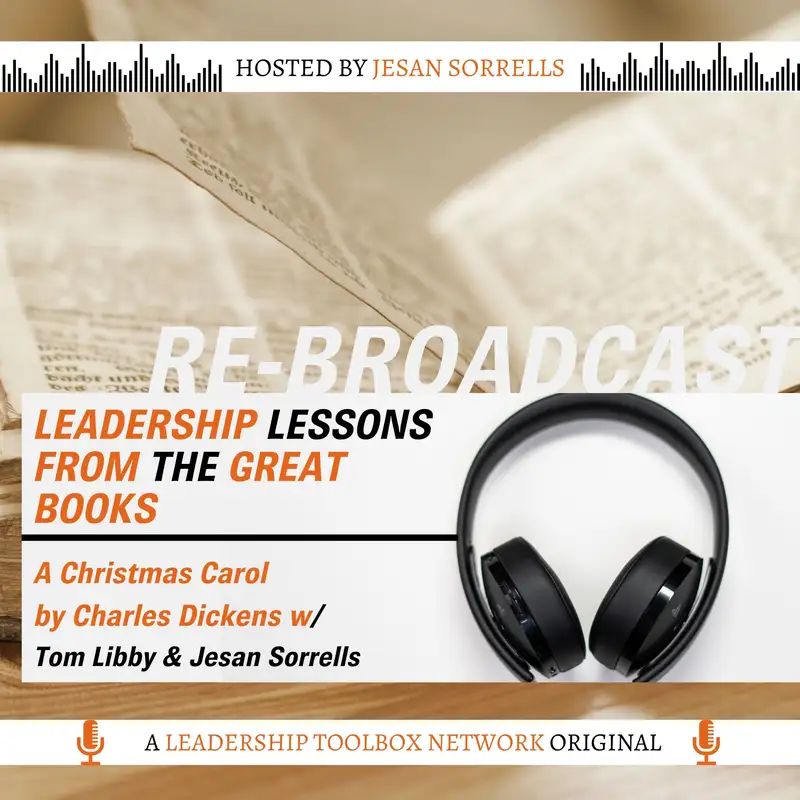
RE-BROADCAST - A Christmas Carol by Charles Dickens w/Tom Libby
So I just wanted to let you know that what you're listening here today is
a rebroadcast of a previously posted
episode of the Leadership Lessons from the Great Books podcast.
No new episode today, but enjoy this rebroadcast
because listening to a rebroadcast of the Leadership
Lessons from the Great Books podcast is still better
than reading and trying to understand yet another business
book. Hello, my name is
Jesan Sorrells, and this is the Leadership Lessons from the Great Books
podcast with our book today,
the penultimate Christmas classic, just in time for
the holidays. And you'll be able to see it as I hold up the book
on the YouTube of this, which will probably be coming out
after the Christmas holidays. I mean, let's be real here. A
Christmas Carol by Charles Dickens. And of course, we're
welcoming back to the podcast Tom Libby. Hello, Tom.
How are you doing? I'm doing fantastic, Hasan, thank you very much. And
awesome having coming back. I'm super excited to be back. Yeah, it's going to
be great. We're going to. Normally, I don't have good timing
when it comes to things like this, so normally I'm
terrible. I'm usually scrambling kind of like most people
scramble five days before the holidays. I'm kind of scrambling together a podcast
episode before the Christmas holidays or before any
major holiday. Fortunately, I was on it this year. And so
we will be talking about A Christmas Carol, a book
that has, as I was saying before we hit the record button, a book that
has stood the test of time in many, many ways,
and that has set the foundation for what
we think of as Christmas. When we think of that in our heads,
whether we are Christian or not, kind of in irrelevancy. Right.
It's actually gone beyond religion. And now we're into the
space of myth, and we're into the space of something that
everybody can appreciate increasingly from a global
perspective. So our concepts of tinsel,
sleigh bells ringing, the food, and
of course, the spirits of Christmas. And we'll talk about the
spirits of Christmas in just a minute. And the tensions between
capitalism and, well,
morality are all evidenced in
Charles Dickens's A Christmas Carol. So we're
going to start off a little bit talking about
Charles Dickens and A Christmas Carol. And so I'm going to read
from A Christmas Carol. Now. The version that I have is the
Bantam classic version. I always usually talk about this, usually later on the
podcast, but I'll bring it up early now just to get it out of the
way. This is the Bantam classic version of a Christmas Carol. So it has
the original, original story in it, talks a little bit about
the reception that Dickens's classic
had back in the Victorian era. And then we also get
into the literary life. A brief biographical sketch
of Charles Dickens. And so I want to introduce you to him in case
you have not met him. The new office boy
who reported for work in the London law firm of Ellis and Blackmore one
May Day in 1827 was small for his 15 years but
he seemed sure enough of himself. He arrived neatly dressed,
handsome of face and sporting a big black eye which he got on the way
to the office after he had hit a bigger boy who had knocked off his
cab. The boy in this incident was Charles Dickens.
Destined to become a giant in literature. Dickens was born in Landport, about
75 miles southwest of London on February 7th, 1812
to John and Elizabeth Dickens. The years with his parents between then and
his new job at Ellis in Blackmore were important in shaping the ideas of Dickens
the writer. Dickens father was a clerk in a naval pay
office but pretended to a place in society he could not
rightfully claim. This pretension led him to spend more than he earned and
plunged him into financial troubles which affected the life of his firstborn son. He
piled up debts which required him to pawn the family possessions and to move his
household from one place to another, each time to a neighborhood less desirable than
the last. He found it impossible or inconvenient to
keep Charles in school and made arrangements for his son to go to work. Not
an unusual fate for a 12-year-old boy in the 1820s. In a blacking
warehouse, Charles earned 6 shillings a week
pasting labels on bottles of boot polish from 8 o'clock in the
morning until 8 at night with an hour off for lunch and half an hour
for tea in the afternoon, Monday through Saturday.
The boy hated this job because he thought he should be in school and also
because he found his work humiliating. Evidently some of his father's desire
to better his social status rubbed off on his son. Charles was often seized with
fits of fever and spasms during his months at the blacking warehouse, a malady that
afflicted him throughout his childhood. Whenever things were going badly,
by the way, pause we would call this psychosomatic. These days
his humiliation was deepened when his father, along with the rest of the family
was sent to debtors prison. His
deliverance came when his grandmother died and left enough money for his father to obtain
a release from prison. Finally his father took him out of the warehouse, but not
without protest from his mother. And sent him back to school. The whole term
of working could not have been six months long. If the experience left a mark
on Dickens which a life of immense popularity and great wealth could not
erase. He could not bring himself to tell either his wife or his children about
it, or his family's term in prison. And his later writings bear
witness to his interest in the economic and social factors which made such
childhood agony possible.
Charles spent two and a half years at Wellington House Academy, a private boys' school
where he impressed people with his quick wit, his habit of laughing boisterously for no
apparent reason, and his interest in staging plays in the toy
theatres. He was happy in school, but it was inevitable that his schooling
should come to an end when his father's financial condition took the now familiar turn
for the worse. So Charles found himself at the end of his formal schooling and
in the law firm of Ellison Blackmore as an office boy.
There he found his work dull and his mind turned towards journalism. Learning
that he could not succeed in newspaper reporting without a knowledge of shorthand, he set
to work to learn and became very proficient. Dickens did so well at
it that he became a reporter in Parliament, distinguishing himself by the speed
and accuracy of his reporting the long debates. Although he had by then
barely turned 20. Such success led him
to being given editorial responsibilities on the newspaper Mirror of Parliament,
which reported parliamentary proceedings. In his reporting job, he observed closely the people
about him, something he had been doing since he was a small boy. And many
of those people were destined to appear as characters in the novels yet
unwritten. Dickens career in writing began with the
publication of a fictional sketch in the December 1833 issue of the monthly magazine.
This led to sketches by boys and a lifetime of creative outbursts which only a
genius and a man of inexhaustible energy could produce. The serial story in
newspaper and magazine was then in high fashion, and Dickens founded a splendid outlet for
his flowing descriptions of scene and character, which were always amazingly
accurate reports of the author's sharp observations.
The Pickwick Papers was his first novel and it appeared in 20 monthly
installments. Although Dickens literary career was surging forward, he took on these new
writing jobs but continued his newspaper work. Dickens still
found time to fall in love and marry Catherine Hogarth. She was not his first
love, nor his last. Indeed, women were a part of Dickens exhilarating and expansive
personality, causing him joy and trouble through much of his life.
For example, he began married life in 1836 with a young, beautiful and
admiring sister in law, Mary Hogarth, sharing his household
after 20 years, two years of marriage and 10 children,
Charles and Catherine Dickens separated. No small scandal in Victorian England.
Georgina Hogarth, another sister in law, continued to live in the author's home, caring for
the children. In addition, Dickens name was linked with the names of many
women during his life. A man of prodigious
energies, his life was filled with writing, traveling. He sailed to America twice, a
considerable journey in those times, acting and giving public readings of
his works.
Thus
we
have
as
the setting, the background for A Christmas Carol,
the literary life of Charles Dickens,
probably the most popular writer of the Victorian era.
I was just saying to Tom, before we came on,
the guy would probably have been one of those authors with a podcast and he
probably would have loved Twitter, actually. He would have loved it insanely.
Jane Austen would have loved Facebook. We mentioned this in an earlier. But
Twitter, my boy Dickens would have been on Twitter and he'd have been tweeting
all day.
Being born when he was in the 19th century,
he witnessed the transition of humanity in England
from farms and factory factories and villages to the beginning of the
Industrial Revolution. I mean, when you're getting paid $8
or not $8, you're working 812 hours a day and getting paid a
few bucks to put labels on bottles of boot
black and boot polish. You're at the beginning of something.
And the Industrial Revolution would bring more
prosperity to more people than anything else that human beings had done
up to that point. But it would also bring a lot of
pathologies with it. It would also bring a lot of challenges with it, many of
which we are still working through today. As a matter of
fact, infamously enough, Karl Marx
said that about Dickinson's writing in a book called Hard Times,
which appeared, I believe, right after Pickwick Papers. And in between that one and Oliver
Twist, he said about Hard Times, and I quote directly,
that book converted more people than Das Kapital did, from
capitalism to more communistic
ideas.
One other thing you have to know about Dickens and we
moderns underestimate the power of religion. We really do,
because every man can pick his own God now. That's the world
we live in today. But back then you didn't have a lot of options.
You picked one or you didn't pick any. And that was It. Those are your
two options.
Now,
he used his talent for writing books and for observation and
for having that prodigious energy that was mentioned there at the beginning
to publish one book which we are going to talk about today, A
Christmas Carol. It was published in 1843 and it has never
been out of print. We are in the 179th year as of
this recording of A Christmas Carol, and I anticipate we will get
right to 200 years and we'll go right past that. A
Christmas Carol set the tone in the west and increasingly around the
world for what Christmas actually means. Whether you're
secular or not, whether you bow at the altar of
commercialization or whether you're a person who really believes that it's all
about Jesus either way. Right. You
have this image in your head of what Christmas is. And that
image was created by Charles Dickens, just observing
what he was seeing and writing it down.
And so after all of that, I'm going to open
up the door to Tom a little bit here because he's listening to me patiently.
So what are your memories? Let's start with this. What do you. What do you
know about the Christmas Carol and its core themes? And by the way, this has
been turned into movies, theater shows, television. My
God, it's been everywhere. So, yeah, that was actually going to be my first statement,
which one of the things I find fascinating. The. The most. Probably
the most fascinating thing that I found about the book was no matter
what media we've come out with, the book has some sort of
interpretation based on that media, meaning it was on. It was on
Broadway or some sort of stage version. And then movies came out,
it came out, or radio came out. They did it on the radio. The movies
come out. They did on the movies. Now we have all this technology, you know,
you know, available to us, and it's been interpreted by just about
everybody from, from, you know, network
televisions to Disney. Yes. Like, Disney has a
version of it with, like. I think it. I think that that is probably the.
One of the Most fascinating things to me that such a simplistic. And if you.
And I don't mean to downplay Dickens by any stretch of the imagination. The theme
is simplistic, right? Like, yeah, you think of, like, what the theory is, what the
theme is here. It's. It's capitalism over your family
or wealth over relationships or however you want to word
it. But that theme. And by the way, that theme has still not changed.
Right. So anyway, I think the book is fascinating. I think it's
been amazing to see the journey
that it's been
on, you know, and just
through
historic value,
because obviously I wasn't alive in 1843,
but, you know, nor you. But, but, but as
students of humanities, the two of us have been
able to go back and see how this simplistic idea has morphed into something that
is just bigger than itself. It really is
just bigger than itself at this point.
And I'm not going to name names, but even, but you'll know what I'm talking
about as soon as I say it. Even the big companies that are
100% trying to sell you something are using the
drips and memes of, like, it's about family, it's
about relationships, but come buy this product because we want you to buy it.
Like, that's right. Like they're even. They're even coveting this, this
battle, internal battle that we use. So anyway, I think the book is fascinating.
I think it's been amazing to see the journey that it's been on,
you know, and just through historic value, because obviously I wasn't alive in
1843, but, you know, nor you. But, but, but
as students of history, the two of us have been able to go back and
see how this simplistic
idea has morphed into something that
is just bigger than itself. It really is just bigger than itself at this point.
It has not only has it morphed into something that is bigger than itself, but
it's also created. And I loved how you mentioned core themes. It's
created this. This tension that
probably didn't exist before and could only have existed under industrialization
between, like you said, wealth and relationships. And
Dickens was the first one to sort of see that at the beginning of the
Industrial Revolution and really hit on something human inside of that.
And of course, what makes it timeless is it doesn't matter
what the, what the externalities of the people are. When it
comes to a celebration of relationships over something
else, you're going to have that tension. Right. People talk about the
Christmas spirit all the time. Well, the Christmas spirit is more than just about giving
and gratitude. It's. It's about. Which I think Thanksgiving is
much more about that. But it's also, but it's about this idea of
how do you resolve that tension between the material
and the spiritual, you know, to put it quite frankly. Well,
and the other thing like you mentioned a few minutes ago, and I
again find it fascinating how he used.
You mentioned his faith. Right. His. And a lot of
his writings come from that, but he doesn't put it in your face.
I think that part is also extraordinarily
brilliant, like coming from somebody who was raised
Catholic. And it was like, not just put in my face, it was like shove
down your throat. Right. Like so it was,
you know, but he did it so subtly. Right. There was, there are, there are
little nuances to this that make you understand and realize that he's
Christian. You can see it in there. But it's not so blatantly
obvious that you feel like it's a religious story. Exactly,
exactly. It's, it's, it's really brilliant how he
balances that, that pen or pencil. Well. And it's not,
it's not long. It's only an 87 page story. Like you can
bang through this in an afternoon and you can get that.
And so it's that economy of language, it's the economy
of image, but it's also this idea
that something exists. And this is the
amazing thing about it. And by the way, I will be honest, like before this
podcast, I had probably not actually gone. I know, not
probably. I had not actually read the book, the
story, the Christmas Carol. Right. Because why do I need to read that? Like, I,
I mean, I see the movie. Like, I got it. Like,
I've seen the 18 movies. I've seen the 18 movies. I got it. Like
I'm sad. I don't need help. 27 television
specials. Yeah, yeah, yeah. I personally like the Jim the Nudge,
the, the Bill Murray version, scrooge from like
1980 something, which I can't show my kids because it's a PG13 movie from the
80s, which is actually an R rated movie today.
But like I, because I'm. And I'm a huge Bill Murray guy. So like him,
you know, kind of flopping around as Ebenezer Scrooge as a media
mogul is just kind of amazing to me. Yeah, yeah. And I'm waiting for the
AI version, the Open Chat GPT version
of the Christmas Carol because even the robots are going to want to wrap their
arms around this. I suspect even the robots are going to want this one.
But in reading it and actually going back and looking at the source material, which
is what we do on this podcast for leaders, in looking at the source material
and going, okay, what can we pull out of this for leaders? What do
they have to understand? Right. You realize
just how brilliant
and influential something small can be
and just how much it can tip over a whole bunch
of other different kinds of concepts in your head
and make them easy for you to understand in a
really meaningful way. And Dickens, that was Dickens's talent.
I mean, you know, the guy would have been
a leader. Regardless of what era he would have been born in, that talent was
going to come out. There are just some people that you realize you could pick
up and move throughout the eons of history, and they would be successful
regardless of where they were. Right. And I think he's one of them. I think
you're right. Yeah. Yeah. Well, back to the book.
Let's. Let's talk a little bit about this. This guy,
this. This fellow. Talk a little about Scrooge.
Going to meet Ebenezer Scrooge, right? Gonna
get into the Christmas Carol. Let's. Let's go meet this
fellow who's been portrayed by, well, by all kinds of different
actors. Again, my. My personal favorite is Bill Murray. You
may have a different. You may have a different favorite. I do know, again, there's
been animated versions of this Disney. The Disney version of A
Christmas Carol. I mean, my gosh, like, it's. It's been all over the place.
So back to A Christmas Carol.
The same face, the very same Marley in his
pigtail. This is Jacob Marley, his former partner. Now
passed usual waistcoat, tights and boots, the tassels on the ladder
bristling like his pigtail in his coat skirts and the hair upon his head. The
chain he drew was clasped about his middle. This is the ghost of
Marley visiting Scrooge. It was long and wound about like
a tail, and it was made for Scrooge observed it closely. Of
cash boxes, keys, padlocks, ledgers, deeds and heavy purses wrought
in steel. His body was transparent, so that Scrooge, observing him and
looking through his waistcoat, could see the two buttons on his coat behind.
Scrooge had often heard it said that Marley had no bowels, but he had never
believed it until now.
Nor did he believe it even now, though he looked.
Though he looked the phantom threw and through, and saw it standing before him. Though
he felt the chilling influence of its death cold eyes and marked the very texture
of the folded kerchief bound about its head and chin, which wrapper he had not
observed before, he was still incredulous, and he fought against his senses.
How now? Said Scrooge, caustic and cold as ever. What do you want with me?
Much. Marley's voice, no doubt about it. Who
were you? Ask me who I was. Who
were you, then? Said Scrooge, raising his voice. You're particular
for a shade. He was going to say to a shade, but
substituted this as more appropriate in life. I was your
partner, Jacob Marley. Can you sit down?
Asked Scrooge, looking doubtfully at him. I can do it.
Then. Scrooge asked the question because he didn't know whether a ghost so transparent
might find himself in a condition to take a chair, and felt that in the
event of its being impossible, it might involve the necessity of an embarrassing explanation.
But the ghost sat down on the opposite side of the fireplace, as if he
were quite used to it. You don't believe in me, observed the
ghost. I don't, said Scrooge.
What evidence would you have of my reality beyond that of your
senses? I don't know, said Scrooge.
Why do you doubt your senses? Because, said
Scrooge, a little thing affects them. A slight disorder of the stomach makes them
cheat. You may be an undigested bit of beef, a blot of mustard, a
crumb of cheese, a fragment of an underdone potato. There's more of
gravy than of grave about you, whatever you are.
Scrooge was not much in the habit of cracking jokes, nor did he feel in
his heart by any means waggish. Then the truth is that he tried to be
smart as a means of distracting his own attention and keeping down
his terror. For the specter's voice disturbed the very marrow in
his bones. To sit staring at those fixed
glazed eyes in silence for a moment would play. Scrooge felt the very deuce with
him. There was something very awful, too. And the specter is being provided with an
infernal atmosphere of its own. Scrooge cannot feel it himself, but this is
clearly the case, for though the ghost sat perfectly motionless, its hair and skirts and
tassels were so agitated as by the hot vapor from an oven.
You see this toothpick? Said Scrooge, returning quickly to the charge for the reason just
assigned, and wishing, though it were only for a second to divert the
vision's stony gaze from himself. I do, replied the
ghost. You are not looking at it, said Scrooge. But I see it, said the
ghost notwithstanding. Well, returned Scrooge, I have to
but swallow this and be for the rest of my days persecuted by a legion
of goblins all of my own creation. Humbug, I tell you. Humbug.
At this the spirit raised a frightful cry and shook its chain with such a
dismal and appalling noise that Scrooge held on tight to his
chair to save himself from falling in a swoon. But how much
greater was his horror when the phantom, taking off the bandage round
its head, as if it were too warm to wear it indoors, its lower
jaw dropped down on its breast.
Scrooge fell upon his knees and clasped his hands before his
face. Mercy, he said. Dreadful apparition, why do you trouble me?
Man of the worldly mind, replied the ghost. Do you believe in
me or not? I do, said Scrooge. I
must. But why do spirits walk the earth? Why do they come to me?
It is required of every man, the ghost returned, that the spirit within him
should walk abroad among his fellow men and travel far and wide.
Scrooge
stands in. He's an avatar, right? As
Tom was just saying, even in our time, for greed,
avarice and vanity and selfishness and a
callow lack of understanding.
So
turns
out,
as
Tom
was saying before, and again, not to steal Tom's thunder, but it is something that
you can observe yourself. Seems like not a lot has changed
in the last 39 years.
What is remarkable about Scrooge in this little story is that
Dickens wrote him as a critique of capitalism from the left, the political
left, in spite of the fact that he is redeemed by
engaging in the same capitalism that Dickens just critiqued
from the right at the end of the story. It's this neat little
turning that makes this story
political and apolitical all at the same
time.
Spiritualism is the idea that you could
raise ghosts from the dead and that you could speak to people
who had already died. Right?
Now, most of this was scams. The
magician and illusionist of the
19th century, of the Victorian era, what is
his name? I'm going to remember his name in just a minute as I continue
to talk. But very famous magician and illusionist in the
19th century basically claimed he made a bet that if
anybody could raise him from the dead, they would win a bunch of money.
Right. And yet as a literary device,
it works because spiritualism wasn't really about the raising of the
dead. That's not really what it was about. It was about condemnation. It was
about judgment. It was about.
Well, it was about.
I read. I read something found by your measure and being found wanting. Right?
Yeah. Well, as I say, I read. I read somewhere, too, that, that exact, that
exact piece that you're talking about right now was, was the.
That strive for immortality. Right. It had more to
do with the fact that. That you're going to, you
know, once you pass on to the next life, that you can remain in this
life. So there was like an immortality feature to it. So there was this
constant barragement of, it's real, it's real, it's real. Let me
prove it. Let me prove. Let me prove it. So. Right. You know, and I
guess I never really put that two and two together, that Dickens was like,
I got this. Exactly. Well, and that's
the, that's the great thing, because he was. He was sitting around
watching all of this happen
in real time. He was also
in the space of. And the book was published
in 1843. He was in the space of
having conversations or conversations were beginning to be had in the public
on a scientific level, on a very material level, because
Darwin would publish on the Origin of the species in 1859, and that
would turn Victorian society and the rest of society for the
fourth on to now inside out, basically. Once Darwin
published his theory of evolution, that was it, we're off to the races. And you
know, you combine that with Nietzsche and existentialism, which we talk a lot about on
this podcast, and then you have man's meaning. Crisis in the
west anyway, you know, just full on, right? Because if we
evolved from apes, if we came from nothing, Big Bang Theory,
if there is no God in the machine, then what is the meaning, right?
Dickens was having those, was seeing those things happen in the
Zeitgeist in 1843. And when Origin of the
Species came along and people forget he died in 1870, he had 20 years of
those conversations happening around him. And so he was kind of giving a preview of
coming attractions, I think. Yeah, yeah.
What can leaders learn from Ebenezer Scrooge?
It's so weird that you were thinking like that. You just like, you just kind
of like went there, right? Like I went right there. So. Because I was, you
know, the funny part was when, when you, when you had sent me the information
about this podcast, that was really my first thought, like
before I even read the information and all the outline and all that stuff, and
I was like, wait a minute, this is a leadership podcast. What on God's green
Earth am I supposed to take from leadership from Ebenezer Cruise? Well, you
know what? I figured something out. Go ahead, go ahead. Because there's got to be
something. There has to be something, right? And I think one of the things
from a leadership perspective I thought was an interesting
concept that again, if you watch this movie
or read this book from that perspective, I think
the message here is crystal clear that it's never too
late to become a good leader, right? So it's never too late
to change your world around. It's never too late to fix the wrongs,
that you could be the world's worst CEO and treat your people
like crap. I can almost promise you that,
that if you spun it a complete 180 for the next 10
years, that's what people are going to remember about you, right?
So I'm sure you've heard the stories too.
I've heard stories of very popular
big name leaders. And again, I'm not going to throw names out there because I
don't want to. I don't want to cause any kind of like debate or
problem with your audience. But there's been some very big leaders out there in the
past, in our past, especially coming up in the 90s and the early
2000s that, prior to that they were considered
terrible. And all of a sudden the tech boom happens and
they just really flipped the script on their own story, right?
And they were able to become some of the all time what we would
consider greats of leadership. And we still quote them today. But if you look
at their early careers, they were not very good people
and they were not very. No. What's the
word I'm looking for? Scrupulous. There you go. So,
like, they did a lot of wrongs and they treated people a lot really
poorly, but they, they caught it, they caught it at a
point in their life where it was not too late to turn it around. And
then, and then in turn be considered one of the better
leaders of the 20th century, early 21st century. So I think
for me, that jumped out at me when I, when I. Again, looking at the
information you sent and the outline and all this stuff from
leadership, what does this teach me about leadership and all?
Then it turns into, then it turns into what
is leadership other than you as a human being treating other
people like human beings amongst all of the techniques
and the.
He didn't treat people as if they were human beings until he realized that
he needs to do that. And then once he did, his life changed for the
better. Right. So again, I go back to like that. To me, that was the
foundational piece of it. I'm sure there are other minor things here and there.
And if you think of, like there's some
observational skills that you can take out of it. If you think about when
he's looking back in the past retrospective, you should always be
gauging your past to present your future. Things like that. I
mean, sure, there's, I'm sure there's tiny little nuances there that if you
are a very analytical person, you could take out 100 of
those things out of that. Right. And then, of course, the, the predictability
of the future, you know, ghost of future. Right. So the ghost of
Christmas future. Sorry, but the ghost of. And then, so you start thinking
from. I'm a firm believer in Stephen Covey,
right. So you look at Stephen Covey's, you know, work, you know,
start with the end in mind. So you're. If you're trying to become predictive in
what you're, you're looking for from a leadership perspective, well, then you got to work
backwards. Start with what you're looking for, what you're shooting for what you want to
be judged by, and then go backwards from that. So if you're looking at the
Ghost of Christmas Future going, that's what I really want, or that's
what's a possibility, then what do I have to do right now in order
to make that possibility a reality? So I do think there are a lot.
There was way more leadership stuff in there than I expected. When I.
When you first sent me the information, I was like, this is
a Christmas story. What are we doing here? But the more I dissected it, the
more I found a lot of. There's a lot of little nuances in there.
Right. And that's. I am a firm believer that
this is this. And this is why we do literature. I say this repeatedly on
this podcast, and I'll say it again. This is why we do literature.
Because if you wrote the story
of Ebenezer Scrooge and his experiences,
if Jack Welch. I'll name a name. If Jack Welch wrote.
And I know it's not the name you're thinking of, but I'll name a name.
If Jack Welch wrote this kind of story,
No one would believe it. Yeah, no one would
believe that. That. Number one. No one to believe that
a ghost visited you and shook you out of your. You know, that you were
shook, as the kids say these days. No one. No,
no one would believe that. That's number one. But even if they did believe
that, the level to which
Scrooge shifts is.
Can only happen in literature. Right. Because the writers have the ability to push the
character wherever it is he wants the character, but quickly. That quickly,
maybe. Yeah, I think that shift can happen, but it can't happen as quickly as.
It does in literature. Right, right, right, right, right. You know, he had 12. Well,
and the book is. By the way, the book is. The book is squishy with
the time frame. Right? So, you know, the chimes
bell for. What is it, 12 o' clock in the chimes bell for 1 o'.
Clock. But then he doesn't hear the chimes again. Right.
Or, you know, he's traveling through time and through space. And, of
course, because it's literature, you can do that, and
it comes off as this very.
I can easily see a modern version of the Christmas
story or the modern version of Christmas Carol with.
Not to be confused with the Christmas Story with Ralphie and all of that.
Just watched that the other day with my kids. They were like, why is this
so popular? I had to explain to them about the
1940s and you know, the baby boomers and like, childhood
underneath, like, not having as much as we have now. And they still kind of
sort of rolled their eyes, like, whatever, dad, it's fine. Okay. All
right, it's fine. But Ralphie is a penultimate character. Interesting.
We will cover a Christmas story maybe next Christmas, because there are things you
can. There are things you can learn from Ralphie, actually, interestingly enough.
But. But leadership is everywhere. And
that hero's journey, again, without the psychology, right?
Dickens is writing at a time before Jungian psychology. He's writing at a time before
Freud. He's writing at a time before all of this stuff that we now frame
A Christmas Carol or any other book around. But it was
a hero's journey. Except Scrooge is the villain, right? Scrooge is
the unlikable, terrible villain. As a
matter of fact, when he goes. Well, when the ghosts go and show
him what other people are saying about him, none of it is positive.
No. They're all crapping on the guy. And so,
so, yeah, it's. You're right. It is. It is this idea that a leader
can change, but there's. There has to be. And
I think this is a very enlightenment idea that Dickens is holding on to.
There has to be a. A push or a force from the outside
that makes that happen, you know. Or in the case of leadership
in organizational leadership from the inside, right? It has to be a force from
outside of yourself. But you're right in like
anonymous surveys that are truly
anonymous, by the way. So anonymous surveys, things like that. You know,
that stuff. When you really get to the heart of what your employees are thinking,
only that's the only way you're going to get to that paradigm shift. You're not
going to have an epiphany all by your lonesome when you're sitting in
your bed on Christmas Eve, right? It's not. That's not going to happen with one.
Piece of coal and some port wine that you ripped off from some clerk.
But. But over the course of time and really
striving for understanding of the mentality of your workforce and of the
mentality of your. Even of your customer base or however you want to look at
it, that you can start to.
To. To shift that paradigm, right? Like you can. It just. You
have. First of all, though, here's the biggest problem and what, again, what something that
we can learn from, from this story is willingness, right? Are
you really willing? Are you really willing to listen? Are you really willing to change?
Because if you're not, then it's all a moot point. You can take all the
surveys you want, you can take all the understanding. You get all the understanding from
your readers, your clients, your customers, your friends, your family. None of that
matters if you don't have the willingness to listen,
to learn to change. Exactly. It's. Exactly.
And some people say they are or think they are, and they're really not. They're
really not. Yes. Well, well. And that gets to,
that gets us to this idea of. I just did a whole.
I just did a whole class this year, the last half of this year, on
ethics. And we know we separate ethics from
morality for a whole variety of different reasons that we don't
have the space to get into on the podcast on this episode anyway, of the
podcast. And we'll explore some of those next year with some of the books that
we're reading because this is a fascinating separation that leaders need to pay attention to.
I will also say at the outset, I don't think you can uncouple ethics or
morality, but that's my own bias. Let's put that aside for just a
second. In looking at
how you care about people and in looking at what those forces are from the
outside, well, how does a
leader become ethical in paying attention and going in the right direction? Right.
Dickens has some thoughts for us. So back to the book, back to
the story of Christmas Carol. So
the ghost of
Christmas Present grabs a hold of,
of Scrooge here and
starts taking him around, starts showing him some things,
right? And the ghost of Christmas Present in this
part of the story really does set the tone for,
again, what we think of as Christmas. Holly, mistletoe,
food, people getting together, all this. And then. And by the way,
these ghosts communicate with, with, with Scrooge. So there's
communication that goes back to that spiritualism idea and that idea. I loved how you
brought this up about Mora. Immortality. Right. Going back and forth
across the veil and being able to gain knowledge.
So we picked this up at this point in the book. But soon the steeples
called good people all to church and chapel. And away they came
flocking through the streets in their best clothes with their gayest faces.
And at the same time, there emerged from scores of by streets, lanes and nameless
turnings, innumerable people carrying their dinners to the baker
shops. The sight of these poor revelers appeared to interest the
spirit very much, for he stood with Scrooge beside him in a baker's doorway and
taking off the covers as their bearers passed, sprinkled incense on their dinners from his
torch. And it was very uncommon. It was a very uncommon kind of torch. For
once or twice when he. When they were angry, when there were angry words
between some dinner carriers who had jostled each other, he shed a few
drops of water on them, and their good humor was restored directly,
for they said it was a shame to quarrel upon Christmas Day. And so it
was, God love it, so it was. In time the bell
ceased, and the bakers were shut up. And yet there was a genial shadowing forth
of these dinners and the progress of their cooking in the
thawed blotch of wet above each baker's oven, where the pavement
smoked as if its stones were cooking too. Is there a
peculiar flavor in what you sprinkle from your torch? Asks Scrooge. There
is my own. Would it apply to any kind of
dinner on this day? Asked Scrooge. To any kindly given
To a poor one most. Why to a poor one most?
Asked Scrooge. Because it needs it most.
Spirit, said Scrooge, after a moment's thought, I wonder you, of all
the beings in the many worlds about us, should desire to cramp these people's
opportunities of innocent enjoyment. I. Cried the spirit,
you would deprive them of their means of dining every seventh day, Often the only
day on which they can be said to dine at all? Said Scrooge. Wouldn't you?
I. Cried the spirit. You seek to close these places on the
seventh day, Said Scrooge. And it comes to the same thing
I seek. Exclaimed the spirit. Forgive me if I am
wrong. It has been done in your name, or at least that of your family,
said Scrooge. There are some upon this earth of
yours, returned spirit, who lay claim to know us, and who do
their deeds of passion, pride, ill will, hatred, envy,
bigotry, and selfishness in our name, who are as strange to
us all and all our kith and kin as if they had never
lived. Remember that, and charge their doings on
themselves, not on us.
And
perhaps it was the pleasure the good spirit had in showing off this power of
his, or else it was his own kind, generous, hearty nature, and his sympathy with
all poor men, that led him straight to Scrooge's clerk. For there
he went and took Scrooge with him, holding his robe. And on the threshold of
the door the spirit smiled and stopped to bless
Bob Cratchit's dwelling with the sprinkling of his torch.
Think of that. Bob had but 15 books a week himself. He
pocketed on Saturdays but 15 copies of his Christian name. And yet the ghost of
Christmas present blessed his four-roomed house. Then rose up
Mrs. Cratchit, Cratchit's wife, dressed out but portly in a
twice-turned gown, but brave in ribbons, which are cheap and make a goodly show
for sixpence. And she laid the cloth, assisted by Belinda Cratchit, second of
her daughters, also brave in ribbons, while Master Peter Cratchit plunged a fork into the
saucepan of potatoes, and getting in the corners of his monstrous shirt
collar, Bob's private property conferred upon his son in heir honour, in
of the day unto his mouth, rejoiced to find himself so
gallantly attired and yearned to show his linen in the fashionable park.
And now two smaller Cratchits, boy and girl, came tearing in screaming that outside
the bakers they had smelt the goose and known it for their own. And basking
in luxurious thoughts of sage and onion, these young Cratchits
danced about the table and exalted Master Peter Cratchit to the skies, while
he, not proud, although his collars nearly choked him, blew the fire
until the slow potatoes bubbled up, knocked loudly at the saucepan
lid to be let out and peeled. What has ever gotten into your precious father
then? Said Mrs. Cratchit. And your brother Tiny Tim and Martha, weren't as late last
Christmas Day by a half hour. Here's Martha, Mother. Said a girl,
appearing as she spoke. Here's Martha, Mother. Cried the two young Cratchits. Hurrah.
There's such a goose. Martha, I bless your heart alive, my dear. How
late you are. Said Mrs. Cratchit, kissing her a dozen times, taking off her shawl
and bonnet for her with officious zeal.
We'd a deal of work to finish up last night, replied the girl. I had
to clear away this morning, Mother. Well, never mind, so long as you're
come, said Mrs. Cratchit. Cratchit. Sit ye down before the fire, my dear, and have
a warm Lord bless ye. No, no. There's father coming. Cried
the two young Cratchits, who were everywhere at once. Hide, Martha, hide. So
Martha hid herself, and in came Little Bob the father, with at least three feet
of comforter, exclusive of the fringe hanging down before him, and his
threadbare clothes darned up and brushed to look seasonable, and
Tiny Tim upon his shoulder. Alas for Tiny Tim,
he bore a little crutch and had his limbs supported
by an iron frame. We get
a glimpse into Victorian morality here, a little bit
between the Ghost of Christmas Present critiquing Scrooge and
setting him sharply, a right
about vanity and avarice
and what gets placed on the spirit world and what is the responsibility of human
beings? Everything cannot be blamed on God. Some things are just human
beings. And knowing where
that line is is really, really hard, even in the best of times.
The fault of men abound. I can't remember where it comes from, but there's a
sign. There's a fault of men abound.
You know, many times, you know, we're blaming the devil and we're blaming God. In
reality, we should just be blaming ourselves. Sometimes we're just at fault. So, you know,
most of the time, it's your fault. Exactly, exactly.
Dickens writes at the beginning of. And this is something that really struck me
in reading about the Ghost of Christmas Present in particular. Not so much future and
past, but in the Ghost of Christmas Present. Dickens
is writing at this. At this space of modern men seeking to separate
religion from morality because of everything going on around them and the massive changes they
were going through in the Industrial Revolution. And even in that description of their clothes
and the food, you are at the beginning of
what we in our day would consider extreme poverty. Like,
we would look at that and we would go, those people are poor. But
Dickens is saying they have dignity. And by the way, they were poor back
then, too. But here's the thing, and this is something that
people who went through the Great Depression. My grandma went through the
Great Depression and she would often talk about this. Everybody
was poor, so nobody knew any different, right? There was
no. Everybody was broke. You know, any rich
people in our day,
we have the same phenomenon. But the
challenge we have is we can now see other people's
stuff because of social media or because
of people just showing their highlight reels or whatever. And when people have the
opportunity to curate their lives, like if the Cratchits had the opportunity to curate their
lives, they would have done so. They wouldn't have been any different than any other
human beings. It's not the tool, it's the people, right?
And then. And then scrooge was judged. Right. And Scrooge is being judged
by the Ghost of Christmas Present here.
And, and in that judgment he's being judged in moral
and religious terms. And there's something about that language that Dickens gets
on you and to. You picked up on this. Exactly. And I
love it that you mentioned this. He doesn't actually use the biblical, he doesn't
use biblical language but you know, he's writing from a Christian context.
And you know, and it's so subtle that
if you know, you know and if you don't, it doesn't matter. The
story still has the impact. And so
the question I have is in the times at which we live now,
the year, the year of whoever,
2022,
could this story get written now like we never had had the
Christmas Carol? Could this story have been written now? Would someone have popped
up with this? As odd as it sounds, I don't think
so. And I don't, I go
back. Like if you think about it, the mid-1800s, late 1800s is really where
they started recognizing that 80/20 rule, that
80%, that 80% of the wealth is controlled by 20% of the people.
And today we talk about the 1 percenters, right? Yeah.
So that ratio has been so skewed that I don't think the
1 percenters truly understand and know. I think that gap has gotten
so much further apart that the 1 percenters look at the
poverty line as, as not
something in which they can impact for the greater good, but they look at
it as something they, if they, if they keep it a status quo, then they
don't change their status. Right. Whereas back then
of the 80/20 rule, there could have been a solid
50% of those 20 percenters that could have
felt like Scrooge and they, they could change the world, right? Oh yeah, yeah.
So I don't know. I don't know. I don't think, I really don't think so.
I don't think that we, I don't think now we, we've already talked about on
this particular conversation that,
that there's a lot of similarities, right? That there's a lot of things that there's
a lot of impact similarities. There's a lot of socio economic
similarities. There's a lot of those similarities. But I do
think that, and again we're talking so hypothetical
because the book was in fact written and we are, you know, we
see the impact that the book has had over the last 180 years. You know,
179 years. So if we eliminate that
could somebody have at this point said, oh, I think I can see a
storyline here. I mean, maybe, maybe, but. But knowing what
we know about how it was written, when it was written, and why it was
written, I don't think that we have the same.
I don't think we have the same dynamics in, in social
aspects, in, in, even in religious aspects. Like
we talked about earlier. He's writing from a Christian perspective. In today's world,
you have people abandoning religion like the Titanic
and just about every organized religion. I'm not suggesting it's just
a Catholic or a Christian. Oh, no, no, no. This is. Yeah, but just about
every organized religion has people leaving it by the by in
droves. So I think that there's some dynamics
that we have today that, that, that wouldn't make for the same
impact that Dickens had in the, in the mid-1800s. Yeah,
I, I just, I, I would think it would be much more difficult to have
that kind of impact now. Can I. Let me just say there was one.
And we don't have, I don't, we don't have to talk about it deeply, but.
Did you ever see the movie the Book of Eli? Oh, yeah.
Huh? Yeah. Yeah, yeah. I have this weird association with
that book of how literature could, like, because I think that
that would not have been able to be written 100 years ago. Right. Like. So,
yeah. There's, like, there's certain ways in which we can tell these stories
that. Because of what we have available to us and the way that
we view the world and as it changes. But the same
morality, the same principles apply or the same morals apply.
And there's some, there's some things there that I think that could have come out
of it if it was written today, but not exactly the same way. I'm not
sure it would have had the longevity that it had. So what do you
think? Do you think it could have been written today?
I think the impulse still is there.
I think the impulse to write it is still there. And by
impulse, I mean you made the observation about the
1% versus the 99%. Okay,
I may quibble with that framing, but let's use that for the time
being because this sets my idea.
Underneath that framing, you're going to get certain types of art
and certain types of cultural critiques produced. So
you're going to get Marvel
movies with Iron Man. That's what you're going
to get. And I'm not objecting to Marvel movies. I was a
comic book guy for many, many years. I have a geek streak.
10 miles wide. I'm not objecting to any of those movies. Well, actually I
object to many of them, but it doesn't matter. Point is, point is
not for this purpose, for the purpose of this thing. I accept all of them.
Wakanda forever.
But
the Woody Allen type films that are small and introspective and
adult, about adult people having adult problems and dealing with them in an adult
way. That
construct
produces
very specific types of entertainment and very specific types of cultural
critiques.
Does the arc of justice, does the arc of morality really bend towards or the
arc of history really bend towards justice? Or are we just
delusional? Right. And I don't know where, I don't, I don't have a good answer
for that. I don't know. But I think that's part of this answer. Right.
With those two things combined together, the arc idea, do we
become better morally? And there are certain things that are made during certain times.
I am on the fence because I think that impulse is
still there. Like my immediate gut.
Like
that's my knee jerk
leadership.
So I think you would get the Christmas literature, but the beats would be different.
That's true. But to your point, I think part of it, because it might the
same. I understand exactly what you're saying, because I'm thinking,
not to answer your question, because I think it's a much longer conversation than we
have time for today. But whether the morals ebb and
whether the morals grow with us or go back, I think there's an ebb and
flow to it. I really think that circumstances pending
impact the morals of tomorrow. Right. So what I mean by that
is, you know, like you could have a, you know, something on the worldwide
stage that, that you don't like that happens, changes the morality of the
American people. And then in the very next month, the
president could do something or say something that goes right back, that swings it right
back the other way.
The.
So I think to your point, maybe it could be written if the
right. If the right.
What is the. If the right solutions happened at the right time, so to speak.
Yeah, right. Yeah. But. But literally a year later,
then the answer would be no because of X, Y and Z. That had just.
You know what I mean? So I do think, and I don't think they had
that back in the mid-1800s. I think that there was some. That, that slow and
steady cog of machinery, of society was
very like. It wasn't quite as, as
spiked as we have it today. The ebb and flow. The ebb and flow happened
over longer time frames than. Than we have today, I would
agree with. But I think from their perspective, they thought it was spiky.
It may have. Yeah, sure. I mean, I don't even, I don't know anybody that
wasn't alive back then, but. Right. My oldest relative, when I.
That I remember having a conversation with, was born in like
1907. Right. Yeah. Okay. So. Yeah, it was before. It
was way. It was way after that. Even in talking to them and the
stuff that they've seen in their lifetime we'll never experience ever again.
Right. Yeah. So. So there's, there's that too. Right. Like the
stuff that, that, that hockey stick effect that we had in technology
is now no longer. It doesn't exist anymore. So I
think that also plays a role in some of that. So, you know, the
Industrial Revolution was a hockey stick in mechanical engineering, and then technology
came around with the hockey stick and technology and the technology part of it.
But I don't think we're ever going to see that again in either leadership, I
don't know. I would push back on that. I think we are. I think we're
in the middle of a hockey stick. I think we're in the middle. Now, let
me be clear. I don't know if the hockey stick is going down and going
down into the left or going up into the right. We are.
So I'll, I'll quantify with that. But I think,
I think, and I've been saying this to folks about the Internet, I think we
are at the beginning, all of us right now who were born between, I would
say, 46
or 48, and like
2017, 2018,
we're all in the middle of a revolution. We're all at the beginning of, like
a Gutenbergian level revolution with the
Internet, not social media, not the applications built on top of
it. All that stuff doesn't. Put all that aside, the fact
of being able to have this conversation,
publish it to the world and have people listen to
it multiple times over and get something out
of it and be able to do that with almost zero
cost.
Like, we stare flatly at that because, like,
yeah, okay. We're like, okay, whatever. But I do,
I think of Gutenberg's printing press. Like, it was a good.
And you'll probably all correct me as listeners if I missed this number, but I
want to say it was a good 30 years between the time that the printing
press got really solid and up off of its legs, and then Martin
Luther came along, and then the doors just got blown open off of Europe. And
then it was 500 years of war after that, because everything shifted around.
Right? I'm not saying that we're on the cusp of 500 years of
war, but I am saying we are on a hockey stick and
we don't understand. To
paraphrase from the trailer for the new movie Oppenheimer, which I'm going to go see
next year that's coming out in July. I love Christopher Nolan's films.
We don't understand the technology, and we won't understand it until we use it.
And that's the same with every freaking technological advantage, of course,
that we've ever created. We like, like, we're met, we're mucking around with this thing
we call artificial intelligence right now. So we
don't understand.
Yeah,
but you're talking about, again, the printing press literally took
the production of literature and just went, whoops, right up the, right up
the scale. Yeah. Now instead of, And I think what you're talking about
is foundational change, meaning we have this
foundational technology. Okay. We're going to manipulate it as we go to
make it better or to make it worse, depending on what, you know, whatever. But,
but the, the, the stuff that we saw in the, in the Industrial Revolution
and the tech boom, that true hockey stick effect of
impact to society, I don't see, I don't think we're going to see that
in, in any way, shape or form unless it's some sort of, I mean,
unless it's the reverse. Unless it's a downward hockey stick that I can foresee
some apocalyptic thing that happens there where technology
is wiped off the face of the planet. We don't have it any longer overnight.
Yeah, right. Like some apocalypse like that.
Sure. Then you're talking a different kind of hockey stick. Yeah, yeah. Then it goes
down into the left. Yeah, but I, I, but I really do. And I think,
I think that, I think that some of the stuff that you're talking about with,
you know, in this back to the storyline here, back to the story of
the Christmas Carol is I think that they
had that ability to see that hockey stick. He was living that
hockey stick through the Industrial Revolution. Right. So
somebody today, maybe that book could have been written during the tech boom
because that's the same hockey stick effect and seeing the differences in
society and morality happening right in their, Right in front of
their eyes. Yeah, I see where you're going. Okay. On a day to day basis
like this today that we're with the stuff that we're seeing on a day to
day. I don't think, I just don't think the book could have been written. I
don't think it could have been written on today's
platforms. Okay. All right, well, let me. Weirdly enough, normally
I don't come off as an optimist on my own podcast. Normally I'm taking the
pessimistic spot. But now we're going to flip it. I'm going to come off as
optimistic. I'm going to say, in 500 years, the hockey stick
will be up and to the right. I'm going to take the optimistic tone.
I'm going to have faith in humanities.
I'm going. I'm going to do this because I think. And the reason why I'm
going to do this is very simple. Remember I said the impulse is still there.
I think the. I think the human impulse
towards productive
growth that improves humanities, I think that impulse
is still there. Now, the strength of it, we can argue
about that. The. Where that is, where that's actually
postulated and we're focusing a lot on technology. I think it might be
more in the. In the quote, unquote, in the real world with real people
doing real things. I think it might be more in there and solving really hard
problems, which is why sort
of building in the physical world is very interesting to me.
Because you're solving. You're solving for real things like the power grid. I'll use that
as an example. If you want to solve for the power grid, that's a real
problem that, like, has to be solved by real human beings. And nothing on
Twitter is going to help you solve the power grid problems. Right. You know, you
actually have to, like, figure out a different way to pour concrete and a different
metal to put in electrical generators. And you have to figure out real hard problems.
Right. That will move humanity forward.
And I still think human beings are capable of that. I do. I fundamentally think
they are. I'm not disagreeing with you. All I'm saying is the story as
it's written now. Yeah. It just wouldn't look the same. It just wouldn't look the
same. Even like I said earlier. And you can rewind this and listen to it.
Like I said earlier, I think they could still get the same messages across. I
think there'd be some underlying. But I don't think they'd be able to do it
the same way. Yeah. I don't think that you're going to have this vision of
somebody petrified of some spirit visiting them to change
their way of thinking. Yeah. Okay. The way that we know
the things that we know today and how driven we are now, if you, if
you, if you come to me and say, you know, my computer comes
alive and the AI and my computer starts dictating my life
again. Like, if you want to go back to a movie that I think is,
this movie was so underrated, nobody even knows about
it. It's a movie called Jacksy. Oh. And. And it's
about. It's about a guy's phone and I ruining his life.
So if we want to take it from that perspective, but
still try to get the underlying morality behind it, I then, sure,
maybe it could be written, but it would. It would look different, is all I
was saying. Yeah, no, I. I do agree. Would
look different. That I absolutely agree with. I do. I do agree that it would
look. Different, but I also think that it would need to come from a.
Like, I still stand by what I said. I still think it need. He was
right dead smack in the middle of the Industrial revolution and that 80/20
rule being built that was right around that timeframe, that, that 80/20
rule, I think it was 1896 or something like that was the first mention of
the 80/20 rule, if I remember correctly. So it was just shortly
after, you know, Dickens's death that. That they started thinking like
this. So I still think there has to be something like that that would
drive. It is getting at. Okay, all right. No, I think
that. I think that thesis has weight. Absolutely. I think
that thesis has weight. It is. I've never got a chance to be positive on
my own podcast.
I never get a chance to take the positive side.
Speaking
of the social conditions and the Industrial revolution and the 80/20 rule,
let's sort of turn the corner here and read our last portion here
of A Christmas Carol. And by the way, I would recommend going out and picking
this up and reading it to your kids and making
it part of whatever your holiday tradition is,
because, again, it is, regardless of
how we think about it or how we're talking about it here on the podcast,
it is something that I. It is a document, I believe, that is
fundamentally foundational to
understanding who you are as a human being and understanding who you are
in a much larger context and getting this inside of your kids. It's
a really good thing. Also, it definitely makes you kind of
look inward for sure. It does. Absolutely. Absolutely.
So our last piece here from A Christmas Carol. This
is the. This is the
Phantom. So this is going to be the Ghost of Christmas Future showing,
showing Scrooge. The next thing,
Scrooge and the Phantom came to the presence of this man just as the woman
with a heavy bundle slunk into the shop. But she had
scarcely entered when another woman, similarly laden, came in, too. And she was closely followed
by a man in faded black who was no less startled by the sight of
them, that they had been upon the recognition of each other,
After a short period of blank astonishment in which the old man with a pipe
had joined them, they all three burst into laughter. Let the char woman alone to
be first. Cried she who had entered first. Let the laundress alone to be the
second, and let the undertaker's man alone to be third. Look here, Old Joe,
here's a chance. If we hadn't all three met here without meaning it,
you couldn't have met in a better place, said Old Joe, removing his pipe from
his mouth. Come into the parlor. You were made free of it long ago, you
know, and the other two ain't strangers. Stop till I shut the door of the
shop. Ah, how it screaks. There ain't such a rusty bit of metal in the
place as its own hinges, I believe, and I'm sure there's no such old
bones here as mine. We're all suitable to our calling.
We're all well matched. Come to the parlor. Come to the parlor. The parlor was
the space. Behind the screen of rags, the old man raked the fire together
with an old stair rod at having trimmed his smoky lamp, for it was night.
With the stem of his pipe, he put it in his mouth. While he
did this, the woman who had already spoken threw her bundle on the floor and
sat down in a flaunting manner on a stool, crossing her elbows on her knees
and looking with bold defiance at the other two. What odds, then? What odds, Miss
Dilber? Said the woman. Every person has a right to take care of themselves. He
always did. That's true. Indeed, said the laundress.
No man more so. Why, then, don't stand staring as if you were afraid of
the woman. Who's the wiser? We're not going to pick holes in each other's coats,
I suppose. No, indeed, says Miss Dilber and the man together. We should hope
not. Very well, then, cried the woman. That's enough. Who's the worst for the loss
of a few things like these? Not a dead man, I suppose. No,
indeed, said Miss Dilber, laughing, if you wanted to keep him after he was dead.
A wicked old screw pursued the woman. Why, wasn't he natural in his lifetime?
If he had been, he'd have had somebody to look after when he was struck
with death, instead of lying gasping out his last
there alone by himself.
That's the truest word that was ever spoke, said Miss Dilbert to judgment on
him. I wish it was a little heavier, one, replied the woman. And
it should have been. You may depend on it. If I could have laid
my hands on anything else. Open that bundle, old Joe, and let me know what
the value of it is. Speak out plain. I'm not afraid to be the first,
nor afraid for them to see it. We knew pretty well that we were helping
ourselves before we met here. I believe so it's no sin. Open the bundle,
Joe. But the gallantry of her friends would not allow this. And the man
in the faded black mounting the breach first produced his plunder. It was not extensive.
A seal or two, a pencil case, a pair of sleeve buttons, and a brooch
of no great value were all they were
severely they were severally examined and appraised by old
Joe, who chalked the sums he was disposed to give for
each upon the wall and added them to a total where he found there was
nothing more to come. That's your account, Said Joe. And what I wouldn't give another
six pence if it was boiled for not doing it. Who's next? Miss
Dilbert was next. Sheets and towels, a little wearing apparel, two old fashioned
silver teaspoons, a pair of sugar tongs and a few boots. Her account was stated
on the wall in the same manner. I always gives too much to ladies. It's
a weakness of mine, and that's the way I ruin myself, said Old Joe. That's
your account. If you ask me for another penny and make it an open question,
I'll repent of being so liberal and knock off half a crown. And now
undo my bundle, Joe, said the first woman. Joe went down on his
knees for the greater convenience of opening it, and having unfastened a great many knots,
dragged out large and heavy roll of some dark stuff. What do you call this?
Said Joe? Bed curtains. Ah, returned the woman, laughing
and leaning forward on her crossed arms, bed curtains. You don't mean to say you
took him down, rings and all, with him lying there? Said Joe. Yes, I do,
replied the woman. Why not? You were born to make your fortune, said Joe, and
you'll certainly do it. I certainly shan't hold my hand when I get anything in
it by reaching it out for the sake of such a man as he was,
I promise you, Joe, returned the woman coolly. Don't drop the oil upon the
blankets now. His blankets? Asked Joe. Who else do you think? Replied
the woman. He isn't likely to take cold without him, I dare say.
Hope he didn't die of anything catching, eh? Said old Joe, stopping at his work
and looking up. Don't you be afraid of that, returned the old woman. I ain't
so fond of his company that I loiter about him for such things if he
did. Ugh. You may look through that shirt till your eyes ache, but you won't
find a hole in it, nor a threadbare place. It's the best he had, and
a fine one, too. They'd have wasted it if it hadn't been for me.
What do you call wasting of it? Asked old Joe. Putting it on to be
buried, to be sure, replied the old woman with a laugh. Somebody was fool
enough to do it. But I took it off again. If calico ain't good enough
for such a purpose, it isn't good enough for anything. It's quite as becoming to
the body. He can't look uglier than he did
in that one.
I laugh with a sense of irony because
a couple of problems occur to me that are actually not in the script. A
couple of solutions occur to me in
my time. I
don't
know
what Tom's experience has been with this, but
it has always struck me as a thing
that is quite an example
and stands as parallel to what we just read in that clip
there, a piece of the book
they were fighting over, they were trying to make money
off of the last pieces of Ebenezer Scrooge.
Rather than putting it into a dumpster, they were taking it to a pawn shop,
figuring out what it was worth, which was less than nothing,
and then taking what they could take as
Ebenezer was lowered into the cold, cold ground.
This is an example of the Marxist critique of
capitalism taken to its logical end
all the way to the end of life.
A friend of mine used to quip in college that communism only works in one
place, and that's in heaven, where they don't need it.
And maybe he was correct. But here on Earth,
where we all are still living, who's going to watch out for your
stuff? Becomes a huge issue towards the end of your life.
And it's really going to be interesting. We talk about our own time. We just
came through that in our last little segment there where we talked about, could this
book have been written? Now I'm very curious to see
who's going to get scrubbed off the Internet as we all wander towards our
80s and 90s, who came up under this thing,
or are we just gonna want to be more realized,
more Internet junk that should probably be put in a dumpster?
Because after we're gone, and I'll speak for myself on this one,
I do have it written into my will that I be removed from the Internet.
I don't want to be around.
I'm here and then I'm gone. Kind of
like Ferris Bueller at the end of Ferris Bueller's Day Off. Show's
over. Go home. Go home. Are you still here? Why are you
hanging around? Get out. There's no
more show here. I'm not here anymore.
The essence of me isn't even here anymore. And we get this in A Christmas
Carol. We get this in this piece. It's so funny you say that, because there
are. There's ways that you can set social media,
like, get. Like, there's a. On. Upon death, my control
goes to so and so. Like, there's ways to do that. I found that
fascinating and I never really gave it any thought until you just literally just said
that. I really do. I really
want to be available after death, like on social media, stuff like that.
And is anybody going to look for you? Yeah,
that's beyond your. Beyond your family, maybe.
Pardon me? Beyond your
family, maybe. I mean, your family, intimate people
who actually cared about you in your Life. Are the
600 of your best friends on Facebook gonna look for you?
Yeah, I. You know, unless you're one of those people that.
Who's like a Tony Robbins or something like that, right.
Where you. Maybe you're in your. Your, you know,
some of your. Some of your lectures or lessons or whatever should
stay forever or what, I don't know. And I'm just picking somebody who, sure, to
your point earlier, who everybody would know, right? Everybody in the world knows who Tony
Robbins is, whether you like him or not or don't like them or not. That
doesn't matter. But to your point, me, lonely, old, small
peon, me, like, like, who the hell's gonna care if I go?
Like, right. Well.
And then the other dynamic here is to make other people responsible for
your. The detrius you leave across the Internet from everything that
you've done after you're gone.
At best, I can see it as a burden to others who never
asked for it and who don't care. And at worst, and that's at
best, at worst, I see it,
I see it being used by people with
less than honorable intentions to market things to people that they don't
need. And I don't want to have my face showing up in the
background of some marketing campaign 500 years from now to sell
soap. Sorry. Nope.
I mean, Google, Google doesn't. Google doesn't get the final vote.
No, again, like I said, I literally gave it not one single thought
until, until you just said that this is. And you
read that it's going to plague me. That's going to play. I'm going to stay
up at night now. Going to be thinking about this for the next 18 days.
Like. It'S the little things.
Little things. I do. It's little things. Well,
I mean,
How do we. Well, I mean, we're turning
the corner here anyway. How do we, how do we stay on the path? How
do we, how do we, as leaders. I mean, we know the
big lesson from the Christmas Carol is leaders can change. Right?
You can turn that corner. Right. You can come
to something different. Right?
How do leaders stay on the path with this tiny little book?
I think, I think one of the things that, for me anyway, I think one
of the things that, that it's. That
you have to care. Right? Like that's, that's the, under the other
underlying message here. Right? Right. There has to be a
sense and sensibility of your humanity when it comes to interacting with
other people, regardless of what position you hold in the company, whether
it's mid level manager, whether it's a
vp, whether it's a CEO. The C level, you
have to, you, that's like, that's like the old adage of like that
powerful CEO of the Fortune 100 company that knows the name of the
janitor when he walks in the building. That kind of stuff,
as much as you don't think so or you may not think so
matters like that, that, that human connection where that
guy and I worked for a guy, by the way,
and he was, he was a senior level vp.
And I remember walking in the door one day
to the office and I was a, I was a sales manager for him and
he was a, he was the senior VP of sales and marketing and Fortune 100
company. Yeah. I remember walking in the door one day and he had the
vacuum in his hand and he was vacuuming the office. And I
walked in, I said, Tom, what are you, what are you doing? He goes, the
guy who normally does this, he's not feeling well. He's in the bathroom. I think
he might actually be throwing up. And I went, okay, so the floor
doesn't get vacuumed today. No big deal.
I, too, felt bad that he didn't feel well, but I didn't have the forethought
that I'm gonna help this guy with his job because
I don't want him feeling like he might get. I don't even want
him thinking about the fact that if he doesn't do his job, he gets fired.
And I was like, whoa. That was a. That was a big thing for me
to see that somebody of that stature, in my opinion, of that
stature at that time, because now I don't really think that much about a senior
VP of sales and marketing, but whatever. Anyway, that's another. That's
a story for different problems. That's a different. That's a different podcast episode. Exactly. But.
But at that time moment in my life, I had thoughts of grandeur of that
role. I had. I had a certain vision of what that role
and what I thought that they felt about people underneath them. And he
changed it with a. Just that one interaction. Yeah. I went,
this guy actually gives to,
you know, rats patoot about this guy. He really cares about this guy as
a person in their titles, in the company. Didn't matter to him.
Yeah. And I was like, so that's kind of like, you know, the. Again,
some of the underlying stuff that I take out of this is that it's. It's
about. It's about. And it's also about not judging their
status. Right. It's like, so it's about caring them as an individual person
and not caring about them based on what they do or say or can or
do or can or say for you. Like that. That role in life
is just being a person. Just being a person. Right?
It's. I think it's there too. I think. I think. And I think
a question about, like, how can leaders maintain this
throughout the course of the year? Because people have this weird tendency to shift their
mindset come the holiday season, right? And all of a sudden it's like.
It's like, you know, it's like, you know, November. November
15th comes, and all of a sudden it's all about family and friends and everyone's
Kumbaya, blah, blah, blah, and where does this go the rest
of the year? Which, by the way. And we can definitely talk about
this on another podcast, because I have my own, like, why do we have
Black History Month? It should be black history twelve months a year. Why do we
have a Native American Heritage Month? It should be Native American Heritage all year round.
Oh boy. We're going to talk about that next year. But,
but when we isolate, when we isolate these things, then we
only draw focus on them for a short period of time and it's unnecessary,
right? Yeah. Same rule applies here. November 15th
comes and it's all about family and friends and holidays and gatherings and how wonderful
life is. But we don't think about it the rest of the year. And we
have to, we have to. It's, it's the, it's
the, you know, it's the after effect of the
holidays and the five months of bills. You know that's stupid song,
right? Well, your employees still have those five months
of bills. Like you're, you may not because you have a C level
position and you just, you know, you spend whatever you want to spend and it
doesn't impact your budget because you're part of the 1%. Whatever, fine, I'm
happy for you. But that's not the reality for that. For if you're that
Fortune 100 CEO, that's not the reality for 90% of your
employees. So coming to work on
January 1st or 2nd or 3rd or whatever, when the holidays are all done and
over with and now you're starting to buried, bury
them in deep with KPIs and goals for the next year
and making sure that we're hitting these numbers and make, you know, you just
switch that whole dynamic and you have the ability to
not do that. Yeah. You have the ability to look at this
and go, I want you to have goals and, you know,
and KPIs for next year. But I want them presented in a way
that makes you think that I give a rat's ass about
you. Right. Like, so that you have, you have control over that.
So why not do it? I think it's very simple. I really do. I
think being able to take that quote, unquote Christmas spirit and measure it all year
round is simple. It's about humanity and
making sure that they, they know that you see them as a person.
They are not just a number to you. They're not just driven metrics.
They are, they are a human being that matters to you as a
human being. When you ask somebody how their day is and they answer you and
you're already thinking about something else while they're answering you, that's a problem.
Stay in the moment when they, when, when, when I ask, I, I,
I've had hundred thousands of people work for me, and when I ask
a person, how's, how's it going? How's everything going? And they go, oh, my God,
my dad's in the hospital. My mind is not checked out. And thinking,
all right, this person is just going to blubber on for the next three minutes,
and I can move on, say, I'm really sorry to hear that, and move on.
Or I hope they get better and move on. No, you sit there and go,
do you need to be here today? Do you need the day off?
Would it benefit you to go home and deal with this? Does your
father need you at the hospital with him? Is that there's so much humanity that
can come out of your mouth right in that moment, and you 100%
change the dynamics of how that person thinks. Of you, and then
maybe the arc of morality does move up into the right.
Yeah. I've never had a person work for me. I've
fired people. Hasan that would still give me good reviews
because even in firing them, I care about them as a person. It's not about,
it's not about you as a person. It's about your performance. Maybe this job is
not the right job for you, but God damn it, I will be the first
person to say, I'll help you find one that is right for you.
If you find one that is right for you and you need somebody to stand
up for you and say, this person is a good person, I will do it.
I don't care. I fired you because you couldn't perform. Yep. You know,
like, that's it. Just because, Just because one
plus one equals two does not mean that we throw out the threes.
Right?
Well, and I think, I think you're, I think you're hitting on something that
is. And I do think it
is, it is meaningful. I do think that it
is meaningful that Thanksgiving, Christmas, and New Year's all occur at
pretty much this. I think that's, that's significant. I do not think that that is
insignificant. I think that's significant. But I think it's significant
for the reasons you're talking about. And I would
add to that, that
gratitude, being awed and being
renewed are something that should happen, are things that should
happen at every point in time during the year.
And if you think of it from a holiday perspective. Right. The next holiday on
the calendar that brings up any of those emotions or thought processes. Easter.
Right. So what did we do? We invented one to put in the middle.
Right. Valentine's Day. We were like, we can't go this far without
having. Let's invent one in there. Let's put that one in there.
That's what we did. Right. Like, so we tried to use holidays
to do that, and we just kept adding them to the calendar to try to
make this a continuation of that feeling. And it didn't work.
It didn't work. Yeah. Sweetest Day is also in there somewhere,
but that's in October. I think something like that. I don't know.
No, I think you're correct. I think you're onto something. And I think that
examining the impact that we have on each other and an individual and at a
corporate level is the larger message of the Christmas
Carol. It's also.
Fundamentally, I think what you're talking about in a real way
is the. Is part of the. Begins the
part of the steps out of this. This grinding
nihilism that we are under. That
irks me and creates the meaning
crisis and has undergirded some of the many of the conversations I've had this year
on the podcast with people. We've
got to get back to meaning.
And if we have to leverage
Christmas to do that, fine. I'm fine with that. I'm fine with
that. If we have to leverage Valentine's Day to do that, I'm fine with
that. If we have to leverage a month to do that,
I'm fine with that. Now, here's where I'm not fine with it.
I'm not finding that leveraging, being used for
venal or avaristic purposes to market stuff,
that's where I'm not fine with that. I get off the train there,
I'm not fine with it. When we're having flat conversations
that are ideologically driven and we have no room for
nuance, I'm not on board with that at all. And
as leaders, it's our responsibility to figure out what we're on board with
and what we're not on board with and be very clear about where the. Where
the separation is between those two things and fight like hell for
meaning. Fight like hell for it.
And when you come to the end of a year. And by the way,
this does matter, because this is a cycle, right? None of us will ever
live in 2022 again like, it's over, it's
done. And none of us yet have lived in
2023. You know, I
published a shorts episode, and as of the recording of this podcast,
that will be yesterday. So post a shorts episode yesterday so you can go listen
to that basically said, you know, or I basically
put out the point that think of all the problems that didn't happen this year
that we were all screaming about that we thought were going to happen. You know,
nuclear war didn't happen this year.
We all didn't burn off the planet in an apocalyptic ecological
nightmare. We're all still here. Plan
didn't burn up. An asteroid didn't hit the
planet this year, though there were several asteroids that came really
close. And for those of us who are
maybe more religious minded, Jesus didn't return his long anticipated
return to 2022. Not, not this
year. So not being flippant, I'm saying
the things didn't happen. What did happen,
what did happen this year was that leaders, public and
private, small and large, with position and status, to Tom's
point, and those without, made decisions
to move the rock forward.
There were some leaders that made the decision to move the rock backward, or try
to anyway. But I believe in the aggregate of the small
people. I believe in the power of that 80%,
not the power of the 80% in sort of a Marxist revolutionary kind of way.
I'm not talking about that. I'm talking about
solutions. Yeah, there you go. Exactly. It is
that accountability factor. It's also.
It's also that 80% who get up every day and do
listen to their employees and do
vacuum the floor when it needs to be vacuumed so somebody doesn't lose their job.
They do go the extra mile and deliver the food when someone needs to
have it delivered. And they are unsung and untalked about
and usually not thanked. So
on this podcast, the last new one of this year of
2022, I would like to thank those leaders.
Thank them for their time and for the effort that they put in and for
all of the work that they have done during this year.
It is not something that is ignored or not seen.
And during this holiday season, I want to recommend that you pull the folks
close to you who will remember you at the end of the day
and honor those people as much as they have
honored you.
And enjoy Christmas Carol and enjoy your holiday season. Always have to be downer.
Enjoy your holiday season. Have fun. The eggnog and the gifts
and the giving, the traveling, the eating is the really
big thing. Watch your eating. Watch. Watch your eating. Don't watch that. Eat
is my I. This is. This is what I live for. This is the part
that I live for.
I
want to thank Tom for coming on the Leadership Lessons for the Great Books Podcast.
Always great to have you, Always fun to be here.
Tell
all
your
family,
tell all your friends, and tell the leaders in your life that you know
that need to be listening to this show. That this show exists.
By the way, if you want to get started on the leadership path yourself or
you know some people who need to go on the leadership path, HSCT
Publishing, the home company of Leadership Toolbox and Leadership
Lessons from the Great Books Podcast can help you and your team
do that.
You
don't like videos, you don't like training, but you really like the podcast.
Well, I would also recommend reading a book.
Matter of fact, I'd recommend reading my most recent book, 12 Rules for
Leaders, the foundation of Intentional Leadership.
Finally,
of course we're on YouTube just like everybody else is. We'd love to have
you help us grow the YouTube channel so like and subscribe to the video
version of this podcast on the HSCT Publishing
channel on YouTube. Just search for HSCT
Publishing. Or you can search for Leadership Toolbox and hit
the subscribe button.
Creators and Guests