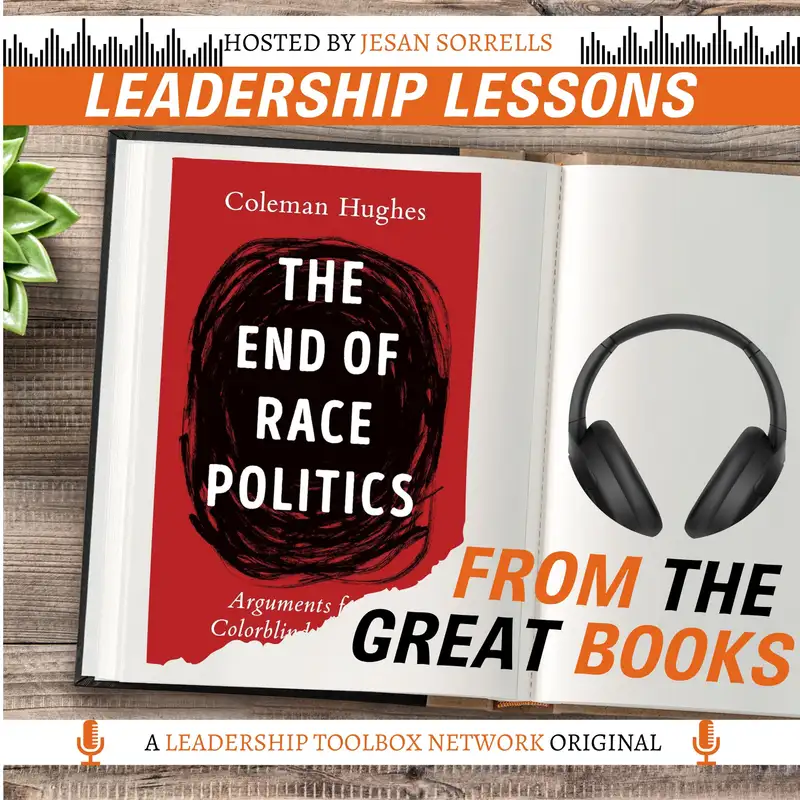
The End of Race Politics: Arguments for a Colorblind America by Coleman Hughes w/Dorollo Nixon & Jesan Sorrells
Hello, my name is Jesan Sorrells, and this
is the Leadership Lessons from the Great Books podcast,
episode number 179.
Now, traditionally, we would open up with a
quote from our book or an excerpt from our book, but because
our book that we are covering is so new, instead what
I'm going to do is I'm going to summarize the
introduction from this book, and then I'll give you the
author and the title along with some of my own
thoughts before we welcome our guests to the
show today. The book that I'm going— that we're
going to discuss, that we're going to break down, begins with an introduction
that begins with the title, Why Write About
Race? And in this
introduction, the author makes an assertion
talking about his background, his racial background, his
ethnic background, and how his ethnic and racial
background guided him in particular to a conference
when he was in his early teenage years, where an
ideology was espoused that was absorbed by
conference attendees And this ideology focused
around the victimhood, in his opinion anyway, of
race. He always thought
that his race was a neutral fact,
irrelevant to his deeper qualities as a human being.
As a matter of fact, he frames, uh, race
in general throughout the book as something that is not
necessarily intrinsically interesting. But may
present an ideological construct that other people
can pour their ideas, their thoughts, and their particular
unconstrained visions into. The
author then proceeds to go through his introduction and talk
about how he went to Columbia University. And at Columbia University,
he was asked during orientation week to
divide himself Well, the class was asked
to divide itself by race and discuss
how we either participated in or suffered from,
quote unquote, systemic oppression.
This huddling, this orientation act,
led to more confusion. And ultimately, during the
course of his work and the course of his studies as an undergrad at
Columbia University, led to him beginning down the
path that led him to rejecting
ideologies that he has talked about in the book that we
are covering today. And so
we are going to talk about, just in time for Black
History Month in America, today on the show,
The End of Race Politics: Arguments
for a Colorblind America. By
Coleman Hughes.
Now, when we think about race and when we think
about ideologies around race, there is no
area more ripe and more sharp for conflict and
disagreement. Matter of fact, I'm going to bring up a conversation that DiRollo and I
had a couple of years ago about Malcolm X, where
I raised some points that I think Coleman Hughes I
think Coleman Hughes's arguments represent the, uh, the
clearing at the end of the path on some of those arguments, and
they represent a new way forward into the 21st century.
Coleman offered up and opened up his introduction with this quote, and I love this.
This is going to be the anchoring quote for our— I think for our show
today. He said, I've always found race boring.
As do I, Coleman. But myself and my guests
today, we are also part of the tail end of a generation that
benefited from the efforts of folks who came before
us. And those acts, as
beneficial as they were, can sometimes act as an
anchor, at least in my life. I don't know about my guest's life, but
can sometimes act as a psychological sociological,
or even cultural anchor that prevent us from moving forward
in all the ways that the author of our book today, Mr.
Hughes, who is a generation younger than both of us,
has decided to completely cut himself off from
and reject. This
vision that is put forth by those
who insist that colorblindness is not a thing
is one of a relentlessly unsafe, illegal, and immoral
social order. And unfortunately, it allows people
with all the resentment and venom of classical racists to
chase clout in a way that would make David Duke himself
blush. I don't hate the
players though, and neither does my guest today. I
just want to know what the rules of the game are. And
Coleman does an excellent job in laying out what those rules are from the
perspective of somebody a generation younger. To
quote from one of my favorite movies, Tommy Lee Jones in the
opening of No Country for Old Men, I don't want to push
my ships forward and go out to meet something I don't understand.
A man would have to put his soul at hazard.
He'd have to say, Okay, I'll be
a part of your world. Close
quote. Today on the show, we're going to
explore the rules of the game. We're going to talk about how the rules of
the game were and what they were in the 20th century. And now
that we are now 26 years into the 21st
century, the rules of the game have to change,
even though the players playing the game
haven't yet caught up to the fact that the rules have
shifted. Leaders,
the rules of the game, the rules of the racial ideological
game are going to be different in the 21st century.
And now back for this season and to explore ideas of colorblindness
and its discontents, such as it were, is our co-host today,
fresh off of a trip to federal court
though not for the reasons that you would think. Good
friend of the show and my continuing guest both this month
and in July, Derulo Nixon
Jr., Esquire. How you doing today, Derulo?
How's it going? Excellent. Doing very well today, Hasan.
Thank you very much. All right. An analog man
in a digital world. amen. Um. You got it.
And there's all those vinyl people who can relate.
Axiomatically. The recording is better, it's more faithful to
the sound. We're more faithful to ourselves with or
without crazy tech. It has a
higher level of audio fidelity, I believe, is the term
for which you are looking. Um, but we are going to
travel into the dulcet sounds, the dulcet
commentary of Coleman Hughes. So before I jump into chapter
1 of this dynamic book, The End of
Race Politics: Arguments for a Colorblind America. Chapter
1 is called Race, Antiracism, and Neoracism. So
before I summarize that chapter, I kind of summarize the introduction, and I
opened up with Coleman Hughes's line, which opens up his
chapter, opens up his introduction, I'm sorry, to his book. And
I love this line. When I opened it up, I was like, oh, this is
the first thing. I've always found race boring.
What do you think of that? I kind of laid out some things that I
think, but what do you think of this, D'Rolo?
I think it's a great line.
Um, I don't find race boring,
I find race perplexing. And
so it's interesting because I wonder, okay, behind it, is
there going to be ennui? Why are you all not past this
thing? Why is this still a concern?
Whereas my approach and the
critique that my approach is based on just comes from a different direction.
Once you recognize, and this is getting slightly ahead of myself, but in my
opinion, once you recognize that biologically speaking, race
is a construct, meaning it doesn't exist biologically, it exists
sociologically, not biologically. To me, that's an important
point of divergence. Because once I know that at the end of
the day, like clothing, someone is putting it on you, and
you can take them off. Okay, so
race isn't reality, then? No, it's not biological reality.
Sociological reality, sure. But sociological
realities change. Sociologically—
sociological realities are always in flux.
Right. It's like the population of, say,
Detroit. Just track Detroit
from its founding as a fort, if I'm not mistaken,
by the French in the 17th century, if
I'm not mistaken. Just track its population from that point forward.
It's not— well, in the same city. Yeah. Different people, different city, different dynamic. Maybe
the same spirit. Don't know. Certain things will remain. I know that
better from New York City. Right. Where there's a commercial spirit
about New York City that comes from the Dutch and
remains there and drives how that particular part of
America works. But the
makeup of the city obviously has changed over centuries. Right. And so
what are the ties that bind, you know? But here in the context of dealing
with one of the most pernicious
ideas that exists. Right. And that Americans have to deal with.
It's interesting, his stance where it's like, oh, this is— I find this boring. Oh,
okay, right. Let's see where this goes. Well, and he finds it
boring specifically, as I sort of went through that introduction, um,
because of the nature of how he was raised, um, the ways
in which his parents positioned race for him or didn't or
chose not to, um, the way
some would say, uh, and I'm sure I'm going to get comments on this when
I clip this and put this, you know, on YouTube Shorts and everybody yells at
me, um, for being naive, But, um, but, um, the
ways in which he was educated through the
modern term of privilege, quote unquote, um, and then
having and being able to, uh, go be, be—
they would say be economically shielded from the conditions of race.
And I find all of those excuses, quite frankly, to be 20th century, uh,
shibboleths that don't really apply
when we're talking about Mr. Hughes, who's a 29-year-old
man, which means his formative years
all occurred after 9/11.
His formative education occurred in light
of— and we're going to talk about a lot of this today— the smartphone
revolution, um, post-Cold War America,
um, post, um
post— what's his name— post-LAPD
rioting America. Go ahead, say it again.
Rodney King. Yeah, post-Rodney King. Right, exactly. All of his
formative experiences occurred after all of that. It's a fundamentally different set
of assumptions he approaches race with, which to your point, are
sociological assumptions
that track to or then inform his
sociological understanding of race. What's interesting me
is that the people that he
is writing his ideological,
for lack of a better term, screed against, which is what this book
is, these people will not hear him because it
benefits them. And he's going to talk about this in his first chapter, first 3
chapters. It benefits them to basically shut their I ears. can.
Understand. Maybe because
I don't think it's boring. Or maybe,
and it may be similar with him, I don't know. I don't know the conversations.
I mean, I read that, you know, his mother died, and that he,
there was disruption in his life because of when she died when he was a
teenager. You know, I sympathize. And so I don't, I
don't know what conversations he has with his father,
with father and mother's siblings, right, grandparents
on these issues. I've had I have decades worth of experience
arguing on these issues with, you know, older Black
parentals, right? And parental types. And so I
did air quotes for y'all who are listening, older Black, quote,
parentals, close quote, you know, people like that, my folks' generation,
my— not so much with my grandparents.
And I mean, I knew one set only, really, but
knew them well, they knew me well. But
suffice to say, I've had decades worth— decades plural— worth of
conversations on, you know, these issues and how they affect things. And
just, you know, but yeah, but it's so— I find it
interesting because I think at bottom you can dig through— so not
our generation, the one before us— that you can dig through some of this. And
I don't think it's merely either they're
burying their heads in the sand because they want to preserve their narrative
without the interference of fact,
okay, or truth.
Um, nor is it merely, well, this has political utility,
this is political capital, which it obviously is. Um,
I'll put it in the most blunt fashion I can,
and, you know, somebody eventually will take me to
task for it. But why does the Reverend Al Sharpton matter
today? Right, because
he can trade on this notion. Now, does he have
a history of, you know, community advocacy going back decades? Yes, I recognize that.
But the point I'm trying to make is that his relevance to me is
not based on the effectiveness of his advocacy. It's because he
came from an era and in a movement where
There was a reality that they were fighting, right? They
fought successfully, right? The country moved on, but they
didn't. And
as I think inevitably, they were confronted with
truth. There's an eye towards, yeah, but here's my power base.
Yeah, but I got to keep them engaged. And what better
way than victimization to keep people
engaged? It's better than success,
because success, everybody scatters. They go all over the place, like,
engaged in whatever their pet projects are. When they believe
themselves to be perpetual victims— dash— caste—
dash— they can always be mobilized, always, to show
up, protest, show up, riot, show
up, whatever, right? And so, uh,
yeah, I, I don't find it boring. I find it, uh,
frustrating and perplexing. Um, and yet,
you know, that to me, there's another— there's another side, okay?
There's a biological side. I'll probably get into it more later,
but the biological side I find absolutely
fascinating. And it's just— it was never
presented that way when I was growing up, right? Right.
Ethnicity was never presented. Race was presented, period, you know,
and not ethnicity. Right.
Yeah. And there's a— I'm glad you brought up that
distinction with the difference between race and ethnicity.
I think we forget that. I think I know we forget that in our
overall cultural schema. But also, to
your point, The individuals who cross
that thin line from being, as you framed it for Mr.
Sharpton, uh, community advocates,
uh, and then they cross that thin line into what I
have termed on this show in past episodes, and we've talked about
Al Sharpton or even in private conversations we've had, and I'm going to go ahead
and go public with this, um, you know, I look
at someone like that as a grifter and a race hustler.
I think that crossing that thin line—
there's a thin line, as Bubs would say on The Wire, between heaven and here,
right? And it is—
it's that thin line. And it's the crossing of that line, I think,
that Coleman's generation
saw in multiple ways or was protected from,
and now has no cultural It
has no cultural glue on, on him. And by the way,
Coleman's 29. Oh, sorry, go ahead. He's, you know, there's
no common frame of reference and there's no experiential
common frame of reference either. Right. And you and
I, and you and I both have sons who are under the age of 10.
I think that those sons are going to have even less of a common
reference than even Coleman does. And that gets
to something else that we're going to talk about today, which is
We brought up in the episode on Malcolm X, what are Americans going to—
what about Americans? What do Black Americans do when they've actually
won legally all of the things they asked for?
The deeper question, of course, is what are you going to do when
you've won, let's say, 60 to 80%
of all of these sociological and cultural things you've asked for?
What do you do? This is the compelling question that my
challenge to all those neo— the neo-racists and the anti-racists
out there. Here's my challenge to you, just like I would put the
challenge to Malcolm X and the revolutionaries, uh,
two generations back. What are you
going to build with your win?
And if you don't have a vision constrained or
otherwise, as Thomas Sowell might frame it,
then I don't know what to do with you.
We can't unite in common cause if you don't have a
vision. And that is where I
have a problem. I have a problem with there being a
lack of vision. And I think that Hughes's book, what attracted me to
Hughes's book was ultimately the other day, in Chapter 6, which we'll talk
about this towards the end of our podcast today, he frames
the beginning of a vision. And that's
amazing. That's what we need today.
So speaking of Hughes's book, let's jump right in. So in Chapter 1
of The End of Race Politics: Arguments for a Colorblind
America, Hughes makes a few points here,
and I want to summarize these. Again, we're not reading directly from the book. I
encourage you to go pick it up.. It is on Amazon. This book was
published in 2024, so it
is only a couple of years old. Actually, if you're
interested, you can go Google or go look on YouTube where
all these things happen. Coleman Hughes's discussion
on the View of this book where Whoopi Goldberg, who's 3
generations— no, 2 generations older than him, 3 generations older than
him, actually. No, I was right the first time. And Sunny Hostin, who
is what some of us would call in the Black community—
well, she's not fully Black. Let's just frame it that way
if we're going to frame it in terms of drops of
Negro blood, which, by the way, he does get into this in the book.
Both Sonny Hostin and Whoopi Goldberg, I believe, in the clip when he went on
The View upon the publication of this book, tried to jump on
him about colorblindness. And he
roundly trounced them because he's a podcaster. And so he's used
to having arguments with people in real time, rather than
having a studio audience and someone there to yell cut and
reset. Anyway, go search that, go search that clip out if you,
if you want. My man Coleman lit some
people up. So Um,
in Chapter 1 of this book, he talks about race, anti-racism, and neoracism. And,
um, he talks about— to, to Derulo's point, he begins with the conversation
about his mother. Um, and he says, for most of my
life, I saw my mother as neither Black nor white. Her
Puerto Rican father was darker skinned than me, and her Puerto Rican mother was as
light-skinned as any white American I knew. Nor did I view her as
quote-unquote Hispanic, a word she hated due to its association with Spanish
conquest, or even Latina, though she would have
certainly checked that box on a census. This is where we
start the opening with an acknowledgment of where he came from. Then
we go into a conversation about what is race. And
he defines the word race, including the concept of race, the
arbitrariness of race, which is where we get into the one-drop
rule. Why not one-eighth? Why not one-fourth? Why not
one-half? Why not one-sixteenth? He
also goes into the racial categories of other, to
Darello's point earlier, ethnos or ethnic groups in the United States,
including Asians and Hispanics, for whom we do not
nearly get as verklempt as we do for folks who have more
melanin in their skin.
And he positions an idea, and
it is an idea in the introduction that drives the rest of his
narrative. He positions this idea by saying
that we often use race as a proxy for other things we
care about. For example, when lawmakers discuss policies
aimed at helping the disadvantaged, they'll use race as a proxy for
disadvantage. They use those expressions like Blacks and
Hispanics and other disadvantaged groups to refer to people their
policies are aimed at helping. But whether we are talking about current
disadvantages, what is sometimes called— as I used the word
previously, privilege— or historical disadvantages, racial identity
is a bad proxy. And then he makes the argument that
I've been making at least since 2004
against all of this nonsense, that it's really hard.
I'm going to paraphrase his argument. It's really hard to convince poor white people
that they have privilege. That doesn't work.
And by the way, by the way,
our good friend and former President Barack Obama
knew that it didn't work. And so in his reelection in
2011, 2012, he told the entire Democratic
Party, and I quote, you can go find this on the internet, we are
going to abandon the white working class male
vote. We don't need it. And from
2012 to now, And I anticipate the
next couple of election cycles, the Democratic Party,
which is the container of disadvantaged folks,
uh, will continue to have trouble
bringing its folks together.
Finally, the end of the chapter, he talks about anti-racism
and he talks about again, Martin Luther King's I Have
a Dream speech. He talks about the colorblind principle and
defines what that is. And by the way, the colorblind
principle, he defines it. He says, um, we should treat
people without regard to race, both in our
public policy and in our private lives.
That's how Coleman Hughes defines colorblindness. No matter how
you may define colorblindness or how society may define
colorblindness. He's positioning colorblindness as a different
way of engaging, a different rule in the game for the 21st
century. He makes a couple of other points in the
introduction, and then I'll let DiRollo go. He makes a couple of other points in
the introduction. He says that the ideas of the purported anti-racists in our culture
don't pass the quote-unquote smell test.
They are clearly proxies for something else. He says the
arbitrariness of race as a construct, biological, social,
economic, or otherwise, acts as a cover to smother in other
ideas that are at the bottom. And this is what I believe,
part of an unconstrained vision of society, the same kind
of unconstrained vision that keeps returning to popularity from Rousseau
to Marx to Pol Pot to even your friend and mine,
uh, the Joker, Patrick Bateman, also known as Gavin Newsom.
The last white man in the Democratic Party with any
power. And no, Tom Steyer, you don't count.
I don't care if you're a billionaire, it doesn't matter. American society, of
course, is the only one on earth that has even
come close to achieving the human task of erasing ethnic divisions.
And it didn't get close by expanding the franchise without
demanding that each person to whom you're— each group to
whom the franchise is expanded accepts some constraints on
reality. And colorblindness is one of those constraints
that I think we are going to have to accept moving forward in the 21st
century. It is a simple request from Coleman
Hughes, but I do not think it is easy.
So to roll up, Hughes defines colorblindness, as I already
said, as the principle that we should treat people without regard to race, both in
public policy and in our private lives. Here's the core question,
and I'll let you go. Can we get there
from here? Let me— it's not even a pivot or
a dodge, it's a feint, right? And then I can counter,
should we get there? Okay, um,
publicly speaking, I have no problem with that.
I believe that's what our laws have called for since the
19th century, since the 13th, 14th, and
15th Amendments, right? And so those have been on the
books for 150 years. Wonderful.
So the country, meaning the government, is supposed to— and that's a
dangerous— I think it's called a solipsism, so I apologize. The
government is supposed to do that already. The government is supposed to treat American citizens
without regard to race, ethnicity,
biological sex, whatever, blah, blah, blah. And
most of the time does, right? Did not most of the time
150 years ago, but most of the time does now. Great. That's wonderful.
To me, that is akin to my assertion that the US government
to the citizenry should only speak English. Okay. It
is meant in part to be unifying.
It is a reflection also of our historic— the
historic roots of the United States. In an
English colonial experience along the eastern seaboard and
not any of the other colonial experiences that were going on as a
route. They went on. Yes. Do they have— are there
populations who are part of the United States today
that had their rebirth of freedom in the Western world
from these others? No, had their rebirth, but it wasn't in freedom
because that wasn't happening, which is one of the reasons why they're part of the
U.S. today and I believe and advocate are better in the U.S.
today than they would have would have been if they were still part of— pick
another country that either exists today or doesn't exist
anymore but was over there. So, um, to me,
they're, they're the same. Okay, you speak this language
and we don't care what you look like. Here are the rights you have
and we will enforce them. Wonderful. It's with regard to
private conduct where I have a sticking point,
and I say, well, wait a minute, wait a minute, wait a minute, wait
Remember, I can look through— so assume
race is, um,
the artificial food coloring you put in a glass of water.
So when we're colorblind, we're looking through
the water in the glass at something else, right? And to me, there's something else,
there's something else that's good, is ethnicity. And so,
um, I revel in ethnic distinctions, just like I revel
in linguistic distinctions, you know, and I
enjoy just subtle nuances
in terms of what otherwise
might just be slight skin
shade or hue differences, how wide your nose
is, how this, whatever. But just
is part of something bigger that is beautiful
and that enriches life. And so, you know,
I think it's easier to understand with examples. So let's start with today and
work backwards. So today I went to one of my favorite coffee places in
Arizona, okay? Press Coffee. They're an amazing local
roastery. They have, I think, 29 locations. No, they're not paying
me to say this. They don't have plans to expand outside of
Arizona, which I think is a shame because their product is wonderful. Okay, um,
and I'm there and it's the same baristas I
see almost every day that I go, uh, and they're wonderful.
Um, and, uh, I'm waiting for my morning
coffee drink that I get, and then there's this man there and he's
in a conversation with two other people. Um, this man is
white. One of the two other people is an East India Indian
woman. Okay, I live in Arizona, so if you say an Indian woman, it
actually here, unlike everywhere except Alaska and perhaps
Hawaii, actually has— it has like real—
the likelihood of you meeting an indigenous person is much higher. And so I'm
stressing that, you know, she and certainly her— she
maybe, but her folks 100% are from the subcontinent. Okay.
Anyway, so we— and then I don't even remember the third person. He was male.
I can't remember what he was. But what I'm trying to emphasize is this man
is here and they're having this conversation while getting their
coffee. And I watched this man's behavior with the coffee.
Thank you. I'm going to go back and
keep podcasting. So I watched this man's behavior with the
coffee, okay? And he was the only man in the
joint who knew how to drink coffee. He got an espresso. He
stood the whole time and drank it, set it back down in the saucer and
walked out. I literally— I chased this man down and I thanked him for
knowing how to drink coffee. And what did I do? I asked him where he
was from. Lo and behold, where is this man from?
Italia, where espresso was
invented. So he knew how to drink it. That's an ethnic
distinction with meaning. It led to a certain
behavior and even just as an observer
enriched my life. Mm-hmm. Next example.
I was in Houston, Texas over the last couple of days.
Houston, which is a swamp, is one of the most
diverse places I've ever been in my life. It didn't
matter where I went. It was diverse.
What does diverse mean? Usually diverse means, oh, there's actually Black people
here. Then sometimes diverse means there's actually
Black people here who aren't only in subservient roles. That's another
connotation of diverse. That's not what I mean, okay? Let's go
back to my coffee line this morning because then I'm going to show you what
diverse really means, okay? What I see there are two Latinos
and everybody else is white. They're male and female. Oh, is
that diverse? No idea. Let me show you what it would, would have
been like in Houston, okay? You have these Latinos
Latinos, excuse me. Every third person is Black, okay?
And there's like 3 Asians, different types of Asians,
okay? And then the remaining people are white. So you look at 10 people and
you're like, wow, um, there's no
way to categorize these people other than biological sex,
and more than 4 of you can fall in one category. Literally like that.
And it was stunning to see. Okay, and it was
obviously very pleasant, stunning to see. Here's the example I bring up. I'm flying
back and the man next to me, um, in
his athletic gear with his
construction helmet, okay, uh, to me look
white, not white as Wonder Bread, but white, okay, has a
beard, okay, fine, large like he works construction, okay, fine. And
so we start talking. You know that man used to
coach basketball in the inner city. The inner city—
what does that connotation mean? It means Black people, poor and
dangerous. That's what it means. That's where this man used to coach.
Oh, that's where this man's father still
coaches championship teams. And he shows me a YouTube
clip with the news thing about his dad, and they're interviewing
his 6-foot-8 dad talking about,
you know, just stuff. Now, what does it have to do with race and ethnicity?
Well, this guy is Cuban. Oh, okay. So we
start talking. This guy, he's a Cuban American. His father is a
Cuban American. Now, his father, unlike the son, looks about as
white as Wonder Bread and he's 6'8". Okay. Anyway,
but Cuban American. So now we have— oh, there's this—
I'm going to resist a trope. That has to do with food. But
basically, there is this positive cultural element that
is unique to them that I now then get to engage
with. And it was coming back the other way because we could talk
about— and it talked about growing up, college, different experiences.
We talked about racism. It was great. Okay.
Very good convo. Okay. And remember, I'm flying out of the Deep South, right,
on the way back to the arid mountains, southwest
deserts where I live. Um, next example: I'm
at a bar the night before,
okay, in Houston, okay? Uh, El
Tiempo Cantina, that's what it's called, okay? Uh, and don't worry,
I'm going to speak in English. There you go. Okay, thank you, thank you, thank
you. I'm at the bar, okay? And
there's this Black woman on one side, and there's this white man
on the other. And I talked to both, and
I had deep conversations with both, okay?
And we could talk about different
things, right? Well, obviously we could talk about the same experience.
We could talk about different things also. And so, um, I
happen to have— because it's me, and I know you will relate— I
brought a book to dinner. By myself on a business trip. I brought a book
to dinner. The book is sitting on the bar. The book was about
freedom colonies. I didn't know what that was. A
freedom colony was an unincorporated Black town
based on agriculture in the Jim Crow South that was
entirely self-supporting, like
Amish. And I study them. And like Mormons. And I
study them. Okay. They were independent Black communities who basically said,
y'all are doing whatever. We're just going to be here, own land,
produce what we need, be independent from y'all, no government
support, and we're good. All 5 fingers, we're good.
Thumbs up. There were hundreds of
them. This book was about them and specifically in the context of
Texas. Fascinating book. Well, this white man sitting next to me,
he named one of the colonies. He's young, he's not even 35. Names
one of the colonies, and we start talking about this stuff. And
it was fascinating because, I mean,
if you had asked me before I talked to him, do you think this man
is going to have any idea about this? Frankly, I would have said no.
I mean, I didn't know. My father happened to grow up
in a community like that, kind of like that in North Carolina.
So why would I expect this man to know?
Well, Here's one of the dangers that comes along with this
whole notion of race and what it's supposed to mean.
We're supposed to assume he's white, therefore ignorant, therefore doesn't
know about any of this stuff. This is a man from the South.
He knew what this was. He's not even 35. He knew what this was. And
we're talking about it. Great combo. Talking about other things,
talking about Southern culture, talking about
How racism is experienced differently in the South,
differently experienced differently by Blacks in the South versus by
Blacks in the North. We talked about this at a bar at dinner two nights
ago. It's great. Okay, great. That's my kind of combo like this. I love
that kind of stuff. Okay. Meanwhile, woman sitting on my
right to whom I spoke to twice as long and spoke to first.
Okay. She runs a medical
practice in like two hospitals that are there. Okay, we had a great
convo talking about all the stuff, talking about family, talking
about these little like cultural things. That was
a shared experience of a shared ethnicity,
and that was happening with she and I and not happening with this dude. Okay,
um, and I, I found
it, you know, very enriching, very meaningful. And so back to what
Mr. Hughes said, The sticking point for me
is in our personal lives, right? Because I
don't believe that a
private citizen needs to approach his or her
relationships with, as it were, glasses that
render him or her colorblind. Okay?
And certainly if it's colorblind and values-neutral, like, no.
Colorblindness itself is a value. That's one thing. But to me, it's still like water
in a glass. It's, it's, it's a
transparency that allows you to see the content of the
character because that should be the driver. Okay. If
I want to hang out with you and is— this it's weird because this is
1A and 1B. If I want to hang out with you, here's the character I
want and I'm not connecting with you because
of how you look. I do happen to be connecting with you in
one of several languages I speak, and that's relevant always. Okay, if I
can't talk to you, it's really hard to hang out. But I can talk to
you, the rest of the distinctions don't really matter. Okay, at
the same time, that's 1A. And so at the same time,
there's 1B. There can be specific engagement with
specific people because of these distinctives, and
that in and of itself can be meaningful. Okay, I'm
gonna tell a funny one. When we got here to Arizona, okay, so
as Hasan knows, right, we used to live in the top end of Appalachia, right?
Uh, you can use two words, sometimes inflammatory, to describe the
culture surrounding us: redneck. Okay,
now I love those guys. These guys are great. Women are great. Okay, um,
we were able to
engage with and enjoy and see some of the
cultural patterns that happen among people
who, um, certainly self-identify that way, uh,
and, uh, other people would throw them in that box. But there's a lot of
self-identification with that label that works, that I find to be legitimate, you
know. Anyway, so we come here and we meet this couple.
Our kids go to preschool together, okay? They got a bunch of kids, we have
a bunch of kids, okay, fine. Well, they invited us to a party for some
of their kids, okay? This is during COVID but this is Arizona, so
nobody's masked. We're there loving it, okay? Love being free.
One of the reasons we moved during COVID out of
oppressed New York State. Anyway, so we're at this party,
and dude, I've
never seen some of these things, and I
attributed to that culture in a good way,
okay? I literally— we go and,
you know, your normal party interaction, whatever, nothing
untoward. And then they have this slingshot,
okay? I'm not even making this up. I can see it right now. They had
a slingshot, um, and the, the bucket part of the slingshot,
uh, is large enough to fit a kid in, okay?
They were launching kids. Oh
well, yeah, we're catching the kids and
this was totally normal to them. And they were like— and I was just
like, wow, this is amazing, you know. I was
stoked that they were doing that, that they were comfortable doing that.
Now I didn't want to do that and my kids didn't want to do that,
you know. I asked Ro, he's like, I ain't doing that. Yep, that's okay, they're
free to do that. I don't want to get in their way. This is how
they want to have fun. Awesome. It was a highly enjoyable party.
Okay. But I remembered that. I remember saying that I love this.
I love that they will do this, you know.
And so I don't want to
cast a vision for an America where people in
their personal lives are literally trying to avoid or
downplay these distinctions that help make us who we are,
these distinctions that help make our groups who our
groups are, distinct from other groups.
And I don't believe it's necessary with all those
distinctives to— I still think even with all those
distinctives, a unifying vision of what America is can still be cast.
There's some tension.
It's not oppositional. It's not even
friction. It's just like a counterweight. Right?
So there are those who would argue— and this is why I let you go
on this for a little bit, because I wanted to get the whole thing out
there. Um, thank you. What you're talking— you're welcome.
What you're talking about is freedom of association as
guaranteed to us by the United States Constitution.
And freedom of association at a, at a, at a
legislative level, there are those who would push back on you
has been abrogated by the presence of, to your
point, um, the 14th Amendment, and then following on from that,
um, the Civil Rights Acts, uh, both in the 1960s and the
1970s. And freedom of association has been
abrogated by the Common Law Act of Title IX.
And then all of these acts— and even Hughes argues this in
parts of his book— all of these acts
these legislative acts erode
the ability, uh.
For. What you are describing to happen in
a culture, particularly when corporations,
particularly large corporations, get involved in—
like they did post-BLM, post-2020—
get involved in cultural shaming. And seeking to
culturally norm people. Case in point,
I'm maybe at a football party, right? Not the Super
Bowl, let's just say a football party, right? I'm at a football party with a
variety of friends that I have freely associated with,
and in the end zone of the product that I'm consuming
is a sign that says, "End racism."
Who exactly is that targeted towards? Now, the
answer to that question, we know. We know precisely
who that is targeted towards. It is targeted to the aforementioned
rednecks with the children in the bucket who were catching them at the birthday party
that you went to. That's who it's targeted towards. The
message is also targeted towards, to your point about victimhood in
an earlier segment, it is targeted as a method of
making me feel good that something is happening about racism from this massive corporation.
And actually it's a nonprofit, folks, known as the NFL, right?
And while I think most people,
to their credit, the people who make $30,000 to
$50,000 a year in this country and are the vast majority of people,
I think most people ignore
all of that and they just go and live their lives. It, it glides
right past them. But where it shows
up, and I think this is where Coleman is getting to, and I think he's
got something here that we have to acknowledge. Where it
impacts them in their private lives is
when they go out in private association with these
corporations via their money. And now these corporations aren't
holding up their end of the deal and are lecturing to them about what they
need to think about or how they need to behave or who they need to
associate with in their private lives. I don't need a
lecture from LeBron James about race. I need LeBron James
to shut up and dribble, shoot the
rock, work on that, LeBron. I don't want to hear
about what you can think about race until you can go to
China and talk about race when you're putting on an
exhibition or talk about the communist government in China. And you would never
dare to do that in China. If you were putting on an exhibition in Saudi
Arabia, you would never dare to speak out against Islam.
Because in those societies and cultures, they don't have, yes,
freedom of speech and you know it, but also there's
a venality of greed underneath this. We're about where the
funding for a lot of these places is coming from. And
that venality combined with the corporate
messaging is what I believe Coleman and his entire
generation are perceiving. Because to your point about fragmentation earlier,
they don't see the differentiations
in mass organizations and institutions. They just put
the government and Walmart and the NBA and LeBron
and you and me at a certain class level and education level all in one
bucket. And they just say, this is the thing. Don't lecture me.
And I think that's part of the new rules of the 21st century.
And I think when people are talking about— when he's talking about public policy and
in our private lives, I also hooked on the private lives part for
exactly the reasons you hooked onto it at first. And
then I thought, I think he's getting at something deeper here. I
think he's getting at the knock-on effects of the Civil Rights Act. I think
he's getting at the knock-on effects of, um, Title
IX. I think he's getting at the knock-on effects of the 14th Amendment
around this area of free association. Because if we got rid of the
Civil Rights Act, Tomorrow,
it isn't as if these corporations are going to go and somehow hire a bunch
of white men. That's not going to happen. They're going to continue
to claim in their policies that they
do not discriminate against anyone. As a matter of fact, they're
going to double down on specifically
picking diversity hires,
and they are going to label those folks that they hire as diversity hires. And
then they're going to put them in the cubicle next to me. And that impacts
my private association with that person because my private association at a certain—
my association at a certain point stops being public
when I have to do work that the private organization is paying
me to do. So that's the only pushback I would put there. And I think
Coleman would agree with that. And I think most of the folks that are under
the under 30s, hell, I'll go into the under 35s,
see this nuance, but I don't know that they know how to describe it. They
don't know how to they don't know how to articulate what they're seeing. Yeah, it's,
it's, it's fascinating because
the public-private distinction is a good
benchmark for measuring
just what we're trying to achieve, right? And I just don't think it— I
don't even think the goals are the same. Yeah. Nor
that they need to be, you know, Like, right.
I forget how. Yeah, people have
said to me, and well-meaning people and people who meant what
they said, and where I will attest to their integrity
in trying to do or in doing what they said, I'm
colorblind. I don't— they say I'm colorblind. I don't see race. Okay.
Okay. Do you see ethnicity? Okay,
do you see that this person is Chinese and this person is
Indian, East India Indian? Or do
you just see two people? I don't see two people. I see people,
see their origins. I mean, I'll give you another example from Houston. I'm on
the bus. I took the public bus in Houston
and I only had to give— I only had to give $5. I only had
to give $5. Okay. One person panicked.
I only had to give $5. Okay, the bus driver
is a brown-skinned man with a long beard,
mostly white, some gray, a little bit of some darker color,
but it's basically dark gray, light gray, and white. Okay, no mustache,
and his hair, I mean, it's probably a few
inches long. Okay, balding. And so I look at him and
it's like, okay, obviously he's Muslim with the no mustache. All right,
so he's probably from Pakistan or Bangladesh. And And I looked at
him and I said, okay, he's a little light, so I guessed Pakistan. So I
said to him, apropos of nothing, I looked at him and I said, hi sir,
Rawalpindi? And he says, no, I'm from
Bangladesh. And I'm like, that was my next guess, Dhaka. And he said,
you know, it was the same country before 1971. In other words, when he was
born, it was the same country, so I was right. Now
I can see this man's origins, you know, it's, it's like, it's beautiful, it's like
a gift. But to me, that's part of— there's meaning in that, and
there's part of the exchange. And so this man now
understands that I understand where he's coming
from, you know, and that means something. Our
engagement is enriched by that, you know. And so, um,
pardon me a second, text message telling.
Me Zoom. Okay, go ahead. Yeah. Um.
Okay, so, so we're, we're in this spot, right? And
I agree, like, there's, there's some things we have to wrestle with in this
idea, this term colorblindness. And Coleman
describes in the second chapter of The End of Race Politics:
Arguments for a Colorblind America, um, the real history of
colorblindness. And so he does the deep dive into the 14th Amendment,
He covers about— he covers Plessy v. Ferguson
and how that led into the civil rights movement.
He also talks about, particularly in Plessy v. Ferguson,
he mentions the lone dissenting opinion being written by
Justice John Marshall Harlan. It contains what is probably the most famous
reference to colorblindness in American law. And DiRollo will know this as a
lawyer. Quote, Our Constitution is
colorblind. And by the way, this was in 1896.
1896. Our Constitution is colorblind
and neither knows nor tolerates classes among
citizens. In respect of civil rights,
all citizens are equal before the law. The
humblest is the peer of the most powerful.
Close quote. Now,
the— he does talk about how Harlan's arguments did not carry
the day. We had separate but equal provisions, which of course then led to
the civil rights movement. It led to the creation of the
NAACP by W.E.B. Du Bois. By the way, we've talked about that on this
podcast before. You should go back and listen to our episode on the
Souls of Black Folk, as well as Up from
Slavery, where I made the assertion that
Black culture and Black people in America have long
divided along two different tracks. The
W.E.B. Du Bois track, of which Ibram X. Kendi and
Ta-Nehisi Coates, and probably a little bit of Coleman Hughes,
although I'm going to give him some more grace on this, are on one track.
And the other track features Booker T. Washington,
which was a track that was first laid by Frederick
Douglass. And so from Frederick Douglass, you go into Booker T. Washington, and from
Booker T. Washington, you get to guys
like, well, like, quite frankly, like me and DeRolo, who have to
work for a living. And that
fundamental distinction of class, of having to work for a living
rather than making money off of ideas, or off
of grifting off of ideas, or hustling ideas,
is something that creates a profound
split in Black America, or did create a profound split in
Black American culture in the 20th century.
And I think that split is going to be resolved, or is in the process
of being resolved, very quietly and underground in the
21st century. And Coleman Hughes is, um, is
on board with that. Then he finally talks about in the chapter
closes out with this idea of
reverse racism and how the advocates
of this, of the idea that
colorblindness was, quote, a cynical invention of white conservatives,
close quote, or a Trojan horse for white supremacy,
close quote. He makes the point, Hughes does, that
they are using these efforts to tarnish colorblindness as
invalid. And as a matter of fact, he says that
appeals to common humanity that came through folks like
civil rights leaders like Martin Luther King Jr. and
Bayard Rustin at the moment when
civil rights were achieved were immediately abandoned
by the same folks who had previously championed those
ideas. By the way, he quotes
from Dr. King several quotes. He closes out this
chapter several things from Dr. Several quotes from Dr. King,
including, um, in an effort to achieve freedom in
America— in an effort to achieve freedom in America, Asia, and Africa,
we must not try to leap from a position of disadvantage to one of advantage,
thus subverting justice. We must seek democracy and not,
not the substitution of one tyranny for another. Our aim must never be to defeat
or humiliate the white man. We must not become victimized with a
philosophy of Black supremacy. Or this
quote, also from Dr. King, properly speaking,
and I like this one for a whole series of reasons,
properly speaking, races do not marry, individuals
marry. And another quote from Dr. King,
as I stand here out here and look upon the thousands of Negro faces and
the thousands of white faces intermingled like the waters of a river, I
see only one face. The Face of the Future.
Hughes, of course, points out that the neo-racists
would ride on the coattails of Dr. King and Malcolm X
and Eldridge Cleaver without actually reading the quotes
or pursuing the, uh, the dream that those
quotes lay out. Now look,
I think the reason we can't have nice things in this country is because we
can't actually get our arms around colorblindness in the way— in the, in the
nuanced way that DiRollo even described it in examples
from his travels in Houston and from his
going to the coffee shop in Phoenix and from even being on
the bus, which, by the way, many of you don't realize
this, being on the bus is a sign that Mr. Nixon
has decided to walk among the proletariat,
at least for a moment. I got on this bus
and, man, it's, it's weird. It's just It's like
it, it, you have to know your city because you can get
on buses in cities and it's a normal
transactional transportation experience. And then there's the
reality that is most of the country, which is if you were on a bus,
you got a problem. And so there
I was on the bus. Hey, you know, I could have Ubered, but
it's me. So I didn't want to. I took that
bus once.
And I got back via Uber.
Let not your class privilege show. So the
question becomes, according to
Hughes, and this is the tee-up question for going into our
next session here, according to Hughes,
Scholars of the civil rights movement have dismissed the idea of colorblindness
as a quote-unquote "trojan horse for white supremacy." Why
would such people do this? Why? If you
look at how they frame the notion, fear is
pregnant in, in the expression. Okay. And so
it seems to me a fear-based response. Right.
And the fear, I think, operates in two directions. It's
a fear that this oppression that we were dealing with
eons ago, or we were actually dealing with eons ago,
would return unless the
fusion of Blackhood and victimization
stays together. And, you know,
that itself is a contentious notion. And I believe that
that itself is a lie. And so
they don't see it that way. They see it as reality, but it
is fundamental to their reality. They must continue to have, um,
not just a framework for Blacks being
victims and white people being oppressors, but everybody else has to have that framework too.
And so it's a threat— fear— threat
to their worldview, to their power structure, to their political
base, to you name it. To their identity,
right? This notion that, hey, now you are free.
You know what's really fascinating? Really
fascinating and deep. Um, if you read the
Torah, which I know you do, you can see
that God built in time during
the Exodus, meaning post-Egypt, post-Red Sea,
he built in time for
the people, the children of Israel, the sons of Israel, to learn to be free.
He built in time for that, recognizing that
you have social and personal and other patterns that are coming out of
slavery, and you have to learn new ways of thinking and doing. And
it's necessary before you can enter into and conquer Canaan.
It's really fascinating because it's just like,
um, I don't know if I would pick up on that if I weren't African-American.
I don't know. You know, but I pick up on it. I'm like, oh, that's
interesting because I'm one of those people. I'm tired of hearing people talk
about— I'm tired of hearing African Americans talk about slavery. I'm tired of hearing it.
And I mean, I was last talking about slavery yesterday.
Okay. I'm tired of hearing African American people talk about slavery. The conversations
I had about slavery yesterday and the day before were fascinating. But most of the
conversations that I
overhear people engaging in are Um,
what, what did Hugh say? Boring, misleading.
Okay, rather than referencing
a reality and then making a point today
that has— where there's a, a relevant tie,
a relevant connection. Okay, because normally I just see
it as something identitarian that I reject, where somebody is
saying, oh, well, when— like the expression, well,
quote, 'When we were slaves,' and it's like, close
quote, and it's like, you were never a slave. You were never— your father
wasn't a. Slave, his father wasn't a slave, his father wasn't a slave. The next
guy may have been, but none of all those other people were. Moreover, if that
other guy, if he got freed, that means he didn't end
as a slave. No, right? And it's
just— well, there's also this massive idea of
generational trauma which I also push back on.
Hughes kind of touches a little bit on— he
glides along the edges of this, but he's young.
Yeah. And with other folks who are a little bit older, who, who are sort
of more familiar with the science of
epigenetics, you know, they'll say, oh, well, there's racial trauma, blah, blah, blah,
blah, blah, there is the genetics. And.
To your point about the Book of Exodus, how many, uh,
generations had to die in the wilderness
before the Jewish people could go into
the Promised Land? How many generations had to go?
One. The, the one that came out and then rejected,
you know, God offering them the Promised Land on a
platter, you know. And effectively, it wasn't on a platter.
But it was on a platter. It wasn't on a platter because they had to
fight all these people. It was on a platter because God was with them and
he said, I'm going to give you victory. Okay, absolutely. You have to play
basketball against LeBron, but I'm going to give you victory. Okay, let's play
right now. Let's play right now. Let's play right now. Let's record it
because this is gonna be great. I haven't dunked in how many
years? In like 15 years I haven't dunked because now I'm old, my knees don't
work. I'm gonna dunk on LeBron. This is gonna be great. And instead, no,
no, no, they're going to step all over us. We're like grasshoppers
in theirs. How do you know? Wait, wait, what?
So this is, so this is, so this is where, this is where I go.
And I wanted to ask you a question about genealogy because you kind of touched
on this a little bit earlier. And I don't think most of us here know
about your deep love of genealogy and all of that. Love this stuff. You
have a— now I'm going to draw, I'm going to draw a line right between
myself and DiRollo here because there's a line of differentiation on with us,
between us on this. DeRolo is absolutely
100% fascinated by genealogy. He's
fascinated by tracing, you know, where his
folks come from and, and where his folks, all parts of his
family came from and where they do, what do they do and how do they
integrate. Matter of fact, I was just walking down the street today and I saw
a plaque on the side of a building in the town that I'm in
that said that where the, the person who put the put the building
up was a lawyer and the lawyer's last name was Nixon.
And I thought, knowing that we were going to have this conversation today, was I
like, I wonder if DeRolo knows who that person is.
And I bet you DeRolo knows
somehow, could figure out if I gave the name, and I'm not going to do
that right now, but could trace the name because that's how deep he is. And
he's laughing now, but he's true that this is how deeply, truly he's into genealogy.
He is reaching out to people in other countries who have never met him before
saying, hey, you're my 243rd cousin. What are you doing there? Okay, this is the
kind of guy that DeRolo is. I want to draw a very clear,
like, frame for folks here, right? Yep. But seventh—
but yes, seventh cousin. Yes, seventh cousin. Okay. All right. And by the way,
I've met, I've met a couple of, of DeRolo's cousins. I've also met some other
folks in, in DeRolo's family and his cousins. They were first cousins.
First cousins. And there's, there's a difference between a first cousin and seventh
cousin. Is there ever? Yes. Yep. But such is it. Work
anyway. Now that's the role of full disclosure.
I fundamentally, at this point in my life,
lack an interest in genealogy because I got enough
problems right now. And none of those folks are helping me solve any of these
problems right now. Matter of fact, all of them are dead and they
can't help me. They don't speak into my current existence.
A, because they're not here, but also B, I don't engage in ancestor worship, and
C— and I'm not saying that DeRollo does either, I'm not framing that in that
kind of way, I want to be very clear on that, I'm not casting aspersions
on DeRollo's love of genealogy. Um, but the third reason is
the people in my family who have explored genealogy
have done so because their identity
was not— and this is going to sound
proud, and I really I don't want it to come off that way, but that's
what this is going to sound like. Their identity was not as solid
as my identity is in where I place my
identity, which is in, by the way, the power and salvation of Jesus
Christ. If I put my identity there,
that's the rock on which I build. That's the cornerstone. That's,
that's the thing all the way down at the bottom. And so anyone
who comes along can never take away
that identity from me. But
increasingly, in a world of biological manipulation, class
struggle, algorithmic manipulation,
uh, economic strife, even the things I went through in COVID,
those other things can be taken away from me, up to and including
the markers of identity that this society claims
are important. And frames somewhat through this,
the study of genealogy. And I'm not saying, again, want I to be very clear,
DeRollo's not doing this. This is what I see on my end. And so I
refuse to play the game. That's my
conclusion. Now, in 20 years,
maybe I won't refuse. Maybe in 20 years I'll have a change of heart
and then I will go seek out DeRollo because I have a resource here and
he will tell me what to do and he will tell me how to go
do the deep dive and then I will go find the things.
I'm saying all that to frame this question for you. As
a purveyor of genealogy, I have now set you up as the expert on
this show of how to do this. As a, as a
purveyor of genealogy—
yeah, you and Henry Louis Gates Jr. Yeah,
yeah, exactly. And he's going to come along, he's going to open up like, you
know, an envelope for me. He's gonna be like, do you know that your relatives
were like slaveholders of some other slaves? I mean, like, yeah, that doesn't really surprise
me actually. Uh, we're fetal capitalists. That would not shock me. This is
America. This is America, man. Yeah, it wasn't a
monolith. It wasn't a monolith. And most of the time it
was small, and most of the time it would have been intimate before it would
have been commercial, period. But nobody ever talks about that.
Nobody ever talks about that. They don't want to have that conversation about
slavery. No, no. Well, that's fascinating, right?
That's a fascinating one. And genealogy to a certain degree allows
you in a sort of, to your point earlier about
Coleman Hughes's assertion around color, around race, it's
a faint genealogy. I see it as a faint that allows you to sort of
get in there and do other things. So my question is, my follow-up question
is this.
Not should. I don't like shoulds and oughts on this show, although
I do use them a lot. I don't really like them. I don't like shoulds
and oughts. Um, ought— my point out
my Immanuel Kant here. Um.
Is it a good idea? Let's frame that. Or, uh,
I'll use myself as a proxy. For Black folks such as myself
who may approach genealogy with the perspective of, I am
disinterested in that, that doesn't have any meaning right now, or, or, or,
or may approach genealogy from the perspective of it has all of the
meaning in the world for my identity and everything must be placed on that. To
your point about the phrase, when we were slaves,
come on, you missed 5 generations of people in your family. Maybe to your
point, maybe 7th, I'll go back 5, I'll grant you 5, maybe 5 generations
ago, maybe that was a thing. But your behind is in Starbucks
right now. So I don't want to hear it. Okay.
Is there a benefit?
Is there something we need to be exploring in genealogy that might help us
get past these identitarian struggles
and help us as African Americans,
as Black Americans, come to more of a deeper
understanding of colorblindness? Is there something in genealogy that can help us? Um.
Yes, because at the end of the day,
um, well-founded genealogical research, okay, will yield the
documentary and now what is even more powerful,
biological evidence to show connections between certain
individuals. Okay, um, and because I
believe in data, and it's funny saying that as somebody who's
analog, it's just you change the form of the data and it's
easier for me to get behind it. But anyway, I digress.
Because I believe in data and data and
the ability to use data to shine a light on something
we've missed, to change a perspective, and then we're now looking along
something instead of at it, and then we have more insights because I believe in
all those things. I would say the answer is yes. It—
what it reminds me of, and I will use the journey
as a really— as I can use the journey as a metaphor for several things.
El-Hajj Malik El-Shabazz,
right? Otherwise known as Malcolm X. Uh, actually technically at
that point formally known as Malcolm X, right? Um, because he had this set of
Arabic, melodic Arabic names, right? And titles.
He did the Hajj, so he's El-Hajj, right? But anyway,
um, when he traveled to Africa and then to
go to Mecca in, uh, in Arabia, right, in Saudi Arabia,
Um, it was paradigm-shattering for him because he came out
of a biracial,
monocultural, bi-religious context, right,
uh, that was racist. And he left it and
encountered people and had experiences that showed him that his racism
was wrong. From a data perspective, it showed him that the data
inputs he had been getting were faulty, that it did not
compute that he was hanging out Muslims who were white
as Wonder Bread and Black as coal, and they were
all brothers. And if you know anyone
like, I believe his name is DuMonte
Washington, the Reverend DuMonte Washington, he's a big
Black Israel partisan type. I like him a lot.
And he talks about, he would critique that and would
show, well, this is what was going on underneath. Here's the
unspoken class structure within Islam and all this. And he's correct. Like that
stuff is there. I'm not trying to, to discount that. It's just
for al-Hajj Malik al-Shabazz, it was
paradigm-shattering to encounter people who
didn't look like him who treated him like a brother. Okay, now this is something
that happens to us, you and I, every day. Happens to our kids every
day. But that did not happen to him every day in 1964,
uh, certainly not where he was, okay, doing what he was doing.
So then he goes to Africa, goes to, you know, Mecca, and then
he has these experiences and it's like, wow, you know, changes paradigm. And
so he returned a different person. Okay, now, um,
do I think that his experiencing this, um,
unity of brotherhood of people who don't look alike
helped him then return to America and not make
meaningful distinctions in his behavior towards others? Yes,
I do. Um, but I also believe that similarly, if
he had stopped, say, in Nigeria on the way back, or,
uh, Kogo, Togo, or Benin—
well, let's leave it to English-speaking places because he— I don't think he spoke anything
but English. So Nigeria,
um, Ghana— Ghana at the time was already independent. Okay, if he'd gone to Ghana
Okay. Do I think that he then could have learned
about some cultural roots that he has that would have furthered that
engagement? Yes. I don't think learning more about your culture will make
you withdraw from learning about other cultures or withdraw from
cultural engagement with other types of people. You know, I just think
it adds levels of richness that
bring more to the table. I went to— so
How many nights ago? Last night, night before, night before. So 3
nights ago now, was it a different place? Okay, having
dinner, Super Bowl's on, um, client call. So
I mean, I got to upcharge, which was good because I had to do work
during the Super Bowl. But anyway,
um, woman next to me, we're talking, you know, and the first thing we could
bond over were kids. Uh, 4, she has 6. Super
excited, you know, and funny because she says she has 6 and she goes like
this, like high five, like give me a high I was 1,000% on board
with that. It's totally like same spirit. I'm on board. Okay.
If you had asked me what this woman's ethnicity was and we were
in Chicago, I wouldn't have known what I would have answered.
We are in Philadelphia. I don't know what I would have answered. We were in
New York. I might have given the same answer generally as an ethnic
group, Hispanic. Okay. But because we're in the Southwest and even though Houston
is almost South by Southwest, right? Um,
I still might have gotten that right, okay? But, uh, turns out
woman's husband is Nigerian, okay? So then we're talking
about that and talking about food she makes because she's— he's
Nigerian, she's female, she's doing the cooking, okay?
Cultural reality, people. Then she's— but so she's making all these
foods, literally foods from her husband's culture, just all this food.
And we're showing each other photos, all that stuff, blah, blah, blah. Anyway, she
recommended one restaurant, and then the following day
I went with my client to that restaurant for lunch.
Okay, why do I bring this up? It's called Chop and Block. Okay,
amazing food. I had some stuff called buka. It's Nigerian. It was awesome.
Okay, it was— oh, it was amazing. Anyway, um,
here's what's weird, okay? My
mother— that my favorite dish my mother made
Growing up for me is a form of that. Hmm.
Largest block of my mother's DNA from that same country. Is that an
accident? I don't know, but I find that profoundly
fascinating. Okay. And I didn't think about that till right now. I thought about, oh,
it's the same. But now it's like, think about it with that
added layer of the, the, the, the,
the DNA input. It's like, oh, Okay, got it.
Anyway, um, in that restaurant there were all these
different types of people, all these different types of people.
So you find out more of who you are, bring yourself to the table. It's
easier to be colorblind. It's easier, I think, to be colorblind at the same
time enjoy the cultural richness that's around you. Okay,
like, ah, it's just,
it doesn't have to be like this. It doesn't have to be
When I think about I'm going into a fight and I look and
here's my buddy who's a Viking descendant,
okay, yeah, I want him in the fight. That doesn't have to be in
tension with— I look over here and here's this brother from South Africa and
it's like he's Zulu.
You can talk to the British about fighting Zulus. Right, right, right. Yeah.
Yeah. Like, you talk to the British about fighting Ashanti. And just like you can
talk to Italians about having to fight, uh, Abyssinians,
beating them, right? Right. It's
just they don't have to be in tension. I don't have to choose one over
the other. I can have both. But if I don't know about those last three,
I can't have both. Then all I have is the Viking, right? There's nothing wrong
with the Viking. I mean, horrible, marauding, raping, okay, but
in terms of like an image of a warrior perfectly fine.
There's other— and they, they all come together. And it's like, what about, you know,
the Terracotta Warrior? You know, what about the horseback, you know,
Mongol that they tried to keep out of— Tatar, a Mongol they tried to keep
out of, you know, out of the Qin, right, out of China,
right, who then built the biggest land empire like ever. Come on.
Well, and you— and we run into this kind of dynamic on the show when
we talk with our, our regular— our more regular guest host Tom Libby,
um, who also has, um, Native American in his
background, right? And so when we talk about
Native American experience, one of the
pieces that he brings to the table is a deep understanding of, to your
point, warrior cultures. So actually last year we were talking about
warfare and war-making. We talked a lot
about it, and we'll be doing the same thing this year. We're gonna cover the
book Empire of the Summer Moon by, I believe it's S.C.
Gwynn. Gwynn, I believe I'm saying that correctly. And yeah, he's great.
He's a Texan. He's great. Yeah. Great.
And, and the level of understanding that the settlers
here coming from, from the East, right, and of course, coming from the,
from the, the American South post-Civil War, the level of
understanding they had about what they were dealing with, with the Comanche.
And just how of powerful those warriors. Were, uh.
Deeply impacts how, um,
Native American tribal peoples
think of their relationship, uh, to, uh, to
quite frankly what they'd be— and they view all of us as usurpers
regardless of how we divide ourselves up, uh, they view all of us as
usurpers. So there's some interesting dynamics here. And
we covered this a little bit with also the book that I got. This is
many years ago, you might want to go check out that episode. I think it
was episode number 15. It was one of the first ones that I explored with
Carola, where we— yeah, where we talked about the Black
Indian slave narratives. Yeah.
So, you know, look, the genealogy is interesting.
And not interesting. It's fascinating. Not fascinating.
It is a there's a dynamic— there we go— that occurs at an intellectual
level for me, um, when I think about how, uh,
how, how in America the,
the thing that it elides for a lot of us is,
is this thing of class. And so Hughes does bring this up
in the book and talks about this in chapter 3. So let me sort of
push on. Through because we want to— that's pretty early. How many chapters is in
the book? This is a 6-chapter book. It's a short book. So it's the
middle of the book. Okay. Middle of the book. Yeah. And we're gonna skip over
4 and 5. We're gonna go right to chapter 6, where he starts talking about
solutions, because we are solution-oriented. And leaders who are listening
to this show have to be going, what is the point of this? Where are
you going? Well, let me take you somewhere. Or they're just fascinated. They could just
be fascinated on the journey. There's no point, no
direction. But hey, you know, it's like a big summer party. What the heck is
the That's the point, right? Just go and enjoy yourself. No, you're not supposed to
accomplish anything except have fun. Great. Or county fair,
whatever.
Hughes talks about in chapter 3, elite neo-racist
institutions, and he opens up with this idea. He says
the neo-racist in-group, which he identifies neo-racist
as the people who are promoting anti-racism as a
function of how America should view or should be opposed
to the white supremacy of colorblindness. He says the neo-racist
in-group comprises many people in elite American institutions,
such as colleges and universities, the mainstream media, and government.
They've used the cultural power of these institutions to
disseminate neo-racist ideology. And then he
has— and then he proved— he shows, as the Gen Zers might say, he
shows the receipts. From tweets
that people have tweeted. Yeah, I do know some things about
Gen Z, um, from the tweets that folks have, have tweeted all the way
to New York Times articles and headlines that have been written over the last 10
years, um, to the ways in which the government has, um,
passed stimulus packages. As a matter of fact, he brings up
in a damning paragraph at the beginning of Chapter 3
this idea here In March 2021, Congress passed
a $1.9 trillion stimulus package, the American Rescue Plan.
Section 1005 of the plan included $4 billion of aid
for farmers with debt, but not just any farmers, only
non-white farmers. Farmers with debt were to
receive $0 of aid. Some of these white farmers faced
foreclosure during the pandemic recession. They reasonably expected
that if their government was going to distribute aid to farmers, it would do so
according to who needed it most. They were understandably
angry to learn that the government was distributing it instead according to skin
color. Some of them sued the government, and the court
ruled in their favor— or a court ruled in their favor. Distributing aid
according to race, it said, was unconstitutional. However, the New
York Times coverage— the New York Times
coverage of this episode didn't blame Congress or the Biden administration for passing a
bill that was both racist and unconstitutional. Instead,
it spun the story in a way that blamed the indebted white farmers,
portraying them as angry conservatives who have ruined a noble government
program and left Black farmers in the lurch.
Close quote. By the way,
he shows more receipts in the Restaurant Revitalization Fund, in the—
from the Centers for Disease Control and Prevention about the COVID vaccine
and to whom it was to be given. And to whom it was to be
held back from. Neoracism in education
from Yale University's Child Study Center, and of course,
university administrators that have
allowed talks to be delivered with the titles such as
The Psychopathic Problem of the White Mind.
Racial segregation on campus, in particular,
um, the presence of segregated dorms, study
programs, clubs, and even graduation ceremonies.
Uh, can you imagine the riot, man, if there was the
psychopathic problem of the ghetto Black male? Can you
imagine? The country would burn
down. He shows the receipts. He
delivers it in page after page in chapter 3. And his,
his point is from K through 12 education
all the way to who gets shot by, who gets shot by
cops. You would think that if you pay attention to the mainstream
purveyors of culture that only Black men such as myself and
DeRolo are ever in danger of being shot by cops in a, in a, in
a pullover. However, he lists in a random
year he picked, 2015, at least 9
situations across the country where Black men— I'm not sure, not Black
men, where white men were shot either crossing the street, uh,
fumbling with, um, their pockets, later found to be
unarmed, robbing some places and then being shot,
or where, where cops served warrants
on doors they weren't supposed to go to, which happened to have white men
behind them, and those white men were
shot. In 2015, he
pulls at least 9 examples of these from publicly
available records. And then he closes, of course, with the
infamous 1619 Project and, as he puts
it, woke washing in Hollywood
films. And his last paragraph in
Chapter 3 is this— you'll like this— neoracism was once fringe
ideology believed by a few radical academics and
activists, a belief system without any real currency in
wider society. I hope the previous chapter has convinced you
that this is no longer the case. Neoracism now infects most of our major
institutions, government, education, media, and more. The
question remains, and we're going to talk about this a little bit later, how did
neoracism go from a fringe belief system into the
mainstream. That's
chapter 3 of The End of Race Politics: Arguments for a
Colorblind America.
We are approaching— and by the way, full
disclosure, DiRollo graduated
from Cornell University. I don't think you would mind me telling that. Just like
Mr. Hughes graduated— publicly available information. Just like
Mr. Hughes graduated from Columbia University, both of
which are identified by folks like myself who graduated from state-level
institutions as elite institutions.
I did not get into Cornell, but I also
did not apply to try. I was like, you may not have tried.
Cornell, right, right, right. And I did
fine at my state-level institution. I am not complaining, nor am I resentful.
I'm not quite sure I would have done better with a Cornell degree or even
a Columbia one. And by the way, I've worked with people on the backend of
Columbia. They're great people, but there's some challenges in
the institution of Columbia University. Oh yeah. Such as
it works. Without a doubt.
Such as loving terrorists.
Let's not bring that one up. Well, I mean,
queering the Intifada, right? I mean, I don't even know what that means.
I've mentioned that before on this show. If you get to the point where you're
saying that as a student, you have clearly overpaid for
something that you clearly do not understand. You've
overpaid. You do not press go.
Do not collect more than— don't collect anything. Don't collect a dollar.
Go back to the beginning and start again. You've clearly
missed something. Anyway, question. After
laying out those receipts to Rolo, what do we do
as we approach our 250th birthday in America this
July? What do we do about these elite institutions? How do.
We excise, to paraphrase from Elon Musk, the woke mind
virus that seems to be infecting these elite institutions? Because
this is that split, more representative of that split
that I was talking about, the W.E.B. Du Bois versus Booker T. Washington. I
don't know average either white or Black or Native
American or Asian or whoever you want to pick group
of people on average who are talking about
these issues as consistently as we see elites in our media,
in our academies, in our governmental institutions, and quite
frankly, um, in our K through 12 and
college education systems talking about them and trying to
redress grievances. The regular people
living regular lives,
doing regular jobs in places outside of those four
pillars, they're not consumed with this trash.
Why, for the life of me, I'm going to deliver it to you.
Why are the elites consumed with this garbage? And you have
direct— you, and I'm asking because you have direct, you've had direct contact. You've gone
to school with these people. You've seen them up close.— maybe in some cases you've
worked with them— why are they captured by these, by these what Rob Henderson would
call luxury beliefs fundamentally? Because they live in an
ivory tower, right? Because they're comfortable and
cushy in a world of their own making that reinforces
their genius, where their genius is honored, and
where the invalidity and inefficacy of what they
are evoking um, in whatever form of— and in
whatever medium, okay, is not apparent. Whereas if you just
start on the ground, okay, this is gonna— I'm gonna make a really weird comment
in about 15 seconds, so get ready. Uh, when you start on
the ground, you won't even get
up to them because it's entirely impractical. Here's a really
weird experience. Want to hear something good about Marxists?
Uh, sure. Yeah, you're like, no, I don't— like, that doesn't
exist. No. Um, sure, I dump on them all the time,
so let's, let's go ahead. Level— and certainly the two original
philosophers, okay, Marx and Engels, um, on some
level they were confronting a practical
reality. So for me,
right, okay, we can move forward by
confronting the practical reality
and engaging in— within building new
institutions and engaging in justice,
not social justice, actual justice, so that the
practical reality of people in America
changes in the direction we want. If we do that,
all of this talking that these people are doing, it can start to
get quieter because people can move away from that.
Okay. Um, it's just like,
I feel like one of the quips in response is just to act like
you're at a protest, there's a protester, and it doesn't matter if you're the counter-protester
or the protester, that which side you're on and what the issues are
aren't relevant. But somebody is yelling something, and one of the first questions for
me is, great, it's the middle of the day, why aren't you at work? Oh,
you don't have a job? Oh, okay. That's failing to
confront a practical reality right in front of the person.
Okay, get that guy a job, his life starts to change.
Teach him while on his job about other things that
matter, and all of a sudden this man can begin to grow, can
begin to shift. And then all of a sudden, at some point, he's going to
hear or see something that says, wait a minute, that's not true. I
was there, you're lying. Like, I used to live and
work in the Middle East, and I remember an incident my clients were involved in,
in a country the US was at war in. I read about it in The
New York Times like a year after it happened, and I could pick out the
factual errors in the actual article
and not merely with information I had because it came from my clients. There was
an article published in the local paper that, that happened like the next day.
Okay, that was better reporting than The New York Times reporting. Okay. It was full
of holes. It was terrible. And so I was there, as it
were. So I remember What I heard, heard what
I heard from my clients, what I read in the New York Times, that was
garbage. Okay. And so
that, in other words, dealing with the practical realities
that we're all experiencing, that people are experiencing, that's how you, that's how
you make meaningful change happen. That's how you
make the reality of being colorblind happen.
And one individual can do it. And as long as each
individual listening makes that commitment and then
identifies certain objective actions, it will
happen. Okay? And it may not look the
same for each individual. Okay?
It may even involve some choices that seem to conflict
with the notion of colorblindness. Okay? It may. I
recognize that. But at the end of the day, if the vision you're pursuing
is we're a society where we look like all different backgrounds, types of people.
There are not bars, there are not
congenital disabling conditions in terms of
people's rights. They're not inherited privileges. Okay, inherited money,
yes. Inherited privileges, no. You know, inherited
money is fine. Inherited privileges aren't. Not for anyone who's a
Democrat with a small d, right? And so,
meaning someone who finds morally objectionable
and legitimately challengeable a political structure that
says you can inherit the right to tell me what to do. That's what I
mean by Democrat. Okay. That's what any Democrat, small
d, is going to object. That's what I mean.
Where does power derive from and how can it be obtained without
violence? Well, right. Either you can vote or
you could be born in the right family. Okay.
Nope. Anyway, Um, so I
think focusing on the practical
reality that are, you know, that is confronting Gen Z, Gen
Alpha, freaking Gen Gamma, whatever, um,
will help make the colorblind vision a reality.
Okay, Hollywood is great. Hollywood is— and,
and Hollywood is great. Hollywood is not good.
Hollywood is great. Hollywood is not good, okay?
And so Hollywood is a great broadcaster of
ideas, lots of which are pernicious, okay? But
a great broadcaster, okay? But at the end of the day, it's still
broadcasting. And eventually you stop scrolling, you turn
off the streaming, and you have to go to work
if you're most of us between 18 and 65.
So that space, that's where you can have
an impact. That's where you can engage with people.
And as you put it, us Booker T types, right?
Watch me end up eating that comment later. Us Booker T types are dealing with
the practical reality of what tools are in your hand and what are you going
to do. I mean, I met a brother who owns a successful business here in
Phoenix. We met, oh, within the first 12 months. And
literally, like, he started with like a bucket and a mop and grew it into
this whole business through his own initiative. There's a guy I follow, a
Muslim guy I follow on— I think he's on he's Insta, on Insta or Facebook—
and literally came out of prison, so no one's gonna hire him. So he started
with one— he, he got money and
like bought a grill and then went and bought
the license or whatever from like Walmart to grill the hot dogs. That's how he
started. And then he branched out and they got a truck and doing trucking, and
I write children's books. This man travels to other continents with talking about his
children's books, and people are inviting him. It's amazing.
America works. Capitalism works.
And when— and colorblindness works.
And so when colorblindness works, we will see that colorblindness
works. If in contrast, okay,
we decline to and shy away
from and avoid and overlook
the practical reality that, um,
what I'm going to call the formerly proletariat, okay,
uh, the plebeus, uh, no, the plebs urbana, okay,
so the propertyless, skillless urban masses,
okay. Now if you look at the world
We've now crossed the threshold where most humans are living in an urban space.
So it's highly relevant when you have propertyless,
skill-less masses of people living
concentrated. Okay. They are the building blocks
of revolutions. They are the building blocks of armies.
They are the building blocks of change. And so
you want hope and change? Show those people that America works.
America moves in a much better direction. If in contrast,
you just keep telling them that not only are they victims,
but they're victims connected to this other conflict in the Middle
East with— And then
all of a sudden, life is one big protest and it's
great. But for me, I still can't but notice it's great
and y'all ain't working. Except the paid protesters, they're working,
they're getting paid. Yeah, but they're going home to an apartment they don't
own. None of those people have to pay a mortgage. End of story. Right,
right. And it's either they're cushy so they don't have to pay a
mortgage and they really believe in this stuff. That's not— that's, you know,
2%, 9, or at best 98% or
more. No, that's not the reality they're dealing with. Okay. Plebs,
Urbana. That's what— that's what we're dealing with.
And whoever gets Whoever gets a hold of them, whoever
gets a hold of those people's hearts, that's who's going to steer
the ship. Okay. So,
Zohra Mamdami, I'm looking at you. I'm looking you dead in the face right
now. And, and, and whoever it
is that the Democratic Party puts
forward as president or candidate running as a candidate for president of the United
States, I'm looking at you dead in the face. I'm also looking at every single
person in a Democratic district
running in the midterms in 2026. I'm looking you dead in the face.
Because here's the reality that the other part of the reality that DeRollo has
not yet touched on, but I'll touch on it. The, the,
the, the replacement for a job is not political
power. The replacement for a job is not
the cultural power that you think the TikTok algorithm
is giving to you because you have you know, 50,000 followers,
and every single time you, you put something out there, uh, you get
claps or likes or whatever the hell it is they, they do on that platform,
right? Uh, that's not a
sign that you are doing something that
is meaningful in the hierarchy of
society as work is. And so this gets me to my
follow-up question, which is this:
The protesters around illegal immigration right now, the vast
majority of them around illegal immigration deportation
practices, are affluent white liberal women.
The acronym for them is AWFLs in some parts of
the internet. That's an awful acronym. That's
terrible. I did not, I did not come up with it. It,
but it is there. Um, and, and my, my—
I wonder if
the solution for most of this is to just eliminate
tenure and have professors go get, to your
point, regular part-time
jobs. You can still teach the neoracism
of 20th century white poets like T.S. Eliot in The
Wastelands Or you can still teach
the unfair lottery of healthcare and
how it impacts racial disparities that you spent
7.5 years writing a PhD
paper on that no one read and cannot be replicated
either in the social sciences or the humanities and increasingly the
hard sciences, but we'll leave that aside for just a second. The replication crisis is
unbelievable. Um, you can still be a
professor based off of that. You can still appeal to the
PhD board, but we will not at these elite
institutions give you tenure. Instead, we will allow you to
work part-time. You will have full healthcare, by the way, because that's really
what you all want. So you'll have full healthcare, you'll work part-time,
and you are required to go get a part-time job
at And I'm going to say the name of the most horrible institution out
loud so we know what we're talking about. Most horribly capitalistic
institution that anybody could imagine who's listening to this, Walmart.
You must go work as a stocker at
Walmart because what, and this is my proposal, this
is my simple proposal, my simple solutions. Eliminate
tenure, have every professor go and work
part-time stocker at Walmart, part-time stocker at the fruit stand,
part-time stocker at the bodega. Part-time Uber driver, part-time
DoorDash driver. That way you interact with
real people who don't
care that you're exploring racial disparities in
nursing. They only want you to hammer a nail so the 2x4
that's holding up their house doesn't fall down. They only want
you to make sure that you stock the cans on the shelf
so the labels are facing out. They want you
to, like I did yesterday, I had a project at my house. I
went and rented a skid steer and my
neighbor with a tractor came over and helped me out. And between the
tractor and the skid steer and me practically shoveling for half the day,
I moved about a ton and a half of
dirt around my property from a recent project that just got
finished. And by the way, I've got a master's degree.
And you can tell from the way I'm talking that I'm fairly intelligent.
This, I think, is what we have to return to. We have to return
to the merging of— we have to move away from what happened in the
20th century, which was the specialization at scale
of professorial and academic
status, and move toward at scale
the deconstruction of that. So that those
professors can, much like Bill Withers or Hunter S. Thompson
or any artist that's worth their salt, actually Charles
Portis who wrote True Grit, who actually, you know,
like did real stuff with real human beings,
can move closer to having those kinds of interactions. That's what I would propose.
That's the proposal I would put forth. You got to go work a real
job. You got to go work a real job, even if it's a part-time job.
You were just part-time. I don't care. Go work a real job where you're touching
on real people who will never attend your elite college. They can't get in the
door. They make $30,000 to $50,000 a year and they have to, to Rolo's
point, practical considerations like,
uh, you know, I got to make rent. So I appreciate
the fact that you wrote this non-replicable
research on this social science paper that does not matter. I appreciate
that you did that. Please make sure the cans are turned with the
labels facing out. And please do that.
Practical. That's helpful. Yep. Yep. You know,
and I know that sounds harsh. It sounds harsh because a lot of those people
would push back on me. Those PhD level people would push back on me and
they would say, well, we were doing all that stuff in graduate school and the
PhD tenure is the reward. But the challenge is those
tenure track positions have dried up because
guess what? What the society is demanding
from elite institutions is not more elite navel-gazing. They're
demanding practicality. And
how is that practicality going to come unless you actually have
people who know how to deliver on it? Which is why community college professors, by
the way, are much better than elite college professors.
Yeah, I think my solution would be harsher.
Um, I, I would just get the federal government out of it. I would just
get the federal government out of higher ed, and then the market will decide. Um,
Harvard can decide however many tenured professors it wants, or what
have you, and what it wants to spend based on its endowment, you know,
and donations, and that's it.
And if they manage it well, which obviously they have over
so many centuries, then they'll be fine. And if they don't,
they'll be out of business, period.
And so I think it's a greater challenge for
state institutions, but to me, that's where it's more fun. Harvard can take care of
itself. That's why it's there.
And it's like, oh, they get money from the US government for this because they're
smart. That's why. It's the
government who's being dumb. Harvard is being smart, right? And so,
and we're being dumber even than the government because we voted in. The people who
are doing— we voted, right, right, exactly. And so when we vote in different
people and then they say no more, the federal government is
getting out of higher ed, all of a sudden
there's going to be— there will be, there will be a
crash, right? People will say,
oh, I can't afford to go to college. And all of a sudden you have
tons of practically minded people who will be interested in business and because doing business
things because they have bills to pay. And
they won't see— because the media won't tell them— but they won't see, hey, wait
a minute, I just saved you $200,000 in debt
that is not tied to real estate.
You can't afford to go to college, great. So in other words, you're going to
get a job and have no debt, right? That sounds like you're ahead.
Sounds like you're ahead to me, you know. Um, but
But after that happens, right, then
there's going to be an oversupply problem. Too many colleges and too
many positions and nothing is happening and not enough students. And
all of a sudden they'll just start shuttering all over the country. Basically, I think
that that vision that they are still trying to operate on
hit its maximum capacity about 1970. That's what I think. Yeah.
Yeah. No, I agree. And they need, they needed retrenchment since then. And I know
it's true in New New York, where I was born. Um, it's— they
needed retrenchment since 1970. Um, there were— when I
left in 2020, there were 64
public colleges, uh, and universities in New York
system, and there are 66 counties. It's either 66 and
64 or 62, um, institutions for
66 counties. Okay, it's crazy. Okay, it's way oversupply.
They need to reduce it to about 7 and
take their best people and put them in the 7
and then cluster the graduate stuff. So in 7
locations in New York, you have undergrad, but you also have the engineering
school, the med school, the dental school, the law school, whatever
other school you need. That's, you know, I'm forgetting one. At least if
you had 7 of those, that would
be awesome, and it would cost less money. It will
cost less money. You don't need all this institutional
infrastructure, which really means paying people in the middle who aren't doing anything,
right? Right, right. I mean, all those administrators, all those
administrators that are like doing nothing. Yeah. And getting, you
know, amazing pensions, benefits, but they're doing nothing and they're driving up the cost.
Right, right. And again, if the federal government's not in it, you can't
do that anymore. The cost is going to come down because who can afford to
pay that extra? Nobody. The only way it's affordable, just like
similar— it's similar with modern real estate prices. The only way it's affordable
is because you're really shifting the cost down the road
and over 30 years because somebody else is footing the bill
now on paper. That's all right now. That's all, you know. Yeah. And I happen
to think that's a good thing in real estate because again, it's
actually attached to something that is going to appreciate.
And so— and that is going to be around if
guy over here defaults, right? And so that's a more solid
base than investing in someone's education. That's
only solid when you have a reasonable assumption that the person
is going to be able to get a job that earns him or her enough
money so that they can pay you back on time. And when those—
any of those factors fails categorically or
systematically, you got a problem. And so there's your U.S.
student loan debt crisis right there. Right
there. Yep. Yeah. All right, one
of those three problems, you know. But yeah, so
colorblindness works. So if colorblindness
works— we're coming up on, uh, yeah, we're coming
up on the end of our time together here with Rollo. uh, We've, we've, uh,
we've had a good conversation here. Get the book, The End of Race
Politics: Arguments for a Colorblind America. He does propose a
solution. I want to be very clear. I want to give credit where credit is
due. He proposes a solution at the end of his book in Chapter 6, which
we're not going to get to today. It's called Solving the Problem of
Racism in America. And in
Chapter 6, he lays out an ambitious plan
which sort of walks the line between, um,
what DiRollo is talking about and what I'm talking about here, sort of takes a
middle ground. Um, he addresses the limits of the potential for
equity and how to fight racial discrimination against minorities
and even within minority groups. He talks about the
uncomfortable truth of affirmative action and what that
actually means, particularly in university admissions, which is what DiRollo
and I were talking about. And he talks about some anti-racist
alternatives to affirmative action and the limits of
race-based policies. He also says, in
essence, kind of like that meme that you see online sometimes that says, which way,
Western man? And there's a person having to go either left or right.
He talks about which way, American man, in here
by talking about how we have an option
to go down one of two roads, either anti-racism or
neo-racism or something else totally different.
I would conclude— we gotta wrap up here— I would
conclude that in the 21st century, part of the
restoration project that we're going to be going on, I think at least for the
next 25 years, if I'm so blessed to see all of this and live so
long, I think the thing, the path that we're going to go
down over the next 25 years is going to be part of our collective?
I think of the old boxer back in the day, our collective Roberto Duran,
No Mas moment.
You know, I, I, this will be short, I promise.
So when I was in George Bush International
Airport in Houston yesterday, the woman waiting on me,
her name tag said Camacho. And of course,
I'm, you know, almost 50. So when I hear— and I'm not Hispanic, so when
I hear Camacho, I of Hector Macho think Camacho. Yep.
She didn't know who that was. She didn't
know who Macho Camacho was. And I'm like,
wow. I said, okay, I guess I'm old, you know. And she's like, oh, I
gotta look it up. And I'm just like, I know President Nixon
was— like, my name is Nixon. I know, I know the
famous Nixon. Like, there's a famous Camacho.
One, you know. Yeah, one.
Just like there's a— there's only one— there's only one Roberto Duran. There's
Duran Duran, which is not the same thing. Um,
Roberto. One Roberto. Being a
rock star used to be something, man. There you go. Um,
I think one of the things, one of the parts with that no más moment
is that we are going to realize the limits of equity.
I think the hangover from the 20th century is
painfully being worked out right now.
And part of the hangover of the 20th century destruction of—
or the 21st century destruction of 20th century institutions that we thought
were all solid, part of that hangover is
understanding and recognizing and returning back to a more constrained
vision. I'm going to mention Thomas Sowell yet again on this
show for the second time. Shout out to Thomas Sowell. Um,
a more constrained vision of trade-offs. The
world is tragic and brutal, and there are only trade-offs.
There are no utopian solutions.
Words, of course, mean things. And DiRollo and I are both
wordsmiths. We use words, we write books, we make arguments with words.
We are, we are, to paraphrase Richard Dawkins, drunk on
ideas sometimes. But these ideas are focused around words
and words mean things. And currently, and this is what was refreshing about
Coleman Hughes's book, we have lived through an era,
both DiRollo and I, I approach 50, he's almost 50 himself.
Our language for the last 25 years has been
unserious and imprecise. I think George
Orwell would probably turn inside out if he were around
right now. And with our words and our language being
unserious and imprecise, that reflects or is a reflection upon our
general incompetence with the concepts and the ideas that lay
atop realities we cannot negotiate away from,
regardless of our class, our status, or even our
immutable, unchangeable characteristics with which we were
born. By the way, that sentence right there is the sentence of a
serious person. Who's actually thinking about this
seriously. Here's the other thing. I think
corporate shaming, government fiat, uh, and
educational indoctrination cannot overcome the results of
incompetence and ignorance and the inbreeding of ideas among
those class structures and those class elites who want to protect
their own gains at the expense of everybody else. And
DEI and systemic racism and all these other
things are mere cover to protect what they really want, which
is status and power.
The last thing I think we will go through over the next 25 years is
this, and I think it is the most important, and is most important for leaders.
If you've made it to the end of this show so far,
here's the most important thing. African Americans
have decisively, legally, culturally, and even socially
won in air quotes, the argument with
America. And by the way, you know how we
know we've won? Because people who have our exact same level of melanin and yet
come from places like Ghana and Nigeria and Jamaica
and Kenya and Somalia
and Puerto Rico and the Virgin Islands
come to America and they do better than those of us who
have quote from Jesse Jackson during
Barack Obama's campaign, slave blood, a.
Hell of a line. They do better. That was a hell of a line.
Caught me by surprise when Jesse Jackson said that. That's a hellish
line. Wow. And so
if the folks who have the same level of melanin
come to America and do better,
or at least as well, as those who were born in
America, the penultimate question for
African Americans in the 21st century will
be, now that you have won,
what exactly are you going to do
with your win? How exactly are you
going to proceed forward from here with
your win? And how are you going to
deal with the situation when it comes about? And it will in the next
25 years. And I already think we're seeing a little bit of a preview of
coming attractions of this dynamic with
how little we see Black Americans
protesting around the illegal immigrant activities of ICE.
How little we see. What are you going to do
when you're just at the end of it, at the bottom of it
all, at the end of all the struggle and the strife, you're just another
American? And if leaders
can't help, if leaders can't
rise— and I think if Coleman Hughes is any
indicator, I think leaders will rise from the younger generation.
Who will view themselves as just Americans.
I think we will get an answer to that question. I think it's going to
surprise all of us old guys. Mm-hmm. But
I don't know what the answer will be, but I do know that's the question.
What will you do with your win? Yep.
What will you do when you're just another American?
Mm-hmm. Final thoughts, DiRollo, on this contentious
topic, but one that we have
to talk about. We have to talk about because if we don't,
we are behaving as if we are, well,
childlike in our colorblindness, or maybe
childish. Maybe that's a better way of framing childish because childlike is a little bit
different. Childish in our conception of colorblindness.
Final thoughts on Coleman Hughes, on the end of race politics. Or even
on the arguments for colorblind America. Final thoughts, Guy, you have the last word.
No, I think it's great. Thank you. No,
it's well-timed. It's an exciting convo. Thank you, all
you listeners and viewers who stayed with us this whole time.
Yeah, no, it excites me. I'm excited
about where America can go. I'm excited. I'm not
one of those who who withdraws and
refrains, for example, from having children
because they're, you know, worried about what's coming.
I'm not. I'm excited. You know, it's a big year, the
250th anniversary of our nation's founding.
And I think that there's a lot there in that
that needs to be explored. There's still more polemics that need to happen, more
scandals that need to happen. But, you know, this, this is, this is life in
America, and it's, you know, this free brawling republic
is just like that. And so, you know, I'm excited.
I'm excited for this guy's future. So yeah.
And with that, well,
we're out.
Creators and Guests