"The Great Instauration" by Francis Bacon w/Brian Bagley & Jesan Sorrells
Foreign hello,
my name is Jesan Sorrells, and this is the Leadership
Lessons from the Great Books podcast, episode number
177 and
reading from our Book Today the Preface
from Our Book Today the Introduction form for our Book
Today it seems that
men do not rightly understand either their store or their strength,
but overrate the one and underrate the other. Hence it
follows that either from an extravagant estimate of the value of the arts which they
possess, they seek no further, or else from too mean an estimate of their
own powers, they spend their strength in small matters, and never put it fairly
to the trial in those which go to the main these
are as the pillars of fate set in the path of knowledge, for men have
neither desire nor hope to encourage them to penetrate further
and since opinion of store is one of the chief causes of want and
satisfaction with the present induces neglect of provision for the future,
it becomes a thing not only useful, but absolutely necessary,
that the excess of honor and admiration with which our existing
stock of inventions is regarded be in the very entrance
and threshold of the work, and that frankly and without circumcision
stripped off and men be duly warned not to exaggerate or
make too much of them. For let a man look carefully
into all that variety of books with which the arts and
sciences abound, he will find everywhere endless
repetitions of the same thing, varying in the method of
treatment, but not new in substance in
so much of the whole stock, numerous as it appears at first view,
proves on examination to be but
scanty.
Now Christians have known
something for about the last 2,000 or so years
roughly, that apparently must be rediscovered
once every generation in the west, without fail,
at least by the more secular and pagan oriented believers
among us. This knowledge isn't Gnostic, and this knowledge
isn't secret. It's recognizable to anyone who
has lived long enough and been surrounded by frustration, particularly with
unmet goals, unquenched desires, and suppressed
appetites. And what's worse is that Christians,
if any of the secular oriented folks around them were paying attention, or
maybe even giving them their due, have been providing the solution to
all the problems this knowledge creates, or this lack of knowledge
creates for at least the last 2000 years as well.
But as John Wayne once infamously said, I think my
kids might have bought me a shirt with this on it. Some
people just can't be helped.
The knowledge that Christians grasp loosely is now in our own time being
rediscovered by very secular people, such as
it was at the start of the Enlightenment project back at the 17th century
last episode which I would encourage you to go back and listen to
episode number 176. We read from Candide by
Voltaire and the author today would have been, would have influenced
Voltaire's writing and approach to the narrative restructuring
via human reason and human skepticism that our author today
absolutely championed. Of course, he
championed it only after knowing the thing that all Christians in
his time, particularly Puritan Christians,
knew in his time by heart
today on the show. Today, on this episode of the
podcast, we are reading and examining the
themes for Leaders from an essay by the great grandfather
of empirical skepticism, a man who laid the
foundation for the scientific method that created the technology
that brings you this podcast today.
But it's the same empirical
skepticism that can't tell you what
bringing this podcast to you actually means.
We are reading from a very long essay certain
select parts of the great
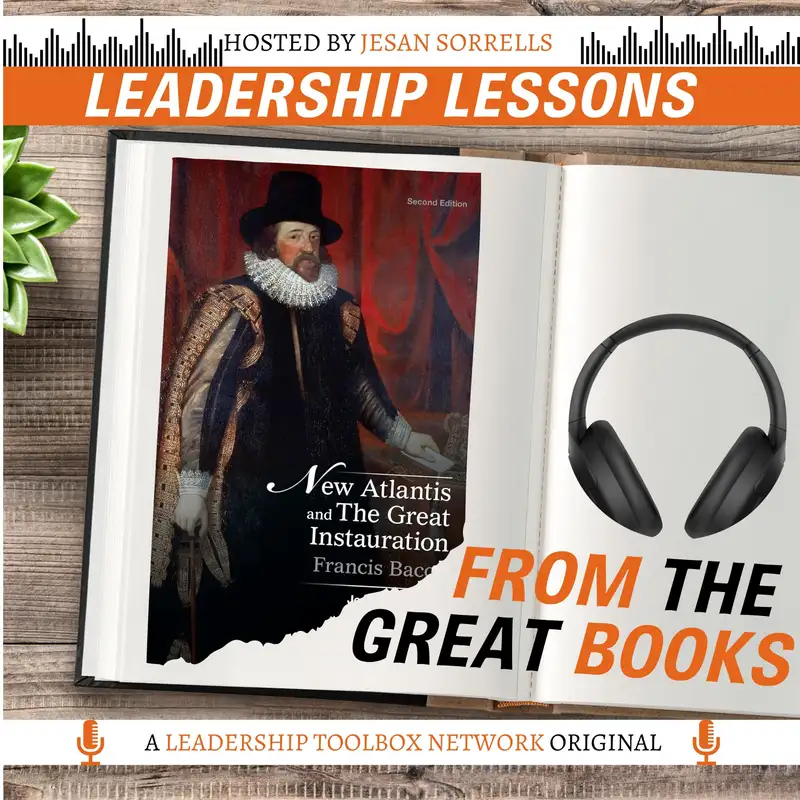
installation by Francis Bacon.
I'm going to hold it up here. That way you can see my copy of
this today.
Leaders, there is no secret to restoring the world and
there is nothing new to be quote, unquote discovered.
In order to fix things for the future, in order to restore things
for the future, I would assert we've got to go backwards,
disciplining ourselves and doing the same hard work that those in
the past committed to doing that got us here
in the first place.
And of course, anytime I talk about
theological based
works or works that touch on theology or place where
works maybe should have a theological bent,
I have to invite my good friend and theological
backstop, Brian Bagley to the show.
How you doing, Brian? I'm doing great. Thanks for
having me. Brian, how is your new year
going? It's going, it's going well. You know,
we're staying busy with work and
kiddos. I've got older, older kids. They're still in the house.
And so as they are active in
school and, and kind of becoming adults,
things, you know, activities, just, you know, you don't get fewer
things to do, I'll put it to you that way. So. No, but we're
enjoying, enjoying that season of life and, and staying
busy with work. So, yeah, doing, doing well. How about yourself?
I am. I'm doing just as well as I could possibly be
doing. You know, we've got a lot of work. We started off with a bang,
you know, because I still got my, still got young kids, you know, living in
my house, so. Larger age ranges than your children, but
fewer children have a larger age ranges. So it's. A buddy of mine was joking
with me about it the other day and he Said, you know, it's like you're,
you're, you're going from one developmental challenge to the next developmental challenge and
you have to like shift gears really quickly because the
20 year old and the 9 year old, while it looks like on the surface
they have the same developmental challenges, they really don't they things going on
in a bunch of different, a bunch of different places. And so you're just, you're
constantly shifting and downshifting and it's true. You are.
Yes. Yeah. That is so true. So true.
So let's, let's dive in a little bit. Let's talk
a little bit about, let's talk a little bit about
Francis Bacon. And we covered
a lot of him and we talked a little bit about his background on
our shorts episode, which you should listen to before you listen to this
episode shorts number, I believe it's 208. The great
inspiration in Francis Bacon. We got to do a little bit about his, about who
he was as a philosopher,
as a writer and of course, and this is going to be where the main
focus of our episode here today is going to be about as
a political and philosophical actor, really coming
to his conclusions around scientific
empiricism and natural philosophy that have laid the
foundations for a lot of the things that we find ourselves in now in the
United States of America overall and in the west in general
over the last, you know, 300 and some odd years of the
Enlightenment. And so we've covered a lot of that
already. We cover a lot of that ground. But for the benefit of Brian, who
I'm sure has not listened to that episode and perhaps
knew very little about Francis Bacon before I sort of accosted him
vigorously about the head and shoulders with this book.
Let me just, let me just, let me just cover a couple of things here
on old, on old Francis that we could sort of jump into this. So
as I said before, Francis Bacon was a writer, a scientist, a philosopher, a
politician, and as a human being, he presents an enigma to the
postmodern, of the postmodern mind, as do a lot of
Enlightenment authors, like even Voltaire. We even had a vibrant conversation
about Voltaire. Bacon believed
fervently that the world could be remade through empiricism and
observation. But he also recognized, weirdly enough, the
barriers that idolatry presented. And we're going to talk a little bit about that
today. Raised in England during a time
of religious conflict and tutored under the precepts of
Puritanism, Bacon was the original postmodern
secular man. Before that was actually a thing. And he
stated that the point of his life was, quote, to uncover truth, to serve
his country and to serve his church. But then if you go back and look
at his biography, look at how he actually lived, he proceeded
in the course of his life to behave just about as nakedly and
grasping as any social climber in
the 21st century would in
the 17th century. Elizabethan court and of
course, the Parliament. And. And Bacon was sandwiched. His
career, his entire career and his entire life in Parliament and in politics
was sandwiched between Queen Elizabeth the First and King James the
First, during a time when Catholicism
and Catholics were being run to ground in England.
And he even advocated for the execution of Mary Queen of Scots
in. In Scotland, who was the cousin of Queen Elizabeth.
And he was also there during the rise of
Puritanism, which much later on in America would become a dirty
word. But he was there at the beginning of that, the beginning of the
Protestant Revolution, and was educated in the principles of the
Protestant Revolution, just as later on, Voltaire would be educated
in France by the Jesuits. And just like Voltaire
wound up biting the Jesuits in the butt with his particular brand
of writing and satire, Bacon wound up.
Well, I would assert Bacon wound up taking Puritanism, or at
least Protestant thought, to his logical conclusion
once it was divorced from, in his mind,
God.
Now, where Bacon actually proved to be influential was not
in the pursuit of empiricism in and of itself and
in observation in service of the scientific method. Other folks would eventually
take on that, take on that ground. Where he proves to be influential,
though, for leaders, particularly in our time, almost exactly 400
years later, is in that he recognized precisely what
the spiritual problems were that would prevent humans from attaining
greater heights materially. And this is the kind of
dichotomy that existed inside of Francis Bacon. If you look at his life
from how he, like I said, was a grasping social climber in the court and
in the Parliament. How he drifted from one position, I'm not really drifted.
He moved vigorously
and I would say intentionally from one
position to another and really played the court like it
tried to play the court and tried to play the Parliament like a chess game.
And sometimes that worked, sometimes it didn't, all the
way to his alleged homosexuality, which is also something very
interesting about him during a time when you could actually
get killed for that in the West. He
was an enigma of a
man, and he's forgotten or
confused with the writer or, I'm sorry, not the writer, the painter, Francis
Bacon. And we
forget that in spite of all of his
dichotomies, and this is something I think, that we're going
to talk about today with Brian, with his theological background, the
theology still mattered. And this is the thing I think, one of
the major things I think, that we have to revisit if we are going to
engage in any kind of restoration project for the west in
general and for America in particular, moving forward into
our next, dare I say, golden age.
So that lays the foundation for Francis Bacon and I, I. Brian, I
sent you a bunch of links, and I hope you had a chance to look
at some of those, but what do you know about Bacon? What are your thoughts
on this man? And I know I don't think you'd read the Great Inspiration before
I brought it up or even heard of it, but I. I hope you had
a chance to take a look at it sometimes. It's published, by the way, underneath
the title of Novum Organum, because he wrote a bunch of different essays
and he sort of cobbled them all together, and then they've been reordered and put
together over the last 400 years. So my order, or your order, may not
match. But, um. But what did you think of Bacon? What did you
think of his essays? What did you think of his writing? You're a deep. You're
a deep thinker in these theological areas. And of course, the history. Lay out the
history of Puritanism for us, for those of us who don't. Who don't know.
Yeah. So I would just say that I,
I hadn't delved too much into Bacon before you and
I talked about it originally. The, the one thing that
is interesting about his lifespan is
that, you know, he was born in kind of the early.
I believe it's the early 1500s. I thought something like that. And. And
then, you know, was lived into the. Into the 16. Maybe it was the
mid-1500s or something. I don't know. But yes. January. January
1561. So he was born 61. And he died in.
And he died in 1626. Yeah.
And I think. I think the Protestant Reformation didn't
quite end until. Or, or run its course fully
until after he had passed away. So he, he was born
after Martin Luther nailed the, the 95
theses to the church door in Fintenberg, Germany, and then
he passed away. So you could even say before. Before it was all
over or had run its course. So he really.
His whole life was spent in that development
of, Of. Of Protestantism. And so
it was not even fully developed by the Time he had
passed away, it wasn't, it wasn't done developing. And so, so
what, what I find very interesting about this essay, the
great inspiration is. And, and
again, not knowing much about him personally, of course. I, I mean, I
understand kind of a surface level about all the complexities and everything, but
what struck me was the, the humility
with which he wrote. You know, like he, he's,
he's talking about, hey, I want to propose this new way, but
here are the limitations. And, and, and he talks about. At
one point, I think he said, you know, human reason. He didn't say it this
way, but he said human reason has its limits. There are limitations on what we
can actually know and what reason can do.
And anyway, he, he made a, and he made another point in there about
the, the, you know, we, the
senses, the a person's ability to
sense, you know, it's limited in a couple of different
ways. It, it can just be flat out wrong
and, and then it, and then it can't sense every single thing like,
you know, it. And so I was just really struck by
his willingness to pursue something difficult, which
is a renewal. Okay, renewals are always difficult, but they're always
necessary. A renewal of, you know, how, how do
we think through empiric empirical information in the, the
collection and organization of, of knowledge of our universe.
But he did so with a warning and
saying, hey, look, these pursuits have their limitations
and I think with, to kind of tie it all together for you.
The, the Puritans, I think, were
largely misunderstood in, in many ways by the
modern mind. I think they were an attempt to try to
ground the Enlightenment that was kind of,
in a lot of ways a loose cannon in, in some, some
sense it, it did some great things, but it, it took
some excesses. I think the Puritans were in a sense
trying to sort of ground the reground the reality
in, in, in Christian thought, in,
in what is true, with working from the assumption that Christian
thought is true. And, and, and I was just struck
by Bacon's humility. And I, I was one. You know, I,
I haven't studied it thoroughly enough, but I wonder if there's not a connection
there, you know, with, with Bacon trying to,
to trying to just say, hey, look, I want to start something new, but also
want to just from the outset just say, hey, we face
real limitations and we face pitfalls in this, in
this endeavor. Well, he seemed
to be a person who, as I, as I've said before,
he seemed to be a person that was full of Contradictions. Right,
so. And it's interesting that you
sort of grounded him at a particular historical moment because
he was writing about
renewal during a time of chaos,
during a time where. And of course we
don't have, I mean, we don't have writings like
we do on.
Well, no, I'll frame it this way. The, the, the
average English person, English peasant, okay.
Was not, for lack of a better term, tick
tocking out to their objections to the Queen
or to the King. And even if that technology
had existed, they would not have been allowed to, allowed to tick tock out
their objections. Okay. We live in such a time. And I,
I've said this in the previous episode too. We're talking about Voltaire and, and
Candide and the Enlight. I fundamentally believe that
America is the final
argument on the Enlightenment. We're the place, we're the shores
where, just as a philosophy, if you could take America as a
philosophy, which, okay, but if you're going to take America as a philosophy,
the United States of America is a philosophy. We're the philosophical end of the
Enlightenment. Everything that comes afterward, either we are going to
be philosophically the seed for the next thing,
or it grinds out here and it's just done, it's over.
And then whoever picks up that, that,
that baton, whether it be the Chinese or the
Russians or the Brazilians or the Saudi Arabians or pick
your poison here, they're not going to do it the
way we did it because they're going to start from a completely different set of
historical assumptions that are not Enlightenment
based. And so that will be a completely different thing. And I think, I think
there's some, there's some in my brain, there's some
truth to that argument. Now,
with that being said, if you go back and look at
Bacon and it's interesting that you brought up this idea.
So Bacon looked at scientific experimentation
as a way of glorifying God and fulfilling Scripture. He didn't
think or he didn't believe as we do now as post
the post modern folks or post postmodern. How many posts were past, and
I have no idea how many posts we are past modernity.
But he would have been, I think,
shocked to. Just as I think
Voltaire would have been shocked, but for different reasons. He would have been
shocked in that we have to explain
the assumption of Christian, of a Christian
grounding to people. Yes, he would have been shocked by this.
He assumed a Christian grounding even before he got
to the Scripture, in spite of all of his personal failings by the way
or his personal predilections, which is of
course what we moderns focus on because we think that that then
allows us to deconstruct Bacon and then we can just throw them out with the
bath water like we've thrown out everything else. Right.
When writing in a chaotic time,
like the time between, you know, I mean, like he was the Lord High
Chancellor of England between 1617 and
1621. He was the Attorney General of England and Wales
from 1613 to 1617. You know, he
served underneath James the First, by the way, James I was the person who
authorized the King James Bible, you know.
So, you know, I'm not, I presume he was somewhere
floating around the edges of that project as well.
I guess the question is, talk with us a little bit because you said the
modern mind doesn't understand Puritanism ground.
Bring the modern mind or the postmodern mind or
post postmodern mind, bring us back to the
grounding in Puritanism. I'm going to ask you how that is going to help leaders,
but bring us back to that grounding. Well, Puritanism was a
project of the
believers in Christianity in England at the
time to try to
reestablish, reassert
the primacy of Scripture. Right. And so there were,
there was so much tumult and so much like you,
you're talking about, you know, that Francis
Bacon's life was a dichotomy or, you know, there's so many
different. On one hand he was, you know, he
spoke in this pious way, but on the other he was conniving and he, you
know, he might have indulged himself in,
you know, affairs and things like that.
And I think that was
not abnormal in that day. I think there were,
there since there was a lot of moral tumult that
the, the Puritans said, hey, we need to re ground
the, the Church of England. And the Puritans were
hated for that in a lot of ways. They were not.
They were in the way they were constantly trying to pull,
pull England back towards a, a
much stronger grounding in the Bible and, and, and
towards a more firm understanding of the Christian
tradition. And
as a result they were persecuted. And so that's why you have a lot of
Puritans that fled on the Mayflower
to other places. They, they, they first they went back to the
European mainland. They were in Holland because they were allowed to be safe there. Then
they were, many a group of them took off to
the New World and settled New England. And so you have a, a
very heavily Puritan influence in New England. But
anyway, all that to say, you know,
Francis was in was
part of the, part of that, that cultural landscape. He
was breathing that same air that the Puritans were breathing
and not just, you know, and from a, from a cultural perspective
is what I mean by that. But, but anyway, so,
so I, I can't help but think that
he, not only was he aware, he may have,
I mean, and I don't know, I'm totally conjecture he may have agreed
with them on some points. He seems to be a fair, open minded person.
He, you know, I'm sure he probably didn't agree with him on everything, but, but
anyway, I, I did appreciate his humility and his willing to,
his willingness to, like I said earlier,
acknowledge limits, which is something that I think the
modern mind has, has a hard time doing.
But anyway, does that, I don't know if that answers your question or if there's
more you want to say. Yeah, no, no, I mean, so if you go and
look at his, you know, you scroll through his Wikipedia article, I'll, you know, again,
where fact checking ourselves on the podcast this year.
So if you go and look at the Francis Bacon Wikipedia entry,
you scroll down to where it says his personal beliefs, says underneath
religious beliefs, it says. Bacon was a devout Anglican.
He believed that philosophy in the natural world must be studied inductively,
but argued that we can only study arguments for the existence of God.
Information about God's attributes, such as nature, action and purposes can only come
from special revelation. Bacon also held that knowledge was
cumulative. That study encompassed more than just a simple preservation of the past.
Bacon's well, we'll talk about that in a minute. I'm going to skip. Bacon was
against the splintering within Christianity, believing that it would ultimately lead to
the creation of atheism as a dominant worldview, as indicated with
his quote that quote. The causes of atheism are
divisions in religion, if they be many, for any one main
division addeth zeal to both sides. But many divisions introduce
atheism. Another is scandal of the priests when it
is come that to that which Saint Bernard saith, one cannot
now say that the priest is as the people, for the truth is that the
people are not so bad as the priest. A third is custom
of profane scoffing in holy matters, which doth by little and
little deface the reverence of religion. And lastly
learn in times, especially with peace and prosperity,
for troubles and adversities do more
bow men's minds to religion. Close
quote.
I think he was right.
And I'm not asking our heroes or our villains to be
morally, to, to match my moral framework
of the, of the world. I think we can learn both from, from those who
have matched the moral framework and those who have not. It just depends upon
what you want to keep and what you want to throw away. Right.
He. Well, okay, so let's,
I want to ask you a question here to sort of. And then we're going
to, going to kind of maybe take a turn and talk about his, his perception
around idols, because I want to talk about that. I think that's a good framing
for our time. When you think about Bacon, you mentioned humility,
you mentioned regrounding reality during a time of chaos. We are
in a. Well, depending upon who you, who you talk to,
Right. If you're among the people who are perpetually online,
we are in an endless cycle of chaos, and
we're going to be in a civil war, shooting each other in the face in
10 minutes. Okay. And maybe not even 10
minutes or down. Maybe we're already doing that. If you talk to people who are
not perpetually online, who is everybody
else or for whom, what is happening online is
for them a sideshow and irrelevance and an
irrelevancy to their real life. We're not, we're close to a civil
war, and there's just some wackadoos that just need to come along,
and we'll eventually get the wackadoos to come along because there's always been wackadoos
and it's not going to be any different. Okay.
I think both of those perspectives would agree that we are
in a chaotic time. If
we could transpose the spirit of Francis Bacon to here
and now, which I think we can, via the great inspiration,
what would Bacon tell us tell both of those folks right now? What would
he tell leaders? Because he'd be looking at leaders because he,
he had a, he had a, he had a. What do you call it, a
strain. He had a sense. He had an instinct for
politics. Right. So he would probably try to get involved
in Trump's White House and he would probably try to get
involved in the Congress because that's where he would understand
that spirit, understands the spirit of Francis Bacon, understands that that's where things happen.
What would that spirit, grounded in Puritanism, say to us now
around regrounding reality for our chaotic times?
Yeah, well, I think you hit the nail on the head earlier when you said
that they would have a difficult. That, that he would have a difficult
Time understanding that we,
that we're so far removed from a Christian
understanding of the world. I think so. I think
first he would, he would want us to try to
reclaim that and understand what that.
What that means. Exactly. So we've.
Have you ever seen the movie? It's an old movie. Sa. Old
movie that's not super old, but Gods and Generals. Have you seen that movie?
Yeah. Okay. So in that movie, what is
so fascinating to me is the way that the
characters talk to one another. They use
very direct biblical language as just part of
everyday speech. And, and I believe
that, that that movie was produced
by Mr. Turner. I forget
is his first name that used to own cnn. Do you know I'm talking
about. Yes. Jane Fonda's husband. I can't remember who
his name was, but yes, but, but he, and he was not a Christian at
all. But it was very important to him that the
dialogue capture accurately the,
the. The Christian understanding of the world.
And that was just what, 160 years ago?
It wasn't that long ago. And so in a relatively short
amount of time, matter of fact, I believe it was in 1892,
the, the late 1800s, there was a
very famous court case, the United States versus
the Holy Trinity. And it was a. It was a
Supreme Court case and the United States declared in a
landmar that the United States is a Christian nation. And then it went and
cited pages and pages and pages of evidence to
support that finding. And so I think by the time
you get to, you know, I don't know, 100 years
later, the American culture is largely
secularized, divorced itself from that Christian
understanding and, and
imposed sort of this neutral. All religions are
the same. Not. And freedom. Freedom from. Freedom of religion
became known as freedom from religion. In other words, we don't have to
have any religion at all. I think
for Francis and for a lot of
men of that age who had such a firm Christian understanding
of the world, I think they
would ask us. And
it seemed like Francis said this in his writing that
when. And, and maybe this gets to the, the point of idolatry that
you're talking about earlier is that
every single person is religious. Like we
are hopelessly religious. Nobody can
not worship something. So.
So in other words, everyone is.
Is going to elevate some,
some type of God to, to the point of. Of
worship and to. And
we've kind of lost our way in. And when we, when we
said, when we sort of declared this religiously neutral
landscape academically, everything else we said, okay, hey, you
know, Islam Christianity, Buddhism,
atheism. It's, you know, it's, it's anything goes.
And, and you just pick what's best for you. Well, that,
that in itself is a religious belief. And so
to adhere to that is to adhere to a new religion. And so
I think France, I think one of the things that, that Francis and, and those,
those philosophers who had such a strong Christian
understanding of the world would. Would want us to kind of
reclaim that, get back to that understanding of. Of the
world in a. In a Christian way. So
I just looked up Gods and Generals.
That was a 2003 movie, so 23 years ago,
starring. It was directed by Ronald F. Maxwell.
And yes, it was. It was. It
was personally financed by Ted
Turner. Ted Turner, that's his name? Yep. Personally Financed by Ted
Turner, ran over budget, and interestingly enough, here's the numbers, because
I'm a movie guy about the numbers. It had a
budget of $56 million and the box office was
12.8 million. So that was back in the day, which you would call
a disaster of epic proportions.
And apparently both the director
and one of the. Or not the director. Yes, the director and
the author of the novel, Jeff Shara,
both expressed displeasure at the theatrical edition of
the film. And the Poor Returns, this is, according to Wikipedia,
forced Ted Turner to cancel Maxwell's planned adaptation of
Sharer's final Civil War novel because apparently this guy wrote three of them,
including Gettysburg. The. The Last
Full Measure. The Last Full Measure did not
get made. So. Yeah,
anyway. And apparently Shara wrote Gods and
Generals, which. Killer angels. Yeah,
killer angels. That's right. And then the. And then the last.
The last Full Measure. So, yeah,
you know, I. Well, it's
interesting because we have to. On the one hand, we want.
We want people with. With power and authority
and money to lead the charge on these things,
on these areas. But when people with power and authority and money
are corrupted, as is in our era,
I wonder how we get there right
from. From here. And maybe one of the ways we get there is by
confronting some of those idols. So let's
pick up with. With Francis Bacon's essay.
We're going to. We're going to move away from the preface and we're going to
go into the sections called the Idols of the Mind.
So the way that this is divided up, at least in. In my. My.
The way that my copy of the Great Inspiration is divided up,
the Idols of the Mind is separated out and it has
the various. The various headings. And so it starts
with, let's see. 38. Ryan goes 38,
39. The different headings go down. And so we're going to start
off here with. Well, with 38. Well, we're going to read a few of these
just to kind of get a flavor of what Bacon is talking
about here. And I quote
the idols and false notions which are now in possession of the human understanding and
have taken deep root therein. Not only so beset men's minds that
truth can hardly find entrance, but even after entrance obtained,
they will gain in the very installation of the sciences meet and trouble
us, unless men, being forewarned of the danger, fortify
themselves as far as may be against their
assaults. There are four classes of idols which
beset men's minds. To these, for
distinction's sake, I have assigned names, calling the first class idols
of the tribe, the second idols of the cave, the
third idols of the marketplace, the fourth idols of the
theater. The formation of ideas and
axioms by true induction is no doubt the proper remedy to be applied for the
keeping off and clearing away of idols. To point them out, however,
is of great use. For the doctrine of idols is to the interpretation of
nature, but the doctrine of the refutation of sophisms is
to common logic. The
idols of the tribe have their foundation in human nature itself
and in the tribe or race of men. For it is a
false assertion that the sense of man is the measure
of things. On the contrary, all perceptions, as well as of
the sense of the mind, sense as of the mind, are according to
the measure of the individual and not according to the measure of the universe.
And the human understanding is like a false mirror which
receiving rays irregularly distorts and discolors the nature
of things by mingling its own nature with it.
By the way, pause for just a second. I absolutely agree with. That
is a stellar examination of the idols of the tribe. I'm going
to ask Brian. Actually, I did not put in our notes here for today,
but I'm going to ask Brian. So I'm going to tee this up right now.
The challenges that we are currently having in Christianity that I'm seeing
rising on the Christian right around ethnos in particular
coming out of anti Semitism, which I suspected this is
where this was going to go, but it's not something this weekend that I want
to get your commentary on. Back to the book.
The idols of the cave are the idols of the individual man.
For everyone, besides the errors common to human nature in general,
has a cave or den of his own which refracts and discolors the light of
nature, owing either to his own proper
and peculiar nature, or to his education and conversation with others,
or to the reading of books and the authority of those whom
he esteems and admires, or to the differences of impressions
accordingly as they take place in a mind preoccupied and
predisposed, or in a mind indifferent and settled, or the like.
So that the spirit of man, according as it is meted out to different individuals,
is in fact a thing variable and full of perturbation and
governed, as it were, by chance, whence it was well
observed by Heraclitus that men look for
sciences in their own lesser worlds, and not in the
greater or common world.
So I'm going to tee up those two right there first,
because I want to talk about some of the idols of our
secular age. So Bacon lists
those four idols, right? Those idols of the mind, which in our time we might
call secular beliefs, right? The, the idols
of the tribe, the idols of cave, the idols of the marketplace, the idols of
the theater. And in our time,
I think, and I wrote this in notes in my book, these
idols manifest themselves as personal and social identity.
That's idols of the tribe. Individual hedonistic freedom.
That's idols of the cave. Vagueness and sheer
incompetence in our language. That's idols of the marketplace.
And of course, propaganda and entertainment in media,
social and otherwise. That's idols of the theater. And
in the 21st century, we have become, 26 years now into
the 21st century, we've become increasingly weary of these idols
because the worship that they demand has judged us and has found
us wanting because ultimately we are judging ourselves and our
judgments are always harsh. Now,
we're recording this right around the time of
civic social strife in Minneapolis. And you can go
Google that if you want to find out more about that. I'm not going to
address that specifically only because it is only
because it serves as a current flashpoint in our
cultural moment of chaos that
reflects the power of these idols. And so
let's start off with this. How does the worship of our modern
idols, Brian, manifest now in the culture of the United States?
Are you seeing the same things that I'm seeing, or am I way the far
off? Yeah, no, I, I would say, if anything, that
the, you know, and I, I, I find this
fascinating that Francis Bacon, what he the, the four idols,
the four main idols categories. I guess maybe I would say it might
even be, well, not might. I would say it's exploded well beyond that
at this day and age. I think our idols Are
many, many idols. And I was reminded, as I was reading
this, I was reminded of. It's in Acts.
I believe It's Acts, chapter 17, where Paul
confronts the Athenians in the
Areopagus. And in that place,
the Athenians are just inundated with, I mean, there's
gods, there's statue to all kinds of gods, and there's idols all
over the place. And hey, you go here
and you find the God that you want to worship and you
worship that God. And, and if there's no God here that suits
your fancy, we have one over here called the Unknown God. And you can just
go over here and just, and that way we, we got you covered. We
got, you know, Heinz 57 sauce of
religious preferences. And, and I think,
you know, what's interesting about our day is we have
a, a cascade of religious preferences, right? I mean, it's,
it's. And that itself kind of becomes,
in a way that becomes the dominant religion
of the day is the cascade of religious
preferences. And so I think
to establish, like, what is, like getting back to,
okay, what is truth, what is
actually true? And
it's, it's not. The, the, the, the freedom
to have a religion is important, but I think what we're starting to discover is
that what's more important than the
freedom to have a religion is actually having
the correct religion. And that not all of your
religious preferences are equal.
Right. And in fact, some are true and some are false. And,
and so getting back to what I think all of the Christian
writers, or these, what I'm going to call them, Christian
thinkers, even though they may or may not have been Christian, who knows? But like
Sir Francis Bacon was clearly operating from a Christian worldview. Like he
understood the medieval structure of the world.
Like all of those things, those were profoundly
Christian and that gave them the framework
from which they could
reintroduce the idea of dominion. You know, when you think about,
like in the, in the Old Testament, what it, what did God tell
human beings to do in the Old Testament? Genesis chapter one, he said
do two things. He said, God creates the world and he puts man in the
garden. He says, multiply and
fill the earth. And then the second thing is have dominion over it.
In other words, I've given you the tools. I've given you this
creation. You're my stewards. Rule it and make
something beautiful out of it. And so,
and so I think, and, and he, even
Bacon, he actually references the creation story in
here. I believe it's in the preface somewhere.
And, and he, he assumes that mantle,
okay, of, of dominion. It's almost like he's saying, I'm
assuming that role of dominion by introducing
or reintroducing maybe even. I guess we can talk about that.
But, but, but this concept of,
hey, let's, let's ask questions and begin to explore
and take dominion, take the dominion that was, that was
charged to us by our Creator, by the One who made us.
And, and I don't think if, if you don't have a Christian understanding of the
world, you're not gonna, you're not going to be
able to receive that dominion mandate
because, you know, I mean, in so much of our secular minds, human
beings aren't the solution, they're the problem. I mean, think about, you know,
if it's, if, especially if you're, I mean, think about all the climate hysteria. I
mean, the human beings are the scourge of the earth. You know, if we weren't
here, this place would be, you know, just a hunky dory. But that's
not true in any stretch of the imagination.
There's a, there's actually a, an old
story, kind of a humorous anecdote that.
So there was a. Charles Wesley was a,
a Methodist preacher in, in England.
And he was going around, he was an itinerant preacher and he would travel around
and visit different estates and he would preach at different places while he was
riding around on his itinerant journeys.
And he, the, the story goes that he drove up on this or he wrote
up on this estate. And, and there's this farmer
working hard in the, in the pasture. And,
and he said, he, he went up to the guy and said, and it was
this beautiful farm. I mean, the guy just, you know, it made this, this
beautiful estate. And he approached the, the, the farmer
and said, he said, hey, God has really blessed you
with a wonderful, with a wonderful property. And the
farmer looked back at Charles Wesley and said, well, yeah, that's great
and all, but you should have seen it when he had the place to himself.
And Eddie, he's getting at the,
the fact that, you know. Yeah, that's right. It is beautiful, but it's
beautiful because I put in the work. Yeah, God gave it to me, but he
gave me the talents and the abilities, but, but I employed those
and, and, and we turned it into something beautiful. And I think that's kind of
what Bacon is getting at. He's like, hey, grounded in
Christianity ground grounded in, in, in
the Christian understanding. Let's explore some things. Let's try to
renew and, and recapture this dominion mandate.
So in recapturing the demand, the dominion mandate, I want to pull up the reference
to Acts that you made. So that was Acts 17, Acts 17 16.
And I'll read from that because I think it's worthwhile. We're also going to read
from another piece of scripture in the, in this podcast as well, because I want
to talk about Nehemiah here because I think that that's, that's an
important point to get to when we talk about what to
do, how to get to restoration. But, but
Acts 17, 16, 22. While Paul was waiting for them in
Athens, he was greatly distressed to see that the city was full of idols.
So he reasoned in the synagogue with both Jews and God fearing Greeks, as
well as in the marketplace. Day by day with those who happened to be there.
A group of Epicurean and Stoic philosophers began
to debate with him. Some of them asked, what is this babbler trying to say?
Others remarked, he seems to be advocating foreign gods. They said
this because Paul was preaching the good news about Jesus and the resurrection.
Then they took him and brought him to a beating of the Aropagius, where they
said to him, may we know what this new teaching is that you are presenting?
You are bringing some strange ideas to our ears and we would like to know
what they mean. All the Athenians and the foreigners who lived there spent their
time doing nothing but talking about and listening to the latest ideas.
Verse 22. Paul then stood up in the meeting of the Areopagius and said,
quote, people of Athens, I see that in every way you are
very religious. For as I walked about
and looked carefully at your objects of worship, I even found an altar
with this inscription to an unknown God. So
you are ignorant of the very thing you worship. And this is what I
am going to proclaim to you.
Close quote. By the way, that is from
BibleGateway.com that is the New International
Version. Acts 17, 16, 22.
Less rolling language in the King James Version, but I guess it'll have to do
for our show today. Gets across the point.
Can I just add one thing to that? Yeah, go ahead. Yeah. So
what's, what's interesting to me is
I've been doing some reading and you know, there's,
it's, it talks about the rise of.
I've been doing reading. I'm sorry, I've been doing reading about the rise of
spirituality and religion in America recently, in
the last, you know, 10 years or so. And I think
it's worth pointing out that just because you're religious
does not mean that you're right.
And so in other words, the type of religion
matters. And just like in the areopagus, you know, there
were many types of religion, but only one of them was true.
And so I think what could happen
that would sort of maybe derail our renewal would
be this multiplicity or, you know, these,
these cornucopia, the smorgasbord of
religious renewal. But it's not Christian, it's,
you know, it's pagan or it's, you know, Islam or
whatever. Like in other words, that the, the
recipe for success has to be and must be
explicitly Christian in order for this
project to actually work. Now
it's interesting that you bring this up because one of the challenges that we
have as a, as a nation state polity
being at the, again, the logical end of the Enlightenment, one of
the challenges we have as a nation state polity is that
we have taken to its logical end
multi ethnos and multi
religios practice
within a sprawling country
that goes across a third of a continent.
And even in Christianity itself,
okay, the
splits, the conflicts,
the challenges, forget in our own era,
just five minutes after the Puritans showed up, because the people
who started off in the Massachusetts Bay Colony
were not the same people as those who started off in Jamestown. Those
were two fundamental different strands that then
moved out over, over the continent over the course of 150 to
200 years. And
the interdenominational strife
because of a full throated, I would
almost say idolatry, but let me not be harsh. A full
throated commitment to freedom of religion
then creates a dynamic where the pagan
secularist person looks at
Christianity and says, okay, well, you got Methodists, you
got Baptists, you got Congregationalists, you got Mormons,
you got Seventh Day Adventists, you've got Church of
Christ, you've got Christ Church, you've got the Branch
Davidians, you know, you've got the Scientologists.
And I'm not saying all these are correct. We know what the differences are in
inside of the game, we know what the differences are. But to the person
looking at it from outside the game, they don't understand
the difference, nor are they interested, quite frankly, in the difference between the
Lutherans and the Baptists. At a doctrinal level, they're not interested
in it. And it doesn't help
when, and this is something that I was going to bring up again, something that
occurred to me this weekend, something that I saw. It doesn't help when
the intervarsity arguments between Christians
are about things that, quite frankly.
And look, I have a lot of problems with post World War II American
Christianity, don't get me wrong. But one of the
things that Post World War II, particularly big evangelical Christianity did
correctly was
put a kibosh on the intramural fights around,
quite frankly, ethnos, race. And
because of the deconstruction and the
collapse of the big evangelical church post Covid,
we are now seeing the intramural
sniping, starting first with anti Semitism
and whether you support the Jewish nation state and what they
did after October 17th or not. You know, all that now devolves into a religious
argument between the dispensationalists and the end time folks and then
the folks who are not right, who are not dispensationalists and the newer, the newer.
More, more, you know, the dispensationalist folks who say more radical.
But, but again, the newer folks who have a different, different
philosophy based on a different reading of the theology that
then devolves into what I've been seeing recently
from like, Joel Webin, who's getting turned inside out
around interracial marriage. Oh, you knew I was going to
bring this up. And so,
and, and me, for me, I look at, I look at the work, I look
at, I look at neither Jew nor Greek. I look at the history of
ethnos, I look at the history of ethnicity in the Middle east
and, you know, I look at the arguments that
not just Weybond but other folks are making, and I
see where they come out of and I go, shut up,
number one. Number two, you're out of your lane. Like, you clearly haven't,
haven't understood the right thing. But yet again, this is one of
those intramural fights that causes division within the body
and in a society that claims freedom of
worship and freedom of religion and by the way, freedom of association.
I shall not be coerced into associating with somebody I don't want to be coerced
with, into being associated with. Okay, fine. You have freedom of the
association. Okay, that's fine. Now
we've got a stew inside of the Christian body
that I don't think can successfully. No, not I don't think.
I wonder if it could successfully mount an eschatological
framework that can restore them. Not
necessarily restore, but bring back the modern secular mind.
And I'm not saying that everybody needs to get on the same page.
I'm not even saying that big evangelical same page is the
way to go. I'm not stating any solutions to this problem. I'm
merely pointing out that these are the fractures. And my
challenge question to you is if I'm on the outside looking at this
and I don't even understand the thing from the beginning, all
of this just seems like more of the same from what I'm already coming out
of. So why would I jump over to that? I'm already comfortable with the thing
I got. Oh, and I don't have to get up on Sunday. I can have
mimosis. Yeah. Well, to
that I would just say. And there's a lot in there. I threw a lot
in there. Now there's several layers, there's several layers of things
there. But, but the, you know, back to the original
point of, you know, somebody on the outside looking in and they're like, there's so
many differences. You know what, you know, you, you may not be interested
in the differences, but the differences are interested in you.
And, and so, and you will be impacted by
those differences. And so I think I, I
think for someone who's on the outside, I
think you should make a, I, I, Francis
Bacon. Okay. For all his faults,
at least he seems like he's making a good
faith effort to exercise humility and to try to
figure this thing out. Okay. And, and not a prideful way.
And so here, here would be my challenge. Here, here would be my ask to
unbelievers out there to say, hey,
yeah, the, the, there is truth that is
out there there. And you owe
it to yourself and to your society to do your best
to come to a, A, an honest
and thoughtful and nuanced understanding
of, of, of reality as it exists and not to bring your
own, you know, we're all going to, we all have our own biases, we all
have our own presuppositions. That's, I got that. That's part of it. But,
but we have to also come at it with the humility that
maybe I don't have it right? Maybe there's something
I'm missing and what is it. And I think Christians
to, to our credit, you know, and
to having lived in negative world for so long
where, you know, you go to a university and you say you're
a Christian and, and you, oh, God forbid, believe that the
Genesis account of creation laughed out of science
class, right? Like having had to endure that level
of scrutiny, mockery, all of that. You
know, we, we had to spend a lot of time understanding
the secular mind and understanding the atheist arguments and
understanding evolution and, and why the evolutionists believe
what they believe. And so I would say out of
necessity, I think the secularists have to do the same thing. They have to apply
this. And they, for. And they haven't had to. They haven't had to.
Yeah. And, and now they have to. And you should. And, and what I
would say is approach it with humility, with
understanding. Maybe I'm not right about everything. And, and
that's something that, that I've had to say about many, many things
to the point about the, the ethnos. I think what's interesting,
when you, you brought that up, I, I would say
that we, of course,
you know, you're familiar with the, the concept. You and I have
talked a lot at length about the fourth turning and
the, you know, the four turns. And so, you know, in a period of unraveling,
there's, there's going to be chaos. And, and so what
I would say about the, the, the, what's important to
understand from a Christian perspective about the ethnos, okay, is
that, you know, a lot of people want to attribute
culture to race. And,
and I would say that's not true. Now that's
not to say that ethnicities don't take on
particular, you know, cultures
or, you know, tendencies or something like that.
But, but culture is way,
it's not tied to the, to the melanin, the color of your melanin or
your facial structure. That has nothing to do with culture.
Culture has everything to do with religion.
Everything to do with religion. So you're so,
so culture is downstream from religion. Religion is the headwaters,
okay? Whatever your religious beliefs are, that forms the
headwaters of your existence. And from, from your
religion flows your culture, and from your culture
flows your politics, forms your family formation forms everything
else. And so if you want to critique
someone's some ethnicities, ethnicities, culture,
it's, it's not to just, it's not to critique their skin color or
their facial structures or the, the geography of where they came from or where
they, they're found. What you're critiquing is their religion.
I mean, everybody says Christianity is a white man's religion. It's only
the white man's religion because it took root in Europe.
Europe was profoundly pagan. Europe
was just as godless as any other place on the face of the earth.
And so the fact that Christian society
took root in Europe has nothing to do with skin color. It just
has to do with the providence of God. And oh, by the way,
the providence of God is that all nations
would come to know him. That's not to say that all, all
nations would become European. That's not what that says at all. It just says that
all nations would become Christian. And so there should be
some similarities. We would think that, that,
that if everyone has a Christian understanding of, of the world,
of creation, of their own human
anthropology, that, that certain things would
follow. That would be kind of basic to every
society. And, but would there be variations within
those cultures? Of course, of course there would be. But, but
the basic, the, the, the, the basic bones would be
the same, right? Christ died for, for sinners, right? We,
we need, we, we are all sinners in need of a savior,
right? I mean all of these, all of these basic
presuppositions would be the same. Now how would they
play out in certain instances? You know,
like you mentioned Methodist, Presbyterian, Baptist, all these things, okay, There,
there may be some differences in understanding
the more nuanced portions of, of our faith,
but we can all agree on the Apostles Creed, okay?
That's what defines a Christian church. Can you accept the
Apostles Creed? Can you accept the Nicene Creed? Those
have been the historic standards by which Christian
churches have been marked. And then from there people can
make, they can read about the
ordinance of baptism in a different way, right? Is it, are infants
baptized or are believers baptized? But there are certain non
essentials, okay, that, that would mark every Christian
culture, regardless of skin color. Ethnos. And if you
think about where did the ethnicities come from?
Ethnicities came about at the Tower of
Babel. And the reasons that the ethnicities came about was
because when mankind was joined together
in defiance against God, when, when man raised
his fist and said, I'm going to build a tower to heaven,
I'm going to reach out to God on my
terms. The, the human race was on
the verge of destruction. They were on the verge of
destroying themselves. And God in his
mercy struck them with language and
confusion, struck them so that they could, they couldn't understand one another, they
couldn't conspire anymore to bring about their
own annihilation. In other words, God saved them by
creating the nations. And then
in the, in the Gospels, right at the end, he says, go into all the
nations, baptizing them, making them, you know,
making them basically Christians who would, who would follow me.
And if you look at, in Acts, I believe it's Acts chapter two,
where the, the Bible talks about the day of Pentecost. That
is a reversal of the Tower of Babel. So now
all of a sudden people are hearing the Gospel in their own
tongue and they're asking Themselves. How is it that we're able to communicate
with one another? How is it that all of a sudden
we understand this story in our own language,
in this place, the temple? And it's the
spirit of God enabling the nations to understand
the message of Christ and the message of which ultimately brings
about peace amongst the nations. So, so I would
just say to, to anyone on the outside
who maybe hasn't taken an interest, maybe because you haven't had to, maybe
because just lack of interest. I don't
know, maybe you just don't see the point. I would say that the. You may
not be interested in the differences. The differences are interested in you. And
those differences will have you, they will. And
if you don't take the time to understand them correctly,
you could very easily end up either missing out
or in the wrong place. And I say that with a lot of humility, like
I don't even know. I pray to God that I'm in the right place. I
pray to God that we're all in the right place. And so I think we
just have to approach this with humility. Understanding there are
non essential or there are non negotiables. And
then there are things that we can negotiate on. We can have
our differences and still have a unified
base from which a,
a healthy culture, a healthy nation can emerge. Does
that make sense? That was a lot. Yeah, no, that was,
that was good. That, that again, that, that rolls us back into the book,
back into the great installation
by Francis Bacon. This allows us to, to pick up. Because I want to
pick up something else that, that,
that Brian has, has brought up. Because
the question now becomes, what do we do
in order to get there? How do we. How do we. Which way
Western man like that, that meme shows up
occasionally, sometimes. So back to the book, back to the
great inspiration. I'm gonna pick up with. I believe it
is 53. We're gonna read.
33, 54, 55.
Little, little snippets. I think he would have really liked Twitter, by the way. Or
maybe substack. Actually, GRI strikes me as more of a substack
guy than a Twitter guy. Yep. All
right. Speaking of idols, and I
quote, there are also idols formed by the intercourse and association of men
with each other, which I call the idols of the marketplace on account of the
commerce and consort of men there. For it is by
discourse that men associate and words are imposed according to the apprehension of
the vulgar, and therefore the ill and unfit choices of words
wonderfully obstructs the understanding. Nor do the definitions or
explanations, wherewith in some things learned in men are wont to guard and
defend themselves by any means set the matter right. But
words plainly force and overrule the understanding, and throw
into all confusion, and lead men away into numberless
empty controversies and idle
fancies. 53. That's 53.
54. Lastly, there are idols which have immigrated into men's minds from the
various dogmas of philosophies and and also from wrong laws of
demonstration. These I call idols of the theater,
because, in my judgment all the received systems are but so many stage
plays, representing worlds of their own creation after an
unreal and scenic fashion. Nor is it only of the
systems now in vogue, or only of the ancient sects and philosophies that I
speak for many more plays of the same kind may yet be composed, and in
like artificial manner set forth, seeing that errors
the most widely different have nevertheless causes for the most part alike.
Neither again do I mean this only of entire systems, but also
of many principles and axioms in science, which by
tradition credulity and negligence have come to be received.
But of these several kinds of idols I must speak more largely and
exactly, that the understanding may be duly cautioned.
55. The human understanding is of its own nature prone to
suppose the existence of more order and regularity in the world than
it finds and though there be many things in nature which are
singular and unmatched, yet it devises for them
parallels and conjugates in relatives which do not exist. Hence
the fiction that all celestial bodies move in perfect circles, spirals and
dragons being accepted name utterly rejected. Hence too the element
of fire, with its orb is brought in to make up the square with the
other three which the sense perceives. Hence also is the
ratio of density of the so called elements is arbitrarily fixed to 10 to 1,
and so on of other dreams and these fancies affect non
dogmas only, but simple notions also.
And then this from 56. The
human understanding, when it has once adopted an opinion, either as being the received
opinion, or as being agreeable to itself, draws
all things else to support and agree with it. And though there be
a greater number and weight of instances to be found on the other side, yet
these it either neglects and despises, or else by some distinction sets aside and
rejects, in order that by this great and pernicious
predetermination the authority of its former conclusions may remain
inviolate. And therefore it was a good answer that was made by
one who they showed him hanging in a temple a picture of those who had
paid their vows as having escaped shipwreck, and would have him say whether
he did not now acknowledge the power of the gods.
Ay. Asked he again, but where are they painted
that were drowned after their vows? And such
is the way of all superstition, whether in astrology, dreams, omens, divine
judgments, or the like, wherein men, having delight in such vanities, mark the
events where they are fulfilled. But where they fail, though this happen
much oftener neglect and pass them by, but with far more
subtlety does this mischief insinuate itself into
philosophy and the sciences.
Francis Bacon talking about cognitive dissonance and cognitive biases
long before 20th century psychology got a hold of it,
proving, of course, that there is no new thing under the sun.
Yep, I want to take a turn here. I want to talk about a little
bit about what we're going to do as we sort of round a corner towards
the end of our project here today, the end of our book today, talking
about restoration.
There's an idea from 2nd
Chronicles 34. 7 so
Israel had a king, several kings, and they all
fell into idolatry. And eventually they had a good
king named Josiah. And in 2 Chronicles
34. 7, the good king Josiah was noted as
having taken the. Taken this action which I'm about to
describe upon becoming an adult and ruling over the folks
in Judah. And I quote and when he had broken down the
altars in the groves and had beaten the graven images into powder and cut down
all the idols throughout all the land of Israel, he returned to
Jerusalem. That's second Chronicles
34. 7 KJV.
There is not yet a quote unquote good King Josiah on the
political horizon of America. But the groundwork, and I think this is what
we were just talking about in that last section, the groundwork is being laid for
that person's coming. I believe a tidal wave of idol
breaking with youth and vigor will accomplish what old age and weariness
cannot. But waiting for the appearance of a
savior before doing the work yourself is a foolhardy waste of
time. And leaders owe to their followers to gird their loins
for the upcoming work. By the way,
doing the work without the benefit of the Holy Spirit.
Brian referenced acts. That's Acts 2:1,
13, which I believe fundamentally, if
you read the Bible, is, is fundamentally the third entry
of the Spirit of God into the world. And we'll just
leave that at that. I think the first entry came in with creation. The second
entry comes in, in the, in the. In the manifest body of Jesus
and his life, death and resurrection. And then the third entry
comes in with the Holy Spirit coming in at Pentecost, by the way, if you
don't believe me, if you go back
and look historically at what happened after Pentecost, the Roman Empire fell,
took a little while, but this was,
this was the start of something interesting happening that has wound up with all
of us here.
At a practical level. So let's move this out of, out of theory
and theology. Let's move this to practicality and more pragmatism, right,
Brian? So at a
practical level, if I'm a leader in my home or
I'm a leader in the civic world, or I'm a leader at
work, right? And
I, I, I, I, I've read a little Francis Bacon.
Maybe I've, I've taken the time to actually treat Christianity
seriously. Maybe I don't necessarily believe it, but I've
decided to treat it, treat it seriously. And I'm
being moved to something about the idols I see around me, either in my
home, my community, or in my, in my work.
Now, the idols that we worship in our time are not
physical and material, although you could say the phones is probably the
material essence of the, of the, of the temple
the Greeks were worshiping at, that Paul showed up at. You can
maybe make that parallel. But how do we begin to
tear down, how do we begin to tear down the idols in the
groves, the psychological idols in the groves?
And by the way, I think people like Jordan Peterson are doing some of this
work. I think people who are questioning the shibboleths
of a modern society, like Doug Wilson
are doing some of this work. I think the tearing down process, or at
least the beginnings of the tearing down of the idols process
has started. But there's so many idols, it's like whack a
mole. And I'm not, I'm phrasing this question from the perspective
of a person who's not Jordan Peterson. I don't have a platform. I'm not Doug
Wilson. I didn't spend 50 years, you know,
building a church. I'm not that guy. I just am the
precinct chair of my local political party in my community. I'm just
the, I'm just the small business owner who has like,
you know, two gas stations. I'm just the
person who's trying to show up and be a good coach at my, my
kids soccer game. And I'm surrounded by all these wackadoo parents. Or maybe
not wackadoo, maybe they're fine parents, but I See, because
I'm coaching their kids, I see the effect of the idols, the
psychological, spiritual and philosophical idols in their lives.
This is very much a pastoral question. So how do you advise
a leader who wants to begin to sort of cut down the sun
statues that are the spiritual groves in our time?
Yeah, I think. I think it
begins in our own hearts. And we have to
realize that we are blind to our
own idols, that we all, like I said earlier, we're all prone
to worship something and, and even
the most pious hearts. Okay. Out
there, that and that. And, and I mean that in a
generous, you know, kind way. What I'm saying
is even. Even the. The best of
us can be. Can be prone to mistakes and
to believe or say things that are not true or we can be misled.
Even good people. I say. And I say good people. And I. Again,
I'm saying that as if, you know, in reality, what I'm trying to say is
none of us are good. Okay? Even, you know, regardless
of what we might think is that our hearts.
The Scripture tells us that our hearts are deceitful and desperately
wicked just in nature. And so
in order to. We're not even capable of truly
recognizing the own idolatry that we have in our own hearts. And so
I think the Psalms are instructive
in how to begin. Where do we start? And
I believe it's Psalm.
I believe it's Psalm 139. It's either Psalm 139 or
137. The Psalmist, he's. He.
David is calling out to God and he's saying
a. He's saying, lord, search my heart and
try me and see if there's any unclean way in me
and, and. And lead me in the way everlasting. In other words, there's a.
There's a humility involved in, in
David. And David was, you know, was one of Israel's
godly kings. You mentioned Josiah earlier. David
was. Was one of the. The godly kings as well. And, and
he was actually referred to by God as a man after my
own heart. A man after God's own heart is how the scripture refers to him.
And so this idea that.
And even the prophet Isaiah says, all we,
like sheep, have gone astray. We've turned everyone to his own way.
And our tendency is to reject God. Our tendency
is to be blind, to be helpless.
And so we have to be utterly
dependent on God and realize that that's the starting point for.
For identifying idols and, and tearing them down, which
is part of the reason why I really appreciate Francis
Bacon's humble approach to this whole project, saying,
you know, hey, we, you know, we. I want to start a a new
a new renewal process, right? Let's renew the sciences. Let's,
let's try to take dominion over the earth again
and with with something new. But he approaches it with,
with a lot of humility, with recognizing his past and trying to build
on the shoulders of of the the
spiritual giants before him. So I think that's where it starts.
All right, folks, so we actually just lost
Brian there, and we'll be inviting him back in a future
episode of the Leadership Lessons from the Great Books podcast,
but wanted to wrap up today's show by wrapping
up with the Great Instauration by Francis Bacon.
So I'm going to pick up here in the book and
we're going to round the corner and close our
show today. And I quote from the Great Instauration
the Preface for my own part, at least, in obedience to the
everlasting love of truth, I have committed myself to the unto uncertainties and
difficulties, and solitudes of the ways, and, relying on the divine assistance,
have upheld my mind both against the shocks and embattled ranks of
opinion, and against my own private and inward hesitations and
scruples, and against the fogs and clouds of nature, and the
phantoms flitting about on every side, in the hope of
providing at least, or at last, for the present and future generations,
guidance more faithful and secure.
Wherein, if I have made any progress, the way has been opened to me by
no other means than the true and legitimate humiliation of the human
spirit. For all those who before me have applied themselves to the
invention of the arts, have but cast a glance or two upon facts, and examples
and experience, and straightway proceeded, as if invention were nothing more
than an exercise of thought, to invoke their own spirits to give them
oracles. I, on the contrary, dwelling
purely and constantly among the facts of nature, withdraw my intellect from them no further
than may suffice to let the images and rays of natural objects meet in a
point, as they do in the sense of vision. Once it
follows that the strength and excellency of the wit has but little to do in
the matter and at the same humility which I use in inventing, I employ
likewise in teaching. For I do not endeavor, either by triumphs of
confutation, or pleadings of antiquity, or assumptions of authority, authority,
or even by the veil of obscurity, to invest these inventions of mine
with any majesty which might easily be done by One who sought to give
luster to his own name rather than light to other
men's minds. Then skipping
down, wherefore, seeing that these things do not depend upon
myself at the outset of the work, I most humbly and fervently pray to God
the Father, God the Son, and God the Holy Ghost, that remembering the sorrows of
mankind and the pilgrimage of this life wherein we wear out our days, few and
evil, they will vouchsafe through my hands to endow the human family with new
mercies. This likewise I humbly pray that things human
may not interfere with things divine, and that from the opening of the ways
of sense and the increase of natural light, there may arise in our minds no
incredulity or darkness with regard to the divine mysteries, but
rather that the understanding be thereby purified
and purged of fancies and vanity, and yet not the less
subject and entirely submissive to the divine oracles, may give to
faith that which is faith's. Lastly, that
knowledge being now discharged of that venom which the serpent infused into
it, and which makes the mind of man to swell, we may
not be wise above measure and sobriety, but cultivate
truth in charity.
For my part, I agree at the close here of our
episode today on the great installation, I agree with
Brian Bagley. I agree with our guest today.
We are blind to our own idols. We are
blind to the things that grab
hold of us and the things that we put the highest, the things that we
worship. We are blind to those things. And Bacon.
Bacon was more aware of this empirically probably, than any
other, any other thinker or philosopher or
even scientist who was working through the chaos
of the transition from a world of
medieval thought and medieval processes to a world of
Renaissance, Reformation and through to a
world that would be dominated by human reason,
human skepticism, and above all, be driven
by an endeavor towards human enlightenment.
We are on the other side of that endeavor. And the idols we worship as
a Western culture have been tested in various ways
over the last 80 years and they have all been
found wanting to provide meaning.
However, we cling to them because we don't have leadership
that has any better ideas.
We don't have any leadership that has any better ideas than rampant
consumerism, more marketing and propaganda, more
entertainment, more media driving
behavior, and of course, more use
of slovenly language. We don't have
leadership that has any better ideas than putting
CCTV cameras on every single street corner
and AI inside of every single device that you have to
monitor your clicks and of course, control
your behavior before the
husk of historical Christianity is completely sucked dry. In the west,
though, there needs to be a restoration project that begins by first
pointing out the ideas, approaches and opinions, opinions that don't
produce optimal outcomes, and then second
rejects those ideas, approaches and opinions
and proposes new solutions and new ideas.
This is why while Christian nationalism might be scary
sounding to people with a secular or culturally Christian
mindset, at least it's a proposed
solution. No more banging
about about the problems.
We do need solutions and we do need new
ideas. But we also need to appropriately position
the people who have given us the ideas that have led to so much
trouble. We talked about
Voltaire and this time, this episode, we're talking about Francis
Bacon. But we've covered Nietzsche on this podcast and we've talked
about Derrida, Kant, we've talked about
Rousseau, these men of the Enlightenment, these
philosopher thinkers, Marx, Lenin.
We've talked about these individuals, Freud, Young.
And what we have noted is that all of these
people, these people who were
people who were well, believed in the
primacy of ideas rather than products, believed in the
primacy of thoughts rather than the primacy of
actions, and whose words were taken by others
and then led to the building out of utopian
schemes that didn't work. These men,
we almost never look at their lives. We almost never look at how
they actually lived, what they actually did.
Rousseau fathered anywhere between five and seven children and abandoned them
all to orphanages. Marx beat his servants and
sat in the library all day and couldn't hold a job.
Kant, well, Kant elevated his own
personal ability to basically be slightly
autistic to societal level. And I'm not saying
that's a bad thing, but that's what he did. Diderot,
if you'll look at him and the French Revolution, he hated women
and could not make a relationship with them. And Francis
Bacon, well, Francis Bacon was a social climber,
a schemer, a man who at the end of the day
may or may not have had predilections that we would look on
as ghastly.
I'm not saying that we should hold these men to be gods, but
I am saying that if we're going to take on their ideas and
look at the results of their ideas, and if we're going to go in a
different direction, we need to pick different
ideas. Because if you don't have the
power to walk the idea out yourself that you're proposing for others,
how good can that idea actually be?
I would also assert that we need to confront and repent of the
idolatry deep in our own personal lives,
away from work, away from civic leadership, away from community
volunteering, away from social media, away from the show,
away from our hobbies, away from our friends. We need to
confront and repent of the idolatry in our own lives and hearts, and
to paraphrase from Second Chronicles and break down the
altars and groves and beat the graven images into powder that exist inside
of ourselves and cut down all the idols throughout all of the
land, the psychological land in particular, that exists
inside each and every one of our minds.
That is the first work we have to do
in order to begin the restoration project and
abandon approaches that no longer, quote, unquote, quote work.
This act will be in the beginning of the
restoration of an individual narrative more lasting
than the false individual narratives we've all been fed by
those individuals who proclaim themselves to be leaders but have no
better ideas than constant surveillance
and scolding.
I want to thank Brian Bagley for coming on the podcast
today. Always a pleasure to talk with him, and it's really too bad we
weren't able to complete our conversation with him today. I want to thank you all
for listening, as usual, to this episode of the Leadership Lessons
from the Great Books Podcast. And well,
that's it for me.
Creators and Guests